
CAVIT Medical Science Practice Exam
$69.00
- Buy to unlock unlimited access to all Quiz questions and Answers in this Quiz.
- After purchase you can print a PDF of the whole quiz at any point. The PDF will contain the questions and the correct answers.
About this Exam
The CAVIT Medical Science Practice Exam is an essential diagnostic tool designed for students enrolled in Career and Virtual Information Technology (CAVIT) medical programs.
This comprehensive assessment is specifically crafted to evaluate a student's readiness for final certification or licensure exams in foundational healthcare fields.
It serves as a critical benchmark, allowing aspiring medical professionals—often high school students or those early in their post-secondary education—to identify their academic strengths and target specific areas requiring further study before attempting their high-stakes final examinations.
Ready to test your knowledge?
Buy Now to Access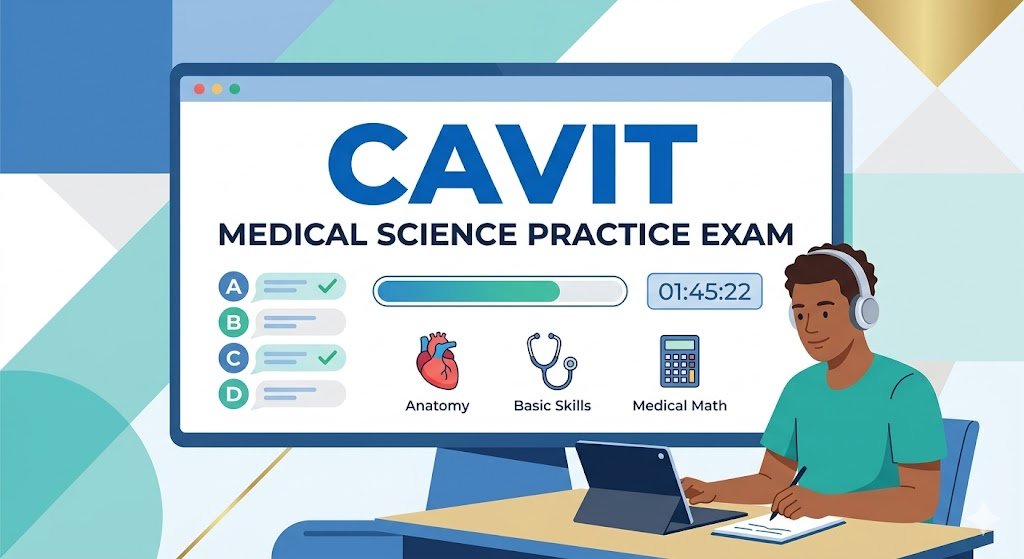
Additional Information
What the Course Entails and Exam Details
The CAVIT Medical Science curriculum provides students with a robust foundation in the essential knowledge and practical skills necessary for entry-level roles in the healthcare industry.
The course of study and subsequent practice exam focus on several core domains that are vital for success in any medical environment:
Anatomy and Physiology: Understanding the structure and function of the human body, including major organ systems and basic biological processes.
Medical Terminology: Mastery of the language of medicine, focusing on root words, prefixes, suffixes, and common abbreviations used in clinical settings.
Medical Math: Developing proficiency in essential calculations, such as dosage measurements, metric conversions, and common healthcare mathematical applications.
Basic Healthcare Skills: Foundational knowledge in patient safety, infection control procedures (like handwashing and sterile technique), and the measurement of vital signs.
The CAVIT Medical Science Practice Exam itself typically consists of multiple-choice questions that cover this wide array of critical topics, ensuring a thorough evaluation of the student's comprehensive understanding.
What to Expect in the Final Exam
While the exact structure can vary depending on the specific certifying body, students taking the final CAVIT Medical Science-aligned certification exam can expect a rigorous evaluation focused on applying their knowledge in practical scenarios.
The final examination is usually a comprehensive assessment, often featuring a significant number of multiple-choice questions designed to test both factual recall and critical thinking.
Students must pay close attention to passing score requirements, which are typically established by the state licensing board or national certifying organization, and they must adhere strictly to the allotted time limits.
Specific rules, including identification verification and prohibited materials, are stringently enforced to maintain the integrity of the certification process, simulating the environment of professional licensure exams.
How to Study and Exam Centers
Preparation is paramount for success on the CAVIT Medical Science Practice Exam and the final certification.
Students are encouraged to adopt a multi-faceted study approach:
Create a consistent study schedule that breaks down core topics into manageable sessions.
Utilize varied study materials, including textbooks, detailed anatomical diagrams, flashcards for medical terminology, and reputable online healthcare resources.
Engage in active recall and spaced repetition techniques to solidify learning.
Take multiple practice exams under timed conditions to improve pacing and identify weak subject areas, focusing not just on the correct answers but also on the reasoning behind them.
Regarding exam locations, the CAVIT Medical Science Practice Exam is frequently administered directly through authorized schools or specific high school career and technical education (CTE) programs.
Final certification exams, however, are typically conducted at designated physical testing centers approved by the certifying body, such as Pearson VUE centers, or they may be offered through secure online proctoring portals, depending on the specific certification being sought. Students must verify the exact testing locations and registration processes required for their chosen pathway.
Job Opportunities from the Course
Successfully navigating the CAVIT Medical Science coursework and passing the associated final certification exams opens the door to numerous vital, entry-level career opportunities within the healthcare sector.
This foundational knowledge is the critical first step toward job titles such as:
Medical Assistant
Certified Nursing Assistant (CNA)
Patient Care Technician (PCT)
Phlebotomy Technician
EKG Technician
Medical Office Administrative Assistant
Pharmacy Technician
Furthermore, completing this course provides a strong springboard for students aspiring to pursue advanced degrees in fields like Registered Nursing (RN), Licensed Practical Nursing (LPN), physical therapy, or emergency medical services.
Frequently Asked Questions
Reviews
5.0
Based on 0 reviews
Leave a Review
No reviews yet. Be the first to review!