
CBAP v3 Requirement Analysis Practice Test
$69.00
- Buy to unlock unlimited access to all Quiz questions and Answers in this Quiz.
- After purchase you can print a PDF of the whole quiz at any point. The PDF will contain the questions and the correct answers.
About this Exam
The Certified Business Analysis Professional (CBAP) is the global standard for experienced business analysis professionals. The CBAP v3 Requirement Analysis Practice Test is a vital tool for professionals preparing to tackle the "Requirement Analysis and Design Definition" (RADD) knowledge area of the CBAP exam. RADD is a critical domain that covers how business analysts convert, refine, and structure the information gathered during elicitation into clear, concise requirements and designs. Achieving CBAP certification, backed by strong knowledge in requirement analysis, confirms your mastery of business analysis principles and techniques, significantly boosting your credibility and career prospects in the global market.
Ready to test your knowledge?
Buy Now to Access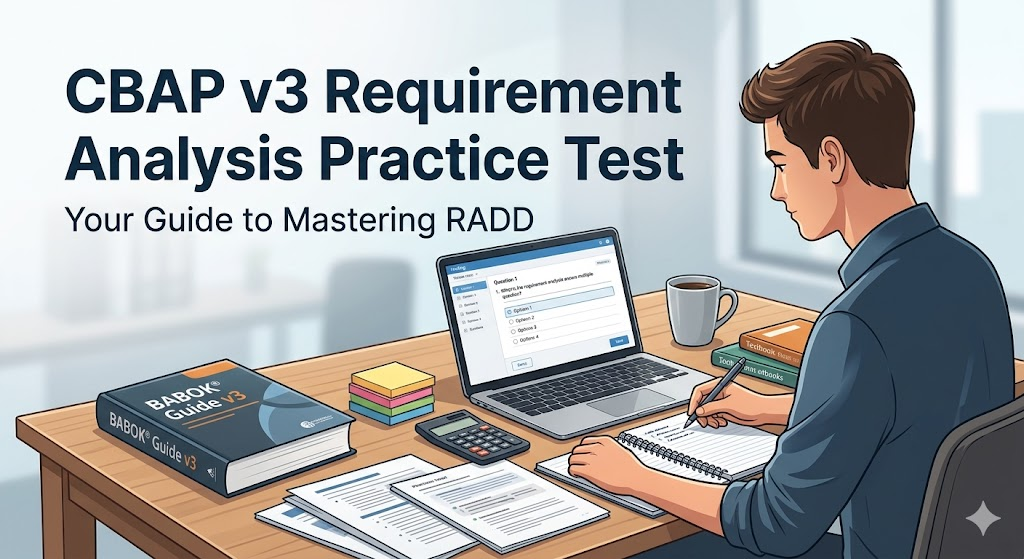
Additional Information
What the Course Entails and Exam Details
The focus of this practice test is the core RADD knowledge area, which is one of the pillars of the BABOK® Guide (Business Analysis Body of Knowledge®) v3.0. You should expect deep coverage of these essential skills and sub-tasks:
Specify and Model Requirements: Learn how to use visual and textual models to describe requirement attributes and their relationships. This includes techniques for creating and refining process models, data models, state diagrams, use cases, user stories, and acceptance criteria.
Verify Requirements: Understand how to evaluate requirements against the defined quality characteristics and stakeholders' actual needs. This involves reviewing for clarity, completeness, consistency, and testability.
Validate Requirements: Master the techniques used to demonstrate that the final requirements and design align with the business goals and will deliver the intended value.
Define Requirements Architecture: Explore how to structure a complete set of requirements and designs so that they support one another and form a cohesive solution definition.
Define Design Options: Learn how to develop solution options that meet the defined requirements and constraints, and evaluate which solution approach provides the most value.
Analyze Potential Value and Recommend Solution: Discover how to estimate the potential value of each design option and recommend the best course of action to the business.
What to Expect in the Final Exam
While a practice test can be configured differently, understanding the official CBAP exam format is crucial. The final CBAP exam is known for being rigorous and practice-oriented. It is not just about memorization but about applying knowledge.
Exam Type: The exam consists of 120 multiple-choice questions. These questions are scenario-based or case-study-based. Instead of simply asking for definitions, you will be presented with complex business situations and asked how a seasoned business analyst should act.
Time Limit: You are given exactly 3.5 hours to complete the 120 questions. Effective time management is essential, and practice exams are critical for building up your speed.
Passing Score: The IIBA does not publish the exact passing score for the CBAP exam. It is determined by a psychometric analysis of the exam's difficulty. However, it is widely considered a difficult exam that requires significant dedication.
Rules: The exam is closed-book, with strict proctoring procedures. Whether you take it in a center or remotely, rules regarding behavior, noise, and visual aids are strictly enforced.
How to Study and Exam Centers
Preparation for the CBAP requirement analysis domain and the full exam requires a systematic approach. Practice tests are a fundamental component of a strong study plan.
Actionable Study Strategies:
Master the BABOK® Guide: Start here. Use the BABOK® Guide v3 as your primary reference for definitions, tasks, and, most importantly, techniques. Spend significant time on Chapter 7 (RADD).
Take CBAP v3 Requirement Analysis Practice Tests: Integrate practice exams early and often. Focus initially on untimed exams to ensure you understand why answers are correct. As you get closer to the real exam, shift to full-length, timed simulations.
Analyze Practice Results: Do not just look at your score. Review every answer you got wrong, and even the ones you got right but were unsure about. Understand the RADD technique or principle that the question was testing and revisit the BABOK® for clarification.
Leverage Study Groups: Join or create an IIBA-endressed study group. Discussing case studies with others is highly effective for preparing for the applied questions on the CBAP exam.
Exam Center Information:
You must be an approved CBAP applicant before scheduling your exam.
Once approved, you can register for and schedule your exam through the IIBA portal.
The CBAP exam is primarily delivered via online proctored testing (using your own computer with a webcam and strong internet connection), providing maximum flexibility.
Testing is also available at specific physical testing centers globally that are authorized partners of the IIBA's test delivery provider. You can search for the closest center during the scheduling process.
Job Opportunities from the Course
A strong knowledge base in requirement analysis, verified by a full CBAP certification, unlocks high-level opportunities across diverse industries. The skills are universally valuable for linking business needs to technological solutions. Potential career paths and job titles include:
Lead Business Analyst
Senior Business Analyst
Business Systems Analyst
Requirement Manager
Process Analyst
Requirements Engineer
Enterprise Analyst
Product Owner / Product Manager
Management Consultant
Frequently Asked Questions
Reviews
5.0
Based on 0 reviews
Leave a Review
No reviews yet. Be the first to review!