
CBAP v3 Requirements Life Cycle Management (LCM) Practice Test
$69.00
- Buy to unlock unlimited access to all Quiz questions and Answers in this Quiz.
- After purchase you can print a PDF of the whole quiz at any point. The PDF will contain the questions and the correct answers.
About this Exam
The Certified Business Analysis Professional (CBAP) v3 certification is the global standard for experienced business analysis practitioners. This CBAP v3 Requirements Life Cycle Management (LCM) practice test is an essential resource designed specifically for business analysts with substantial work experience who are preparing for their certification exam. The test focuses exclusively on the Requirements Life Cycle Management Knowledge Area from the IIBA's A Guide to the Business Analysis Body of Knowledge® (BABOK® Guide). It assesses your mastery of the tasks and techniques needed to manage and maintain requirements information throughout their existence, ensuring alignment from elicitation to execution. This is a critical verification step for senior-level analysts looking to validate their skills against industry standards.
Ready to test your knowledge?
Buy Now to Access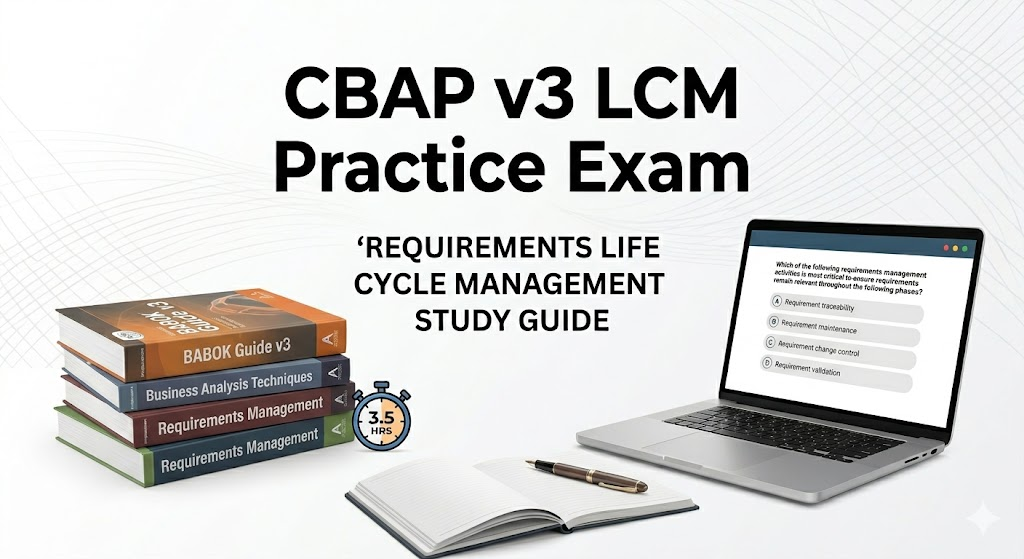
Additional Information
What the Course Entails and Exam Details
This focused practice test simulates the experience of the full CBAP exam by dedicating itself entirely to the LCM knowledge area. It tests the core tasks defined in the BABOK Guide.
Candidates can expect questions covering the five fundamental LCM tasks:
Trace Requirements: Determining the relationship between requirements, objectives, and solutions.
Maintain Requirements: Ensuring that requirements and designs are accurate, current, and reusable.
Prioritize Requirements: Evaluating requirements to determine their relative importance to stakeholders.
Assess Requirements Changes: Examining proposed changes to requirements to determine their impact.
Approve Requirements: Obtaining agreement on requirements with stakeholders for further work.
The syllabus covers a range of essential business analysis techniques associated with these tasks, such as traceability matrices, prioritization methods like MoSCoW, version control systems, and formalized change management processes.
What to Expect in the Final Exam
While this is a practice test, understanding the context of the final CBAP exam is vital for effective preparation. The actual CBAP v3 exam is a comprehensive, three-and-a-half-hour exam comprising 120 multiple-choice questions based on scenarios and cases. While the full exam covers all six Knowledge Areas, your LCM knowledge will account for a specific percentage of that total (approximately 15% to 18%).
When taking this practice test, you should expect:
Multiple-choice questions, many of which are scenario-based and require application of knowledge, not just recall.
A strict focus on BABOK Guide v3 concepts, terminology, and principles.
A simulated testing environment where you should aim for high accuracy and efficient time management. Although there is no official passing score for a practice test, aiming for a consistent score above 80% is recommended before attempting the actual certification exam.
How to Study and Exam Centers
Effective preparation for the CBAP LCM practice test and the final exam relies heavily on deep comprehension of the BABOK Guide.
Start by thoroughly studying the Requirements Life Cycle Management chapter. Don't just read it; analyze each task, technique, and output. Create detailed mind maps to visualize the processes. Develop your own traceability matrix examples and practice prioritizing requirements using different scenarios. Form or join a study group to discuss complex topics and share insights. Using practice exams like this one is the single most effective way to test your understanding, identify weak points, and get accustomed to the question format and time pressure.
The final CBAP exam is administered globally by the IIBA. Candidates must register through the IIBA portal and can choose to take the exam via two primary methods: at an authorized testing center like Pearson VUE or through a remotely proctored online format. Be sure to check the IIBA website for the latest details on exam locations, scheduling, and technical requirements for the online option.
Job Opportunities from the Course
Successfully passing the CBAP certification significantly enhances your professional credibility and opens doors to advanced career paths. Senior roles consistently list the CBAP designation as a preferred or required qualification. The deep understanding of Requirements Life Cycle Management you demonstrate is critical for these high-level positions. The CBAP qualification unlocks opportunities in various industries for roles including:
Lead Business Analyst
Requirements Manager
Product Owner
Strategic Business Architect
Project Manager (with a strong requirements focus)
Solutions Architect
Quality Assurance Lead
By proving your proficiency in managing complex requirement lifecycles, you position yourself as a valuable asset capable of driving successful project outcomes and delivering tangible value to any organization.
Frequently Asked Questions
Reviews
5.0
Based on 0 reviews
Leave a Review
No reviews yet. Be the first to review!