
CBRN Reconnaissance Operations Practice Test
$69.00
- Buy to unlock unlimited access to all Quiz questions and Answers in this Quiz.
- After purchase you can print a PDF of the whole quiz at any point. The PDF will contain the questions and the correct answers.
About this Exam
The CBRN Reconnaissance Operations qualification is a specialized certification designed for military personnel, first responders, and emergency management professionals who operate in environments potentially contaminated with Chemical, Biological, Radiological, or Nuclear (CBRN) hazards. This comprehensive exam validates an individual’s ability to conduct tactical reconnaissance, identify hazardous agents, and perform sampling operations safely. Achieving this certification demonstrates a high level of technical proficiency and operational readiness required for high-stakes mission profiles.
Ready to test your knowledge?
Buy Now to Access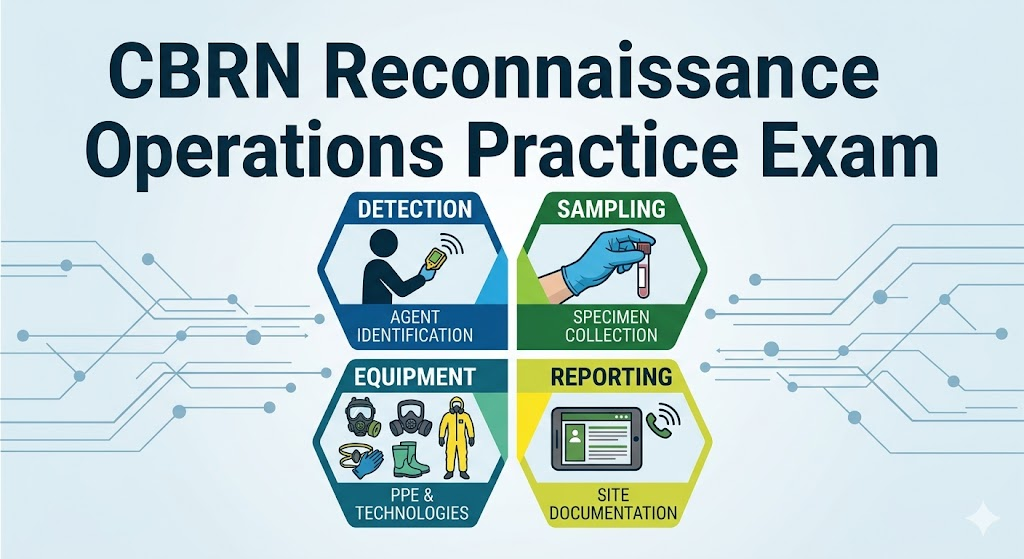
Additional Information
What the Course Entails and Exam Details
The CBRN Reconnaissance Operations curriculum covers a wide array of critical technical and tactical skills necessary for operating in hazardous environments. Core components of the training and subsequent examination often include:
Principles of CBRN Defense: Understanding the characteristics and effects of chemical warfare agents, biological pathogens, radiological material, and nuclear fallout.
Reconnaissance Fundamentals: Implementing tactical movement techniques for dismounted and mounted reconnaissance teams to locate and contaminate areas.
Detection and Identification: Mastering the operation of specialized CBRN detection equipment, including chemical agents monitors, radiation detectors, and biological sampling kits.
Sampling Operations: Executing precise protocols for collecting environmental samples (air, soil, water, and surface) for laboratory analysis while maintaining chain of custody.
Hazard Markers and Reporting: Properly marking contaminated areas using international standards and generating accurate CBRN warning reports (e.g., ATP-45 formats).
Decontamination Procedures: Demonstrating proficiency in immediate, operational, and thorough decontamination techniques for personnel and equipment.
Personal Protective Equipment (PPE): Correct selection, inspection, and extended operation in various levels of PPE, including MOPP gear and self-contained breathing apparatus (SCBA).
What to Expect in the Final Exam
The final CBRN Reconnaissance Operations Exam is a rigorous assessment typically structured in two distinct phases to evaluate both theoretical knowledge and practical application.
The first phase is a written (or computer-based) theory examination. This section frequently utilizes a multiple-choice format, requiring candidates to answer 50 to 100 questions within a set time limit, often 90 to 120 minutes. Questions cover detailed technical specifications of agents, detection equipment capabilities, and tactical doctrine. The passing score is generally set at 80% or higher.
The second, and often more challenging, phase is the hands-on practical evaluation (or a "lane training" exercise). In this scenario-based assessment, candidates are evaluated by instructors while executing a simulated CBRN reconnaissance mission. Evaluators utilize critical task checklists and "Go/No-Go" criteria. Candidates must demonstrate flawless execution of key tasks, such as correctly identifying an unknown agent, following sampling protocols without cross-contamination, and proper reporting, often while operating in full PPE. Failure to meet any critical safety or operational task may result in automatic failure.
How to Study and Exam Centers
Effective preparation for the CBRN Reconnaissance Operations exam requires a balanced approach, emphasizing both cognitive study and repetitive practical application.
Actionable Study Strategies:
Master the Doctrine: Thoroughly review all relevant foundational doctrine and technical manuals (e.g., Army Techniques Publications (ATP) or multi-service tactics, techniques, and procedures (MTTP)) relevant to CBRN reconnaissance. Pay close attention to definitions, reporting formats, and equipment capabilities.
Repetitive Practical Drills: Success on the practical exam depends on muscle memory. Practice donning PPE quickly, operating detection equipment with gloved hands, and executing sampling procedures until they are second nature.
Utilize Practice Exams: Take multiple practice tests that mirror the format and difficulty level of the official written exam. This will help you identify knowledge gaps, familiarize yourself with the question phrasing, and manage your time effectively. Focus on why the correct answer is correct.
Team-Based Scenarios: If studying with colleagues, set up full-scale, timed scenarios that mimic the practical evaluation lanes, including equipment checks and decontamination.
Exam Centers and Registration:
The CBRN Reconnaissance Operations certification is usually administered through specific physical locations rather than public commercial testing centers like Pearson VUE.
Authorized Military Schools: For defense personnel, the primary location for testing and certification is the authorized CBRN schoolhouses, such as the U.S. Army CBRN School (USACBRNS) at Fort Leonard Wood.
Authorized Training Providers: For civilian first responders and international partners, the exam is typically proctored by authorized government training facilities, standardized emergency management academies, or authorized private training contractors upon completion of an approved course of instruction. Candidates must register for the exam through their respective organization’s training coordinator.
Job Opportunities from the Course
Earning the CBRN Reconnaissance Operations certification is a significant achievement that opens distinct career pathways in specialized defense and emergency response sectors. This qualification is particularly valuable for individuals seeking leadership and technical roles.
Potential job opportunities and career paths unlocked by this certification include:
CBRN Specialist / NCO (Military): Direct operational roles within dedicated chemical companies or reconnaissance platoons in combat units.
Hazardous Materials (HAZMAT) Technician: Civilian first responder roles within fire departments or environmental agencies, specializing in the identification and mitigation of hazardous substances.
Emergency Management Specialist: Positions focused on planning for and responding to large-scale disasters, including CBRN incidents.
CBRN Responder (Washing and Decon): Specialized roles in civil support teams or national guard units (e.g., WMD-CST) tasked with supporting local authorities during domestic incidents.
Counter-WMD Analyst: Intelligence and operational planning roles focused on analyzing and countering the proliferation of weapons of mass destruction.
CBRN Training Instructor: Personnel qualified to train subsequent generations of responders and operators at authorized schoolhouses and academies.
Environmental Field Scientist: Roles in both public and private sectors conducting environmental sampling and assessment in challenging or contaminated environments.
Frequently Asked Questions
Reviews
5.0
Based on 0 reviews
Leave a Review
No reviews yet. Be the first to review!