
CCA Ontario Integrated Pest Management Practice Exam
$69.00
- Buy to unlock unlimited access to all Quiz questions and Answers in this Quiz.
- After purchase you can print a PDF of the whole quiz at any point. The PDF will contain the questions and the correct answers.
About this Exam
The Certified Crop Adviser (CCA) Ontario designation is a cornerstone qualification for agricultural professionals who advise farmers on production, business, and sustainability.
A critical, required pillar of this certification is Integrated Pest Management (IPM), a sustainable and data-driven approach to managing pests that combines cultural, biological, physical, and chemical tools to minimize economic and environmental risks.
The CCA Ontario Integrated Pest Management Practice Exam is a dedicated study tool designed specifically to help candidates master this essential competency area.
This practice exam is invaluable for agronomists, farm managers, crop scouts, agricultural retail specialists, and any adviser seeking to validate their expert-level knowledge of identifying and managing pests within Ontario’s unique agricultural landscape.
Ready to test your knowledge?
Buy Now to Access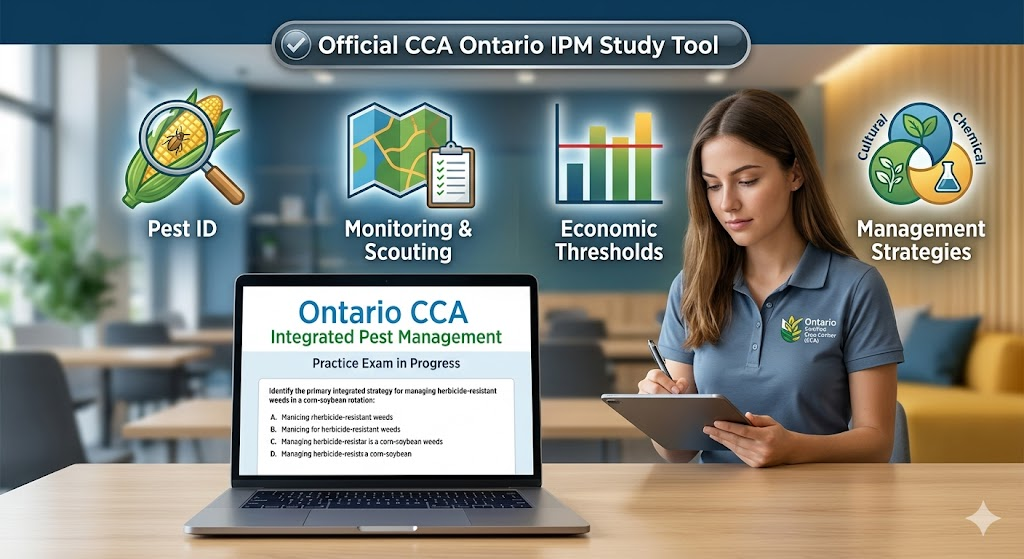
Additional Information
What the Course Entails and Exam Details
This practice exam is built around the strict Performance Objectives (POs) set by the Ontario Certified Crop Adviser Board.
It covers all core knowledge areas required to be considered a master in the field.
You will be tested on your depth of understanding across these primary domains:
Pest Identification: Correctly diagnosing common Ontario insect pests, plant diseases, and weed species, including understanding their biology and life cycles.
Monitoring and Scouting: Mastering systematic field scouting techniques and data collection methods to ensure accurate pest population assessments.
Thresholds and Decision Making: Applying economic injury levels and action thresholds to make scientifically sound, data-driven management recommendations.
Integrated Management Strategies: Effectively blending cultural (e.g., crop rotation, sanitation), mechanical, biological (e.g., enhancing natural enemies), and chemical controls (i.e., targeted pesticide use).
Pesticide Resistance Management: Understanding the biology behind pest resistance and implementing strategies to slow its development, which is critical for long-term control.
Environmental Stewardship and Safety: Adhering to all Ontario regulations, reading and interpreting pesticide labels correctly, and employing best management practices for safety, storage, and application to protect human and environmental health.
What to Expect in the Final Exam
The actual CCA Ontario IPM component is a rigorous assessment administered through a computer-based platform.
The format is typically multiple-choice, testing both factual recall and the ability to apply complex concepts to real-world scenarios.
You can expect challenging, scenario-based questions where you must choose the most effective and sustainable Integrated Pest Management plan for a given crop and pest scenario.
While the wider CCA exam has various structures, the IPM component as a standalone or sub-section is standard for Ontario IPM accreditations and requires a minimum passing score of at least 75%.
The exam is timed, with candidates usually being allocated a strict limit, often between 1.5 to 2 hours for a dedicated component, requiring efficient time management. Candidates are required to show valid identification and adhere to strict proctoring protocols.
How to Study and Exam Centers
Effective preparation is the single most important factor for success.
Start by obtaining and thoroughly reading the official CCA Ontario Performance Objectives for Integrated Pest Management, which are the blueprint for the entire exam.
Use the primary study reference: the "Ontario Pesticide Training and Certification Core Manual." Also, leverage resources from the Ontario Ministry of Agriculture, Food and Rural Affairs (OMAFRA), especially their Guide to Weed Control and relevant Pubs.
Take this practice exam multiple times; do not just look for the correct answer, but understand why the other options are less effective, as this is how the real exam tests your critical thinking.
Create flashcards for specific pest life cycles and control strategies for key Ontario crops. For those seeking structured support, organizations like the University of Guelph Ridgetown Campus offer comprehensive pre-exam workshops and videos.
Once prepared, you will need to register to take the final exam. Contact the Ontario Certified Crop Adviser office or the University of Guelph Ridgetown Campus IPM Accreditation Program for the official scheduling process.
The exam is offered on-demand through an official, authorized online portal that you will access after registration. While taken remotely, some authorized physical computer labs at institutions like Ridgetown Campus may be available in limited cases; confirming with the administrator is best.
Job Opportunities from the Course
Achieving the Certified Crop Adviser designation, with proven expertise in Integrated Pest Management, significantly elevates your professional standing in Ontario's vibrant agricultural sector. It is a powerful validator of your skills that many top employers require or strongly prefer.
Your deep knowledge of sustainable pest control will open doors to numerous rewarding career paths:
Certified Crop Adviser (CCA)
Independent Agronomist and Farm Consultant
Farm Business Manager
Crop Scout and Scouting Team Leader
Pest Management Consultant
Agricultural Sales Representative (Pesticides, Seeds, and Fertilizer)
Agricultural Extension or Field Officer
Regulatory and Compliance Specialist in Agriculture
Agricultural Research Technician (Crop Protection)
Pesticide Application Supervisor
Frequently Asked Questions
Reviews
5.0
Based on 0 reviews
Leave a Review
No reviews yet. Be the first to review!