
CCE Science and Humanity Practice Exam
$69.00
- Buy to unlock unlimited access to all Quiz questions and Answers in this Quiz.
- After purchase you can print a PDF of the whole quiz at any point. The PDF will contain the questions and the correct answers.
About this Exam
The CCE Science and Humanity certification is a prestigious qualification designed to validate a candidate’s foundational understanding of both the natural sciences and the core principles of humanistic study. It is engineered for students seeking a versatile credential that demonstrates a holistic approach to knowledge, as well as professionals in education, communication, and public service who must navigate complex themes intersecting technology and culture.
This certification proves your competency in synthesizing factual data with ethical consideration, a skill highly prized in today’s interdisciplinary landscape.
Ready to test your knowledge?
Buy Now to Access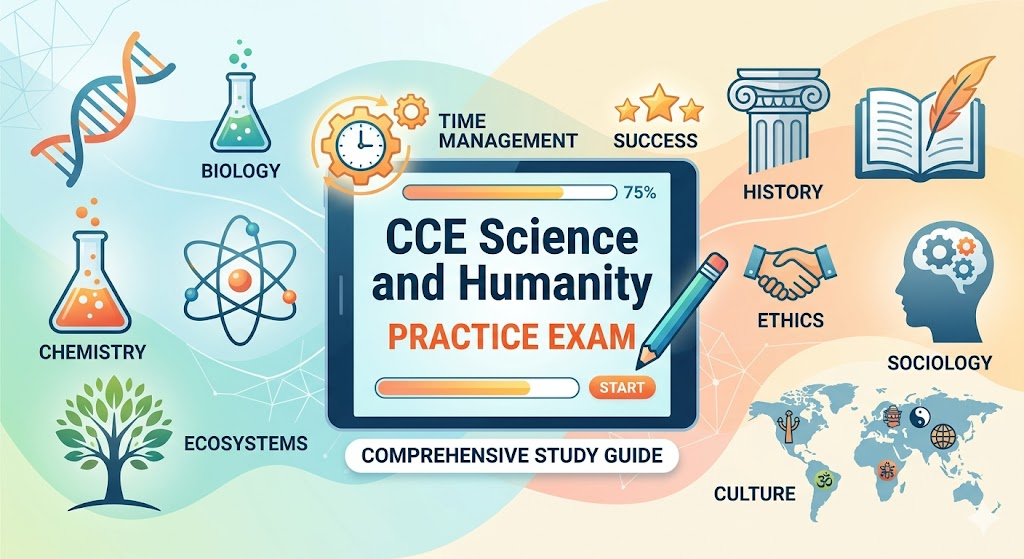
Additional Information
What the Course Entails and Exam Details
This examination does not adhere to a single prescribed course, but rather assesses cumulative knowledge across two major academic domains. The syllabus is broad, testing your ability to understand essential theories and apply critical thinking to diverse problems.
The core assessment domains include:
Scientific Domain
Life Sciences: Principles of biology, genetics, ecosystems, and human anatomy.
Physical Sciences: Foundational concepts in chemistry, physics, and earth science.
Environmental Science: Global ecosystems, sustainability, and human impact on the environment.
Scientific Method: Understanding experimental design, data interpretation, and statistical reasoning.
Humanity Domain
Historical Perspectives: Major world civilizations, pivotal turning points in human history, and cultural evolution.
Sociology and Culture: Social structures, cultural dynamics, social psychology, and global diversity.
Ethics and Philosophy: Ethical theories, philosophical reasoning, moral dilemmas, and the role of ethics in decision-making.
Critical Thought and Analysis: Analyzing primary sources, evaluating arguments, and understanding rhetorical strategies.
What to Expect in the Final Exam
Knowing the exam structure is essential for time management and confidence on test day. The CCE Science and Humanity final exam is a standardized assessment primarily conducted in a digital environment.
Format: The examination consists entirely of multiple-choice questions (MCQs). These questions range from direct recall of factual knowledge to complex scenario-based queries that require the application of multiple concepts.
Question Count: Candidates should expect to answer approximately 120 graded questions. The exam may also include a small number of unscored, pretest questions used for future test development.
Time Limit: Students are allotted a total of 180 minutes (3 hours) to complete the examination. There are no scheduled breaks during this time, so pace yourself carefully.
Passing Score: The passing score is a scaled score determined by the CCE governing board. While the raw score requirement changes based on form difficulty, candidates generally need to achieve a score of approximately 70% or higher to pass. You will receive your official score report immediately upon completion.
Rules: The exam is closed-book. No outside materials, including textbooks, personal notes, or calculators, are permitted within the testing environment.
How to Study and Exam Centers
Effective preparation requires an active study strategy that covers both technical definitions and conceptual understanding. Because the material is interdisciplinary, your study methods must be varied.
Study Strategies and Practice Methods
Take Diagnostic Tests First: Begin your journey by taking a full-length CCE Science and Humanity Practice Exam. This will identify your weakest domains and allow you to prioritize your study time effectively.
Create Structured Outlines: Do not just read. Actively create detailed outlines for both the Science and Humanity domains. Summarize key theories, list essential figures, and draw diagrams of complex cycles (like ecosystems or historical timelines).
Master the Terminology: Use digital flashcards (e.g., Anki) to master the core vocabulary of both domains. You must understand scientific terms like "mitosis" and philosophical concepts like "utilitarianism" on sight.
Simulate the Exam Environment: In the final weeks of preparation, take several practice exams under strict timing and environmental conditions. This builds mental endurance and sharpens your time-management skills.
Exam Centers and Registration
The CCE Science and Humanity exam is administered globally through secure, authorized testing partners.
Online Proctoring: For maximum flexibility, many candidates choose to take the exam via secure online proctoring from their own home or office. This requires a stable internet connection, a webcam, and a private, quiet room.
Physical Testing Centers: Candidates who prefer a traditional environment can schedule their appointment at an authorized Pearson VUE or specialized academic testing center. These physical locations are available in major cities worldwide and provide a standardized, distraction-free environment.
Registration: To register for the exam, you must first create an account on the official CCE certification portal. Through this portal, you can submit your fees, choose your preferred testing method (online or physical center), and select your desired date and time.
Job Opportunities from the Course
Earning the CCE Science and Humanity certification provides a definitive professional advantage, validating the versatile skills needed in modern, complex workplaces. This credential unlocks numerous career paths where synthesis, critical analysis, and a broad knowledge base are required.
The certification is highly beneficial for the following specific job titles and career paths:
Education: K-12 Interdisciplinary Studies Teacher, Adult Education Instructor, Curriculum Developer, and Educational Content Creator.
Communication: Scientific Writer, Technical Communicator, Museum Curator, Exhibition Interpreter, and Public Relations Specialist (specializing in STEM or non-profits).
Public Service & Non-Profit: Program Coordinator, Policy Analyst Assistant, Community Outreach Specialist, and Advocate for Sustainability.
Business: Research Analyst, Corporate Social Responsibility (CSR) Associate, and Human Resources Generalist (valuing ethical reasoning).
Frequently Asked Questions
Reviews
5.0
Based on 0 reviews
Leave a Review
No reviews yet. Be the first to review!