
CCNA 2 Switching, Routing, and Wireless Essentials, Version 7.0 Practice Test
$69.00
- Buy to unlock unlimited access to all Quiz questions and Answers in this Quiz.
- After purchase you can print a PDF of the whole quiz at any point. The PDF will contain the questions and the correct answers.
About this Exam
The [CCNA 2 Switching, Routing, and Wireless Essentials, Version 7.0 Practice Test] is a vital educational tool designed for students enrolled in the Cisco Networking Academy program. It serves as the culmination of the second course in the three-course CCNA curriculum framework. This exam validates a student's readiness to move forward toward the comprehensive vendor CCNA certification (200-301). It is specifically engineered for aspiring network technicians, support engineers, and IT professionals who have completed the "Introduction to Networks" course and are now mastering the architecture, components, and operations of routers and switches in small to medium-sized networks.
Ready to test your knowledge?
Buy Now to Access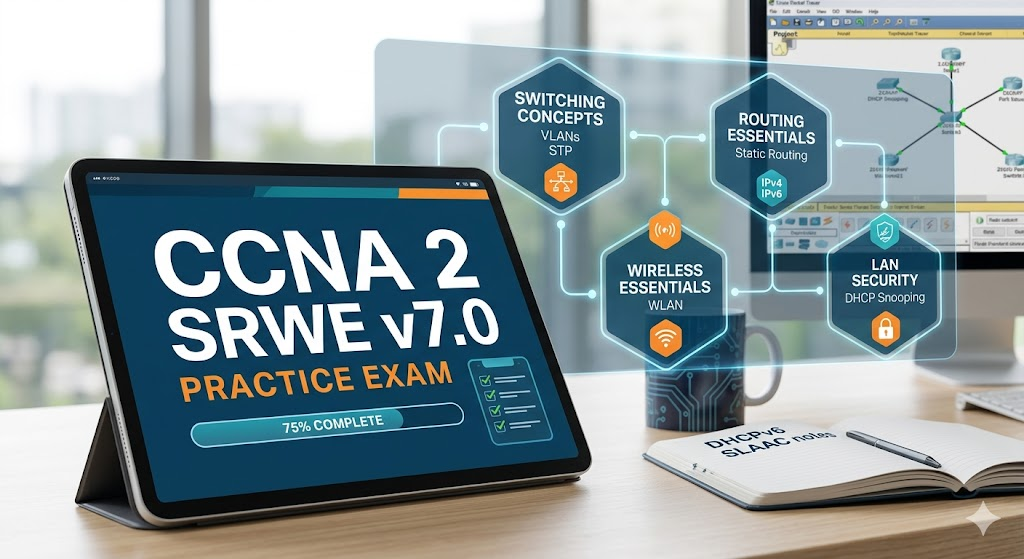
Additional Information
What the Course Entails and Exam Details
The CCNA 2 v7.0 (SRWE) curriculum delves deeply into the technologies that power modern local area networks (LANs) and introduces essential wireless concepts. The core syllabus covers several critical domains. You will learn to configure advanced functionality on routers and switches, moving beyond basic setup. This includes mastering Virtual LANs (VLANs) for network segmentation and security, and implementing Inter-VLAN Routing using methods such as Router-on-a-Stick. The course also emphasizes network redundancy and reliability, teaching concepts like Spanning Tree Protocol (STP) to prevent Layer 2 loops, and EtherChannel to aggregate link bandwidth. You will explore dynamic addressing through DHCPv4 and DHCPv6, learn about SLAAC, and implement First Hop Redundancy Protocols (FHRP). Crucially, the SRWE module introduces LAN security concepts, switch security configuration to mitigate attacks, and the concepts and configuration of Wireless LANs (WLANs). Finally, you will become proficient in configuring and troubleshooting IPv4 and IPv6 Static Routing.
What to Expect in the Final Exam
While "Practice Test" usually refers to the final practice offered within the Networking Academy portal, the actual Cisco NetAcad CCNA 2 Final Exam is a rigorous assessment typically structured in two distinct parts.
Multiple-Choice/Scenario Questions: This section tests your conceptual understanding of all the topics outlined above. You will encounter various question types, including single-choice, multiple-response, drag-and-drop, and scenario-based inquiries that require you to analyze network diagrams or configuration snippets.
Practical Skills Assessment (Packet Tracer): This is a defining feature of the NetAcad experience. You will be provided with a topology and a set of requirements. You must use Cisco Packet Tracer to configure devices (routers, switches, and sometimes wireless controllers) to meet these requirements. You may need to troubleshoot existing configurations or build a segment from scratch.
The combined time limit for these sections is generally around 2 to 3 hours. A passing score is defined by your specific academy but typically requires achieving mastery across all domains. The exam is closed-book, and you are expected to complete it independently within the academy’s secure environment.
How to Study and Exam Centers
Preparation for the CCNA 2 SRWE v7.0 exam must be hands-on and consistent. Your primary resource is the comprehensive online curriculum provided through the Cisco Networking Academy portal (NetAcad.com). You should diligently complete every assigned lab exercise using either physical Cisco equipment or, more commonly, the robust Cisco Packet Tracer simulation tool. Re-doing labs multiple times to build command-line interface (CLI) fluency is critical for the practical skills portion of the exam.
Utilize the structured "Practice Quizzes" at the end of each module within the NetAcad platform. Engage deeply with the official "Check Your Understanding" interactive activities. When reviewing practice questions, don’t just memorize the correct answer; analyze why the other options are incorrect based on Cisco’s validated definitions and architectural principles. Supplemental study materials from Cisco Press, such as the CCNA 2 v7.0 Labs & Study Guide, can provide excellent theoretical consolidation and additional practice scenarios.
As a student-focused exam, you will take the CCNA 2 Final Exam exclusively through your registered Cisco Networking Academy. The exam is administered via the NetAcad online portal under the supervision of your instructor. This differs from the vendor CCNA 200-301 certification, which is taken at Pearson VUE testing centers or via Pearson’s online proctoring service. Ensure your academy account is active and you are familiar with the portal’s testing interface before your scheduled exam time.
Job Opportunities from the Course
Successfully completing the CCNA 2 course and passing its final exam proves to employers and your academy that you possess the core switching, routing, and wireless skills required for entry-level networking roles. It is a massive step toward becoming fully CCNA certified.
This foundational mastery unlocks numerous career paths in network administration and support, including specific job titles such as:
Network Administrator
Junior Network Engineer
Network Support Technician
Technical Support Engineer (L1/L2)
Field Service Technician
System Engineer (Entry-Level)
Network Analyst
Wireless Support Specialist
IT Support Specialist (Networking Focus)
Frequently Asked Questions
Reviews
5.0
Based on 0 reviews
Leave a Review
No reviews yet. Be the first to review!