
CCNA 3 Enterprise Networking, Security, and Automation, Version 7.0 Practice Exam
$69.00
- Buy to unlock unlimited access to all Quiz questions and Answers in this Quiz.
- After purchase you can print a PDF of the whole quiz at any point. The PDF will contain the questions and the correct answers.
About this Exam
The CCNA 3 Enterprise Networking, Security, and Automation (ENSA) Version 7.0 Practice Exam is the definitive preparatory tool for students approaching the final hurdle of the three-course Cisco Networking Academy CCNA curriculum.
This exam is designed specifically for aspiring network professionals who have completed the "Introduction to Networks" and "Switching, Routing, and Wireless Essentials" modules and are now finalizing their associate-level expertise.
It simulates the rigor and scope of the final course exam, providing critical validation of your ability to design, secure, operate, and troubleshoot complex enterprise network architectures.
Successfully navigating this practice exam demonstrates readiness for advanced networking roles and provides the confidence needed to succeed in the formal course final and the subsequent composite CCNA (200-301) certification exam.
Ready to test your knowledge?
Buy Now to Access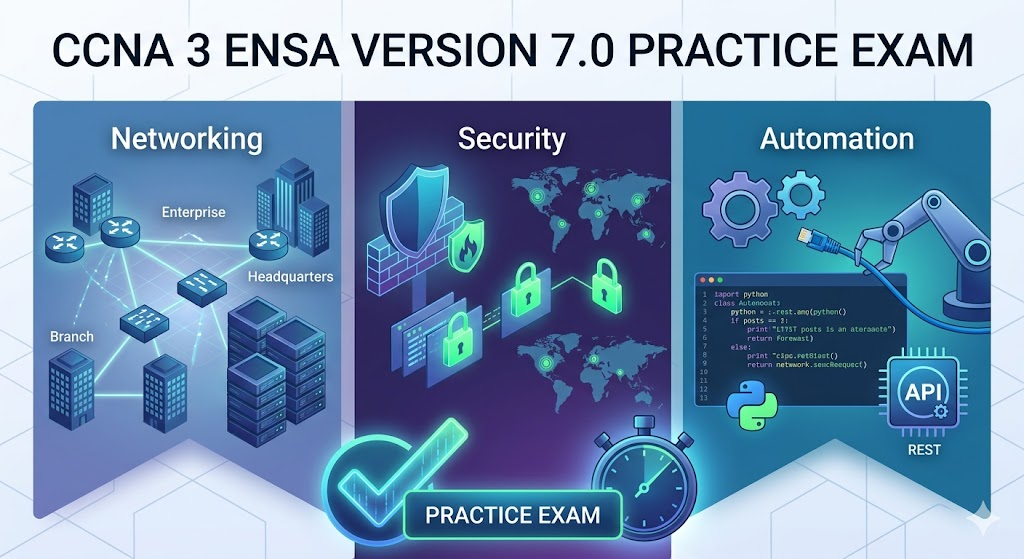
Additional Information
What the Course Entails and Exam Details
The CCNA 3 ENSA v7.0 course shifts focus from basic connectivity to advanced enterprise-level technologies, emphasizing how modern networks scale, secure themselves, and incorporate intelligence through automation.
The practice exam rigorously tests knowledge across several key pillars of the ENSA syllabus:
Network Security: Deep comprehension of Access Control Lists (ACLs), including standard, extended, and IPv6 implementations, to mitigate security threats. It also covers Network Address Translation (NAT) and configuring secure remote access using Virtual Private Networks (VPNs) and IPsec.
Enterprise Routing and Scaling: Advanced configuration and troubleshooting of single-area OSPFv2 in both point-to-point and multi-access networks. Students are also tested on the concepts of wide area network (WAN) technologies and traditional versus modern WAN connectivity options.
Quality of Service (QoS): Understanding mechanisms necessary to prioritize time-sensitive traffic, such as voice and video, within a congested enterprise network.
Network Management and Optimization: Validating skills in monitoring networks using tools like SNMP, Syslog, and NetFlow, alongside understanding network design concepts like scalability and high availability.
Automation and Programmability: Introduction to the concepts of software-defined networking (SDN), APIs, REST, configuration management tools, and the impact of automation on modern network administration.
What to Expect in the Final Exam
While individual institutions may vary slightly, a standard NetAcad final course exam for CCNA 3 ENSA typically follows a strict format that the practice exam accurately mimics.
Exam Format: You should expect approximately 50 to 60 questions, which may include a mix of multiple-choice (single and multiple answer), matching, drag-and-drop, and interactive scenario-based questions.
Simulations: Critically, some questions may involve simulated environments using Cisco Packet Tracer, where you must configure or troubleshoot a network topology based on a given set of requirements.
Time Limit: The exam is typically timed, usually allowing between 75 to 90 minutes. This requires efficient time management and a quick recall of configuration commands and concepts.
Passing Score: The standard passing threshold within Cisco Networking Academy is typically 70% or higher. Achieving a high score on the practice exam is a strong indicator of success in the formal final, allowing you to earn your course completion badge and move toward full certification.
How to Study and Exam Centers
Preparation for the CCNA 3 ENSA exam requires a strategic mix of theoretical review and hands-on practical application.
Master the Curriculum: Re-read the official Cisco NetAcad online modules thoroughly. Focus on the summaries and take the module quizzes multiple times until you consistently score 100%.
Hands-on Lab Practice: This is non-negotiable. Spend significant time completing every Packet Tracer activity and physical lab assigned within the course. Focus especially on ACL configuration, NAT, OSPF troubleshooting, and VPN setup.
Use the Practice Exam Wisely: Treat the practice exam as a benchmark, not just a study guide. Take it under timed conditions without using notes. Analyze your weak areas from the results and return to the curriculum to review those specific topics.
Flashcards and Command Summaries: Create flashcards for key concepts (like QoS models) and compile a comprehensive list of configuration and verification commands for OSPF, NAT, and ACLs.
Exam Centers and Access: The CCNA 3 ENSA course exam is administered entirely online through the Cisco Networking Academy learning portal.
You will typically take this exam at the end of your course, either in a physical classroom at your authorized academy (such as a college, university, or technical school) or remotely, depending on your instructor’s guidance. It is not taken at Pearson VUE testing centers; those are only for the composite industrial CCNA certification exam.
Job Opportunities from the Course
Completing the CCNA 3 ENSA course equips you with the advanced skills demanded by modern enterprises, opening doors to various specialized and higher-level IT career paths.
This certification knowledge is a critical requirement for job titles such as:
Network Administrator
Network Engineer (Entry to Mid-Level)
System Administrator (with Networking Focus)
Network Support Specialist
IT Security Specialist (Junior)
Network Analyst
Data Center Technician
Infrastructure Engineer
Network Design Engineer (Junior)
Technical Support Engineer (L2)
Frequently Asked Questions
Reviews
5.0
Based on 0 reviews
Leave a Review
No reviews yet. Be the first to review!