
CCNA (Cisco Certified Network Associate) Anki Practice Test
$69.00
- Buy to unlock unlimited access to all Quiz questions and Answers in this Quiz.
- After purchase you can print a PDF of the whole quiz at any point. The PDF will contain the questions and the correct answers.
About this Exam
The Cisco Certified Network Associate (CCNA) is one of the most widely recognized and respected certifications in the IT industry.
It validates your foundational knowledge in networking and your ability to install, configure, operate, and troubleshoot medium-sized routed and switched networks.
This certification is ideal for network engineers, network administrators, network support specialists, and anyone looking to start or advance a career in network engineering.
Earning your CCNA demonstrates to employers that you have the essential skills needed to manage the network infrastructure that powers modern businesses.
Ready to test your knowledge?
Buy Now to Access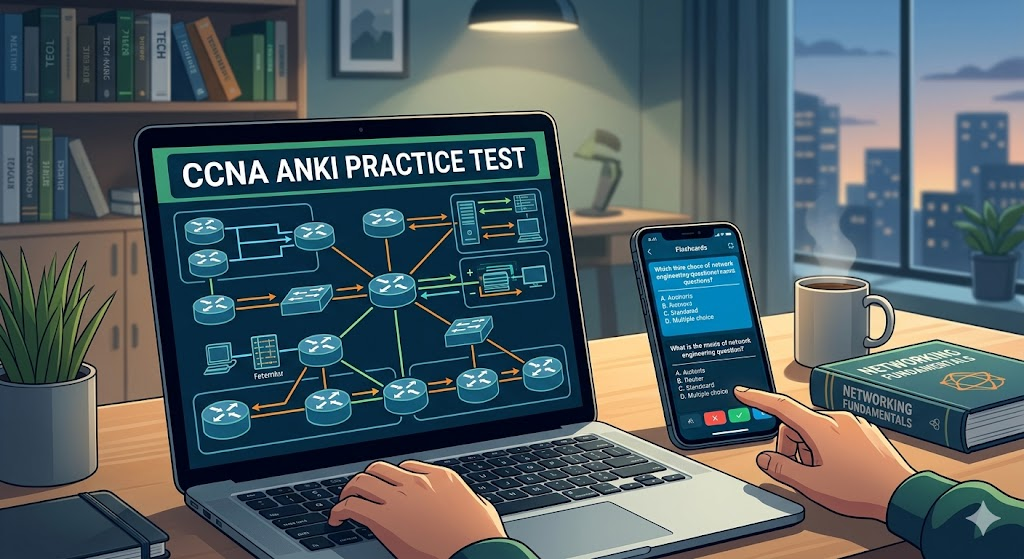
Additional Information
What the Course Entails and Exam Details
The CCNA certification covers a broad range of networking fundamentals.
While there is no formal "course" required by Cisco before taking the exam, the recommended training often includes the Implementing and Administering Cisco Solutions (CCNA 200-301) course.
The actual 200-301 CCNA exam focuses on six key domains: Network Fundamentals, Network Access, IP Connectivity, IP Services, Security Fundamentals, and Automation and Programmability.
Topics you will be tested on include IP addressing (IPv4 and IPv6), subnetting, OSPF routing, VLANs and trunking, Spanning Tree Protocol (STP), wireless networking concepts, basic network security, and network automation tools.
Successfully mastering these concepts requires both theoretical understanding and practical hands-on experience, which is where a dedicated study guide and practice tests become invaluable.
What to Expect in the Final Exam
The final CCNA 200-301 exam is a comprehensive assessment of your networking skills.
You should expect the exam to contain approximately 100 to 120 questions.
The format is predominantly multiple-choice, with questions often featuring a single correct answer or requiring you to select multiple correct answers.
You may also encounter drag-and-drop questions and complex performance-based lab scenarios.
These labs simulate real-world networking situations, asking you to configure and troubleshoot Cisco routers and switches directly in a virtual environment.
The time limit for the exam is 120 minutes.
While Cisco does not publish the exact passing score, it is generally believed to be around 825 on a scale of 300-1000.
Be prepared for a rigorous exam that tests not only what you know but how well you can apply that knowledge in practical situations.
How to Study and Exam Centers
Effective preparation for the CCNA requires a balanced approach.
Start by creating a structured study plan based on the official 200-301 CCNA exam topics.
Utilize various study materials, including Official Cert Guides from Cisco Press, online video courses, and, most importantly, hands-on lab practice.
Tools like Cisco Packet Tracer and GNS3 are essential for building virtual network labs and practicing configuration and troubleshooting.
This is where the "CCNA Anki Practice Test" becomes incredibly powerful.
Using Anki’s spaced repetition system helps you efficiently memorize critical concepts, terminology, command-line syntax, and key facts.
Incorporate active recall into your daily routine by testing yourself with high-quality flashcard decks, ensuring long-term retention of complex networking information.
Once you feel ready, schedule your exam through Pearson VUE, Cisco's authorized testing partner.
You can choose to take the exam in person at a secure Pearson VUE testing center or online from the comfort of your home or office.
When selecting an exam date, make sure to consider available slots at your preferred physical location or review the technical requirements for the online proctored option.
Job Opportunities from the Course
Earning your CCNA unlocks numerous entry and mid-level job opportunities in the field of networking and IT infrastructure.
Here are some specific job titles and career paths this certification makes accessible:
Network Engineer
Network Administrator
Network Support Specialist
Network Technician
System Administrator (with a strong networking focus)
IT Support Engineer
Help Desk Technician (Tier 2/3)
NOC (Network Operations Center) Analyst
The CCNA also serves as a critical prerequisite and stepping stone toward more advanced, specialized certifications, such as the CCNP (Cisco Certified Network Professional) or focused tracks in security, wireless, or data center networking.
Frequently Asked Questions
Reviews
5.0
Based on 0 reviews
Leave a Review
No reviews yet. Be the first to review!