
CDC Low Observable Aircraft Structural Maintenance (AFSC 2A755) Volume 3 Practice Exam
$69.00
- Buy to unlock unlimited access to all Quiz questions and Answers in this Quiz.
- After purchase you can print a PDF of the whole quiz at any point. The PDF will contain the questions and the correct answers.
About this Exam
The CDC Low Observable Aircraft Structural Maintenance (AFSC 2A755) Volume 3 Practice Exam is a critical assessment tool designed for United States Air Force personnel pursuing upgrading training to the 5-skill level. This specific volume, part of the broader Career Development Course (CDC), focuses intensely on the advanced, specialized techniques required to maintain and repair the low observable (LO), or "stealth," characteristics of modern combat aircraft. It is engineered for dedicated technicians already working in the 2A755 field who need to validate their mastery of structural maintenance in a signature-managed environment.
Ready to test your knowledge?
Buy Now to Access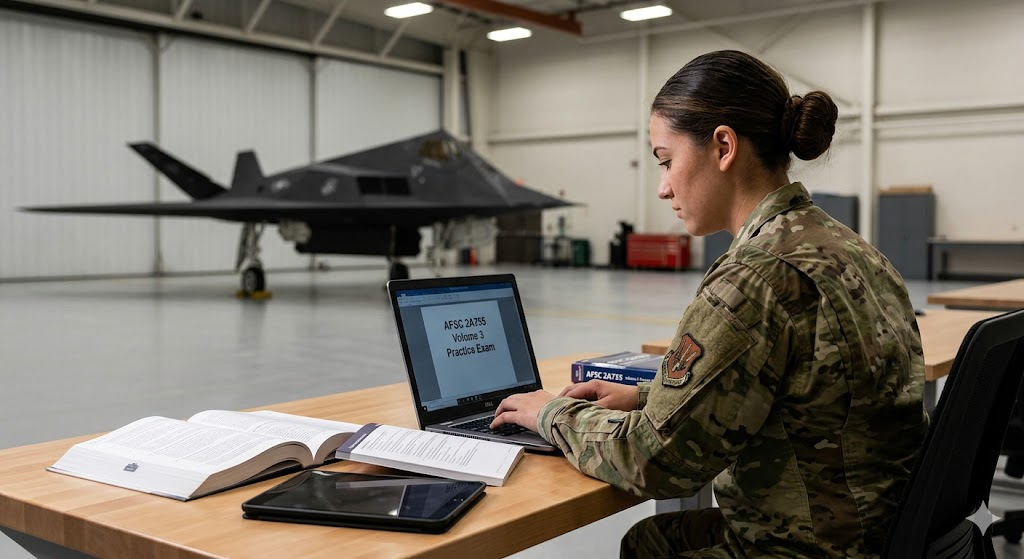
Additional Information
What the Course Entails and Exam Details
This course takes technicians beyond basic structural repair and delves into the complex science of signature reduction. The curriculum covers the application, maintenance, and repair of advanced Radar Absorbent Materials (RAM), specialized coatings, and signature-neutral composites. Technicians will study the theories of radar cross-section (RCS) and infrared (IR) signatures to understand why specific repair procedures are mandatory. Key topics include complex composite laminate repairs, precise application of specialized LO coatings (using specific tools like high-volume, low-pressure spray guns), and the stringent quality control inspections necessary to ensure the aircraft remains "invisible" to enemy sensors. The material validates your ability to restore both structural integrity and stealth capability simultaneously.
What to Expect in the Final Exam
The actual Volume 3 end-of-course exam is a comprehensive, multiple-choice assessment. While practice exams might vary in length, the official Air Force exam is rigorously timed, often allowing approximately 90 minutes for completion. A passing score of 65% or higher is typically required to receive credit for the volume. The questions go beyond simple recall; they are designed to test your ability to analyze specific damage scenarios and select the exact, multi-step repair procedure, including material selection and environmental controls, required by the technical orders (TOs). There is no practical hands-on component during this specific written exam, as skill mastery is verified separately through OJT (On-the-Job Training) journal endorsements.
How to Study and Exam Centers
Effective preparation requires a structured approach. Start by thoroughly reading the AFSC 2A755 Volume 3 modules, highlighting key terms, safety precautions, and multi-step repair processes. The most effective study strategy is the active use of practice exams. Treat these practice sessions seriously: set a timer, eliminate distractions, and attempt to answer without referencing your material. Afterward, carefully review every question you missed. Do not just memorize the correct answer; return to the CDC text and the relevant Technical Orders (TOs) to understand why that answer is correct and the specific steps involved. Form study groups with fellow technicians to discuss complex repair scenarios. The final, official exam is administered in a controlled, secure environment, typically at your installation’s base training office or a designated testing facility, often using automated testing systems.
Job Opportunities from the Course
Mastery of this material and the subsequent 5-level upgrade significantly elevates your career trajectory within the Air Force and opens doors in the private sector.
Low Observable (LO) Structural Maintenance Technician (5-Level)
LO Craftsman (7-Level, upon further training and experience)
Aircraft Structural Maintenance Supervisor
Quality Assurance (QA) Inspector for Signature Management
(Post-Military) Aerospace Composite Repair Technician
(Post-Military) Defense Contractor specializing in Stealth Technology Maintenance
(Post-Military) Specialized Coatings Application Specialist in Manufacturing
Frequently Asked Questions
Reviews
5.0
Based on 0 reviews
Leave a Review
No reviews yet. Be the first to review!