
CED Biological Basis of Behavior Practice
$69.00
- Buy to unlock unlimited access to all Quiz questions and Answers in this Quiz.
- After purchase you can print a PDF of the whole quiz at any point. The PDF will contain the questions and the correct answers.
About this Exam
The New CED – Biological Basis of Behavior Practice Exam is a pivotal resource designed to prepare students for success in one of the most fundamental areas of psychology: the biological foundations of human thought and action. This practice assessment is tailored for students taking advanced placement (AP) Psychology or equivalent courses structured around the current Course and Exam Description (CED). By focusing specifically on the intricate relationship between biology, the brain, and behavior, this practice exam serves as a crucial benchmark for measuring readiness and pinpointing areas for improvement before facing the final, high-stakes examination. Mastering this domain is essential not only for academic achievement but also for cultivating a deep understanding of neuroscience's profound impact on who we are.
Ready to test your knowledge?
Buy Now to Access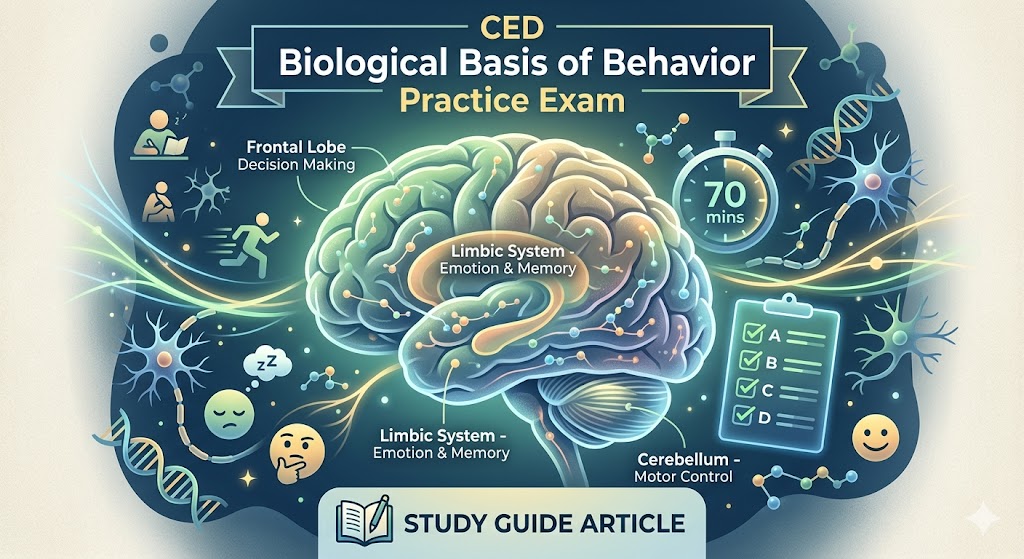
Additional Information
What the Course Entails and Exam Details
The course and this practice exam cover a comprehensive range of topics that elucidate how physiological processes underpin behavior. Students are expected to demonstrate knowledge in areas such as:
Neuron Structure and Function: Understanding the anatomy of a neuron, how neural impulses are transmitted (action potential), and the role of neurotransmitters and synapses in communication.
Organization of the Nervous System: Distinguishing between the central nervous system (brain and spinal cord) and the peripheral nervous system, including the somatic and autonomic (sympathetic and parasympathetic) divisions.
Brain Structures and Functions: Identifying major brain regions (e.g., cerebrum, cerebellum, brainstem, limbic system) and their specific roles in sensory processing, motor control, emotion, memory, and language.
The Endocrine System: Grasping the functions of glands and hormones in regulating various bodily states and influencing behavior.
Genetics and Evolutionary Psychology: Exploring the influence of heredity, genetics (e.g., twin studies, epigenetics), and evolutionary principles on human characteristics and behavior.
States of Consciousness and Sleep: Investigating different states of arousal, the sleep cycle, brain waves during sleep, and the functions of sleep and dreaming.
Imaging Techniques: Familiarity with modern methods used to study the brain's structure and function (e.g., EEG, CT, PET, MRI, fMRI).
What to Expect in the Final Exam
The actual final, high-stakes examination (e.g., the AP Psychology Exam), which this practice test directly models, typically consists of two distinct sections:
Section I: Multiple-Choice Questions: This section generally comprises approximately 100 questions, making up about 66.7% of the total score. It tests a wide breadth of knowledge across all course units, with a significant emphasis on concept understanding, data analysis, and scientific investigation skills, including substantial coverage of the biological basis of behavior. The timeframe is typically around 1 hour and 10 minutes.
Section II: Free-Response Questions: Students must answer two free-response questions, contributing roughly 33.3% to the final score. These questions often involve analyzing research studies, applying psychological concepts to real-world scenarios, and integrating knowledge from different course domains, including detailed application of biological principles. The time allowed is usually about 50 minutes.
Passing Score and Grading: AP exams are scored on a scale of 1 to 5, with 3, 4, or 5 typically considered passing or worthy of college credit/placement by many institutions. Each section is weighted and combined for the composite score.
Exam Rules: Specific rules apply, including prohibitions on electronic devices, strict timing for each section, and requirements for writing in ink or pencil. For digital exams, different rules and applications (like College Board’s Bluebook) may be used. This practice exam aims to provide a comparable format and challenge to build student stamina and familiarity.
How to Study and Exam Centers
Effective preparation for both this practice and the final exam requires a strategic approach:
Master the CED: Thoroughly review the official New CED framework, as it dictates exactly which concepts and skills will be assessed.
Active Recall and Flashcards: Use digital (e.g., Anki, Quizlet) or physical flashcards for definitions, brain structures, neurotransmitter functions, and key researchers. Actively test your retrieval of this information frequently.
Visualize the Brain: Study detailed diagrams of neuron anatomy, brain regions, and the nervous system. Draw and label them yourself to reinforce visual learning.
Practice with Purpose: Take this comprehensive practice exam multiple times under timed conditions. Review every question, understand why correct answers are right, and—more importantly—why incorrect ones are wrong. Seek out additional practice questions and past exams where possible.
Link Concepts to Behavior: Constantly connect biological principles to observable behaviors, disorders (e.g., how dopamine imbalance relates to schizophrenia or Parkinson's), and everyday experiences to deepen your understanding.
Explain and Teach: Try explaining complex topics (like the action potential) to a friend, study partner, or even your reflection. Teaching requires clarity and highlights knowledge gaps.
Exam Centers and How to Take the Test:
For this specific practice exam, its location depends entirely on its source. It may be administered by your high school teacher in a classroom, made available through your school’s online portal, or accessible on the educational platform where you obtained this guide. Consult your teacher or course provider for specific instructions on access and timing.
Regarding the actual final, high-stakes exam (e.g., AP Exam), students typically take it at their high school or at a designated testing center. Registration and scheduling are managed through your school's AP coordinator and the College Board. Information on dates, locations, and registration processes will be provided by your school in advance of the testing window (usually in May).
Job Opportunities from the Course
While a single course or practice exam is just a stepping stone, mastering the biological basis of behavior lays a foundational knowledge essential for numerous career paths, many of which require further education and specialized training. Successful completion and strong performance on exams in this domain can lead toward the following specific job titles:
Psychology Research Assistant
Psychiatric Technician
Behavioral Health Technician
Neuroscientific Laboratory Assistant
Neuropsychological Evaluator (requires advanced degree)
Genetic Counselor (requires specialized Masters)
Clinical Psychologist (requires doctorate)
Neuroscientist / Biological Psychologist (requires doctorate, typically research or academic)
School Psychologist (requires advanced degree)
Therapist / Counselor (e.g., Marriage and Family Therapist, requiring specialized Masters)
Substance Abuse Counselor (entry-level roles possible, licensure required)
Occupational Therapist (requires specialized Masters)
Frequently Asked Questions
Reviews
5.0
Based on 0 reviews
Leave a Review
No reviews yet. Be the first to review!