
Cellular Respiration Practice Test
$69.00
- Buy to unlock unlimited access to all Quiz questions and Answers in this Quiz.
- After purchase you can print a PDF of the whole quiz at any point. The PDF will contain the questions and the correct answers.
About this Exam
Welcome to your essential
resource for mastering the Cellular Respiration Practice Test. This
comprehensive study guide is designed specifically for students taking
introductory biology courses, Advanced Placement (AP) Biology, or pre-medical
entrance exams who need to solidify their understanding of metabolic pathways.
Cellular respiration is a fundamental concept in life sciences, representing
the cornerstone of how organisms create usable energy. This practice exam
serves as a crucial diagnostic tool, allowing learners to assess their
knowledge, identify critical gaps in understanding, and build the confidence
necessary to excel in their official academic or standardized examinations. It
is tailored for ambitious students seeking to move beyond rote memorization to
a true conceptual grasp of biological energy transfer.
Ready to test your knowledge?
Buy Now to Access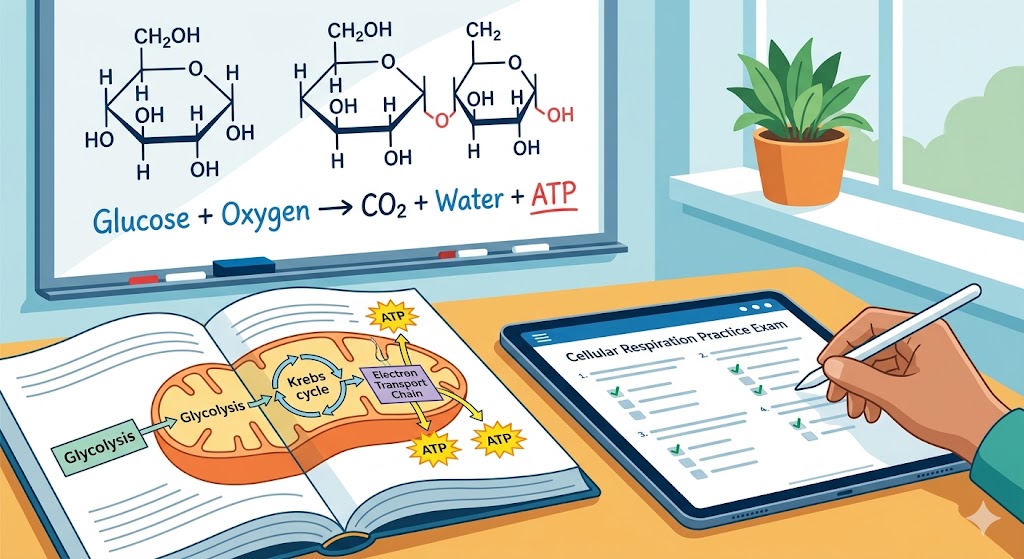
Additional Information
What the Course Entails and
Exam Details
This practice test encompasses
the full spectrum of aerobic and anaerobic pathways involved in the oxidation
of glucose for ATP production. Mastery of this subject requires a deep dive
into several complex biochemistry stages. The core curriculum covered includes
the following major topics: Glycolysis, the universal first step in the
cytosol; the Transition Reaction (Pyruvate Oxidation); the Citric Acid Cycle
(also known as the Krebs Cycle), taking place within the mitochondrial matrix;
and the Electron Transport Chain and Oxidative Phosphorylation, located on the
inner mitochondrial membrane. Additionally, students must understand Anaerobic
Respiration and Fermentation processes. The exam details focus heavily on
chemical inputs and outputs for each stage, the specific cellular locations
where these reactions occur, the role of electron carriers like NAD+ and FAD,
enzyme regulation, and the overall net yield of ATP in different scenarios.
What to Expect in the Final Exam
While this is a practice test,
it is modeled after typical high-stakes academic examinations to provide a
realistic experience. The "final" mock exam primarily utilizes a
multiple-choice format, as this is the standard for testing broad content
knowledge efficiently. However, to ensure deep conceptual mastery, it often
includes free-response or short-answer synthesis questions that require you to
draw metabolic pathways, explain the effects of specific inhibitors (like
cyanide), or calculate potential ATP yields based on provided scenarios. The
passing score requirement is typically set at 75% for this practice level to
ensure proficiency. A recommended time limit of 90 minutes is suggested for
completion, mirroring the time pressure of an actual AP or collegiate mid-term
exam, encouraging you to manage your time effectively between quick recall
questions and complex analysis.
How to Study and Exam Centers
Effective preparation for the
Cellular Respiration Practice Test requires active learning rather than passive
reading. We highly recommend utilizing visual aids; draw out the entire map of
respiration on a whiteboard multiple times until you can do it from memory,
noting where molecules enter and exit. Utilize the practice test not just once,
but iteratively. Take the test, note which questions you missed, and restudy
those specific pathways before attempting it again. Study groups are excellent
for explaining the electron transport chain to peers, which is the best way to
verify your own understanding. As this is a practice examination, it is
administered entirely online via our accessible educational portal. There are
no physical testing centers like Pearson VUE required for this specific
practice version. You can take this test from the comfort of your home or
library at any time that fits your study schedule, providing maximum
flexibility.
Job Opportunities from the Course
A strong grasp of fundamental
biological processes like cellular respiration is not just an academic
requirement; it is the vital foundation for numerous high-demand career paths
in health, research, and industry.
- Medical Doctor (MD/DO)
- Registered Nurse (RN) or
Nurse Practitioner
- Biomedical
Researcher/Laboratory Scientist
- Biotechnologist
- Pharmaceutical R&D
Specialist
- High School Biology Teacher
- Physician Assistant
- Genetic Counselor
- Forensic Scientist
- Environmental Biologist
Frequently Asked Questions
Reviews
5.0
Based on 0 reviews
Leave a Review
No reviews yet. Be the first to review!