
Central Services Sterile Technician Certification Practice Exam
$69.00
- Buy to unlock unlimited access to all Quiz questions and Answers in this Quiz.
- After purchase you can print a PDF of the whole quiz at any point. The PDF will contain the questions and the correct answers.
About this Exam
Welcome to your first step
toward a vital career in healthcare. The Sterile Technician Certification Exam
validates the specialized knowledge required to work in a Central Services or
Sterile Processing Department (SPD). Technicians are the unsung heroes of
patient safety, responsible for the cleaning, decontaminating, sterilizing, and
packaging of surgical instruments and medical equipment. This
certification—often pursued through organizations like HSPA or CBSPD—is
designed for entry-level professionals seeking to prove their competence and
for experienced technicians aiming to standardize their skills. By passing this
exam, you demonstrate to employers that you possess the critical technical
skills needed to prevent healthcare-associated infections and ensure surgical
success.
Ready to test your knowledge?
Buy Now to Access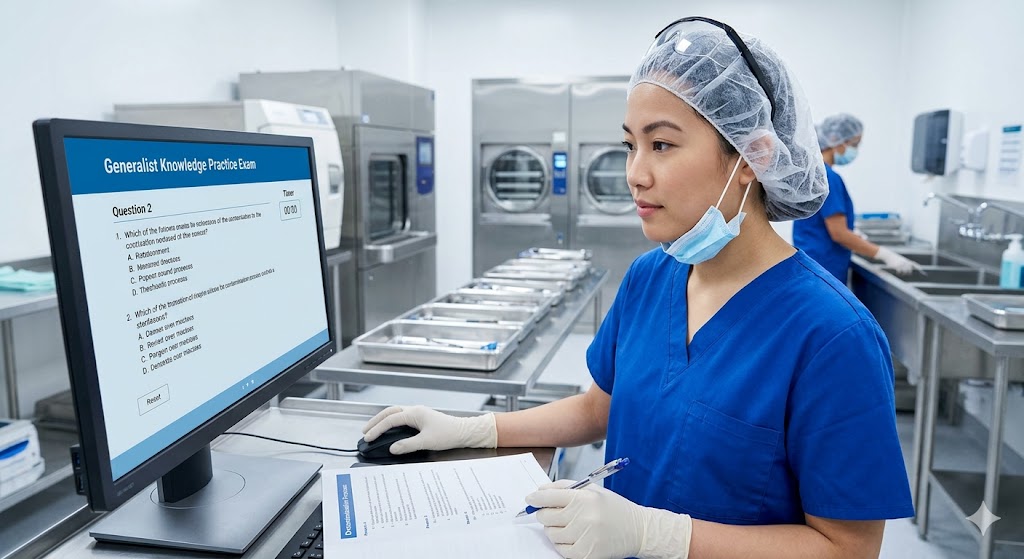
Additional Information
What the Course Entails and
Exam Details
To prepare for this
certification, you will need to master a broad range of generalist knowledge
areas. A standard preparation course or self-study regime covers the entire
lifecycle of a medical instrument. The core syllabus includes comprehensive
training in decontamination processes, understanding the different methods of
sterilization (such as steam, low-temperature, and ethylene oxide), and the
principles of infection prevention. Students must become fluent in medical
terminology, basic human anatomy, and microbiology to understand how to
effectively combat pathogens. Furthermore, the coursework details proper
methods for instrument assembly, packaging standards, and the meticulous
documentation required for quality assurance and regulatory compliance within
the Central Services environment.
What to Expect in the Final Exam
While the exact structure may
vary slightly between certifying bodies, the generalist knowledge exam is
typically a rigorous, computer-based test. Candidates should expect to face
between 100 and 150 multiple-choice questions designed to test both theoretical
knowledge and practical application scenarios. You are generally allotted three
hours to complete the examination. To pass, you will need to achieve a scaled
score, commonly set around 70 or higher. You will likely be required to bring
valid identification to the testing site, and electronics, study materials, and
personal belongings are strictly prohibited inside the testing room.
Provisional certification options may exist for those who have passed the exam
but are still completing their required hands-on experience hours.
How to Study and Exam Centers
Preparation is the cornerstone
of success for this comprehensive exam. We highly recommend starting with a
foundational textbook approved by your chosen certifying body. Complement your
reading with active study methods: create detailed flashcards for medical
terminology and sterilization parameters, join dedicated study groups to
discuss complex scenarios, and utilize this generalist knowledge practice exam
repeatedly to simulate the testing experience. Taking multiple practice tests
will help you identify your weak points and manage your time effectively. When
you are ready to test, you will register through the website of your chosen
certifying organization. These exams are typically administered at authorized,
secure testing centers, such as Pearson VUE, which have locations globally,
ensuring a standardized testing environment for all candidates.
Job Opportunities from the Course
Earning your Sterile Technician
Certification unlocks numerous career paths in the high-demand field of
healthcare sterile processing. This credential is often preferred, or even
required, by hospitals, ambulatory surgery centers, and specialized clinics.
Below are some specific job titles and career paths this certification can
unlock.
Career Opportunities:
- Certified Sterile
Processing Technician (CRCST or CSPDT)
- Central Services Technician
- Surgical Instrument
Specialist
- Medical Equipment Preparer
- Decontamination Technician
- SPD Lead Technician
- Sterile Processing
Supervisor
- Infection Control Liaison
- Medical Device Sales Rep
(Specializing in Surgical Instruments)
- Central Services Manager
Frequently Asked Questions
Reviews
5.0
Based on 0 reviews
Leave a Review
No reviews yet. Be the first to review!