
Certamen for Beginners Practice Exam
$69.00
- Buy to unlock unlimited access to all Quiz questions and Answers in this Quiz.
- After purchase you can print a PDF of the whole quiz at any point. The PDF will contain the questions and the correct answers.
About this Exam
The Certamen for Beginners
Practice Exam is a specialized study resource designed for students who are
new to the exciting, fast-paced world of Certamen. "Certamen" is a
Latin word meaning "competition," and it refers to a quiz-bowl style
competition that tests knowledge of the ancient classical world, including the
Latin language, Roman history, culture, and classical mythology. This practice
exam is explicitly created for the "Beginner" (also known as
"Novice" or "Level I") division, which is typically for
students who are in their very first year of formal Latin instruction. It
offers a simulated environment to help students practice their recall speed,
accuracy, and understanding of the core topics they will encounter in a live
match. This resource is designed to be engaging and confidence-boosting,
helping new classicists transition from classroom learning to successful
competitive play.
Ready to test your knowledge?
Buy Now to Access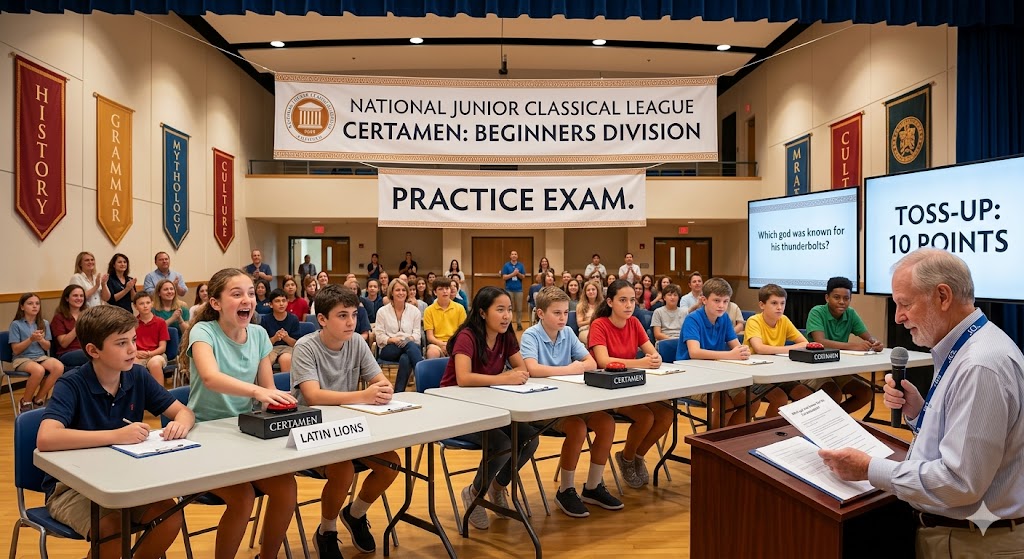
Additional Information
What the Course Entails and Exam Details
While not a "course"
itself, the Certamen for Beginners Practice Exam covers the essential
syllabus that a first-year Latin student should master to be competitive at the
local and state levels of Certamen. The material is aligned with the typical
curriculum of a beginning Latin class, with an emphasis on the foundational
elements.
The practice exam details cover
the following core areas:
- Latin Grammar: This
is the most critical component, often making up half of all Certamen
questions. For beginners, this includes knowledge of the five noun
declensions (primarily 1st, 2nd, and some 3rd), standard verb conjugations
(1st, 2nd, and 3rd-io, in the present, imperfect, and perfect tenses),
subject-verb agreement, basic sentence structure, and use of cases
(nominative, genitive, dative, accusative, ablative).
- Latin Vocabulary and
Derivatives: Students must have a quick recall of a standard set of
beginning Latin vocabulary words, as well as an understanding of English
words derived from those Latin roots.
- Roman History: The
beginner level typically focuses on major events and figures of the Roman
Monarchy and the early Republic. Key topics often include the seven kings,
the founding of Rome by Romulus and Remus, the conflict with the Sabines,
the expulsion of the Tarquins, and major early Republic heroes and
battles.
- Roman Culture and Daily
Life: This covers a wide range of topics that illustrate how ancient
Romans lived. Expected knowledge includes Roman clothing (toga, tunica,
stola), typical meals and dining customs, types of housing (domus,
insulae, villa), educational practices, major Roman festivals and games
(ludi), and important geographical locations within the ancient city and
empire.
- Classical Mythology:
The mythology component for beginners focuses on the main Olympian gods
and goddesses, their symbols, and the most iconic stories, such as the
adventures of Hercules, Perseus, and the Iliad/Odyssey (with a focus on
the Roman interpretations, e.g., Jupiter instead of Zeus).
What to Expect in the Final Exam
The actual Certamen Final
Exam is not a paper-and-pencil test but rather a dynamic, live competition.
The practice exam aims to simulate this format as closely as possible in a
written or online structure. In a real match, three teams of up to four
students compete at a table, equipped with a buzzer system.
A single level, such as the
Beginner division, usually consists of three rounds of play. Each round
contains 20 question sets.
- Toss-up Questions:
Each set begins with a "toss-up" question, which is worth 10
points. The question is read aloud to all players, and any player who
thinks they know the answer may "buzz in" and signal. Team
members cannot confer with each other at any point on a toss-up question.
If a player answers correctly, they earn 10 points for their team and the
opportunity for their team to answer two bonus questions. If the answer is
incorrect, the question becomes a "free toss-up" for the other two
teams, who can still buzz in.
- Bonus Questions:
Each correct toss-up leads to two associated "bonus questions,"
worth 5 points each. For bonus questions, the entire four-person team can
confer together before providing a response. The team captain or their
designee must deliver the final answer.
- Final Score: There
is no single "passing score" for a Certamen match. The team with
the highest point total at the end of the round wins. For practice exams,
it is more beneficial to track your percentage of correct answers in both
the toss-up and bonus categories to identify your strengths and
weaknesses.
How to Study and Exam Centers
Preparation for Certamen
requires consistent, focused study and extensive practice. The key to success
is developing both deep knowledge and fast recall.
- Actionable Study
Strategies:
- Specialization:
Encourage your team members to become "specialists" in one of
the key areas (e.g., mythology, history, grammar, culture). While every
team member should have a strong base of grammar, having focused experts
on specific topics makes the team more effective.
- Flashcards and Drills:
Create or use digital flashcard sets (like Quizlet) for vocabulary, verb
forms, noun declensions, historical timelines, and major mythological
figures.
- Study Guides and
Textbooks: Refer regularly to your classroom materials, but also seek
out dedicated Certamen study resources, such as the beginner packets from
the National Junior Classical League (NJCL) and various state JCL
chapters. These guides often provide high-yield facts, vocabulary lists,
and sample questions.
- Simulated Practice:
The best way to prepare is with regular, timed practice. Use the Certamen
for Beginners Practice Exam to get comfortable with the types of
questions and the time pressure. If possible, practice with a real buzzer
system to mimic the physical experience of competition.
- "Buzzer
Practice" Techniques: Practice buzzing in on common opening
phrases and "trigger words." A skilled Certamen player can
often correctly answer a question after hearing only the first few words.
- Exam Centers and How to
Register:
- Certamen Matches: A
Certamen competition is not taken at a centralized "testing
center" like Pearson VUE. Instead, they are held at various host
schools (both middle and high schools) for local and state-level meets.
- Registration: Your
Latin teacher or JCL (Junior Classical League) sponsor is responsible for
registering your team for upcoming competitions. They will receive the
information about dates, locations, and fees directly from the organizing
JCL chapter.
- Practice Exams: A
practice exam can be administered in a variety of ways: as a classroom
resource provided by your teacher, as a tool on a study website, or as a
resource shared within your JCL chapter. This Certamen for Beginners
Practice Exam is designed to be a flexible study guide that you can
use at your own pace.
Job Opportunities from the Course
While participating in Certamen
does not unlock specific jobs on its own, excelling in a rigorous academic
competition focused on classical studies is a strong addition to a resume. It
demonstrates qualities that are highly valued by universities and employers,
including disciplined study, critical thinking, rapid problem-solving, and a
commitment to understanding the foundations of Western civilization.
Success in Certamen can be the
first step on a pathway toward a number of impactful and intellectually
challenging careers, such as:
- Latin and Classical
Studies Educator: Teaching Latin at the middle or high school level,
or as a professor at a university.
- Historian or Archivist:
Specializing in ancient history, with a focus on classical archaeology,
literature, or art history.
- Lawyer: The
analytical skills and precise attention to detail developed in studying
Latin grammar and translation are excellent preparation for the legal
field.
- Librarian or Information
Specialist: Managing and interpreting complex classical texts and
resources.
- Curator: Working in
museums that house classical antiquities.
- Publisher or Editor:
Specializing in classical texts and educational materials.
- Policy Analyst:
Applying insights from ancient governance and political philosophy to
modern situations.
Frequently Asked Questions
Reviews
5.0
Based on 0 reviews
Leave a Review
No reviews yet. Be the first to review!