
Certificate in Emergency Response Ambulance Driving
$69.00
- Buy to unlock unlimited access to all Quiz questions and Answers in this Quiz.
- After purchase you can print a PDF of the whole quiz at any point. The PDF will contain the questions and the correct answers.
About this Exam
Embarking on a career in
emergency services requires more than just medical knowledge; it demands
exceptional driving skills and unwavering safety under pressure. The
Certificate in Emergency Response Ambulance Driving (CERAD) Level 3
qualification is the professional standard in the UK for frontline ambulance
drivers. This certification is designed for prospective emergency care
assistants (ECAs), ambulance drivers, and even paramedics who must demonstrate
the capability to respond to incidents efficiently and safely, balancing speed
with caution under both routine and blue-light conditions. Preparing
effectively with comprehensive practice is your first crucial step towards
achieving this career milestone.
Ready to test your knowledge?
Buy Now to Access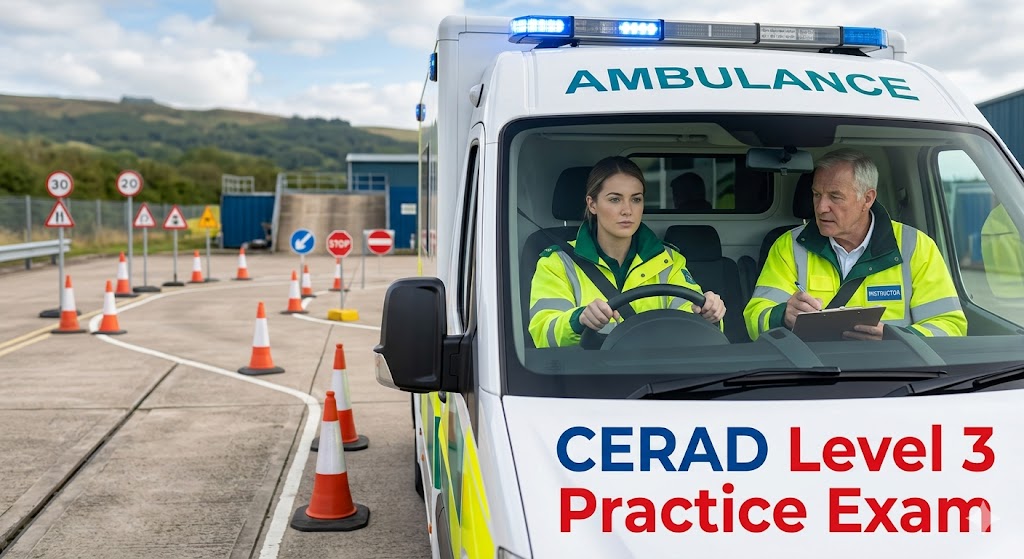
Additional Information
What the Course Entails and
Exam Details
The CERAD Level 3 course is
intensive and comprehensive, covering theoretical knowledge and significant
practical application over several days or weeks of training. Learners deep
dive into advanced driving techniques, the critical legal exemptions allowing
emergency vehicles to navigate traffic differently, and the strict rules
governing blue-light and siren usage. You will master extensive daily vehicle
inspections (VDI) to ensure your ambulance is always roadworthy, study the
latest Road Traffic Legislation, and understand complex concepts like risk
assessment and dynamic hazard perception. The course also addresses the
physiological and psychological factors affecting driver behavior in
high-stress scenarios. Crucially, your training will culminate in assessments,
and resources like "CERAD Level 3 Exam 2 Practice" are invaluable
tools designed to test your understanding of key theory and prepare you for
practical evaluations, often covering topics vital for progressing to
high-speed driving assessments.
What to Expect in the Final Exam
While CERAD Level 3 involves
ongoing assessment, you can typically expect a substantial theory exam and
rigorous practical driving assessments.
Theory exams, potentially
part of an "Exam 2" or equivalent, are often multiple-choice,
time-limited, and comprehensively test your knowledge of advanced driving
principles, traffic laws, blue-light procedures, and vehicle maintenance.
You will need a strong
understanding and typically achieve a high passing percentage to demonstrate
competence in these essential concepts.
The practical assessment is
where you truly put your skills to the test under the expert observation of
accredited assessors.
Expect to be evaluated on
smooth vehicle control, efficient navigation, systematic risk management, and
precise execution of maneuvers.
Crucially, your performance
during simulated or real emergency response scenarios on diverse road types
will be scrutinized.
Assessors focus on your
ability to make safe, decisive choices while using blue lights and sirens
responsibly and adhering strictly to all traffic rules unless legally exempt,
maintaining composure throughout the drive.
Safety is paramount; major
errors or unsafe driving will result in a failure, reinforcing that passing
depends on demonstrating consistent, responsible capability rather than just a
score.
How to Study and Exam Centers
Effective preparation is key,
and structured practice will make all the difference.
For the theory components,
leverage official training materials, comprehensive manuals like the Highway
Code and any service-specific emergency response guides, and dedicated online
resources like "CERAD Level 3 Practice Exam" mock questions and
guides.
Regularly testing yourself
with practice questions under timed conditions will build knowledge and
confidence for the actual theory test.
For the practical
assessments, consistent, quality coaching from accredited instructors is
absolutely vital.
They will guide you through
advanced driving techniques, provide invaluable feedback, and help you refine
your skills in real-road and potentially simulator scenarios.
Make the most of every
practice session, focus on developing smooth control, anticipation, and
proactive hazard detection.
Get familiar with the routes
and vehicle types you might use, and visualize navigating complex scenarios
safely and efficiently.
CERAD Level 3 exams and
practice assessments are generally conducted by qualified assessors within
accredited training providers, emergency services’ internal training
departments, and specific training or test centers equipped with approved
routes and training grounds across the UK.
Your training provider will
arrange for your practical evaluations at suitable locations upon successful
completion of training and requisite theory components.
Job Opportunities from the Course
A CERAD Level 3 qualification
is a significant asset that opens doors to exciting and impactful roles within
both the NHS and private healthcare sectors.
- Emergency Care Assistant
(ECA): Provide essential support to paramedics and other clinicians while
expertly driving ambulances to incidents under varied response conditions.
- Ambulance Driver:
Specialize in safely transporting patients in both routine and emergency
scenarios, often working as part of a crew in frontline services or
private companies.
- Paramedic (Driving
Component): Qualified paramedics must satisfy strict driving requirements,
often including CERAD 3 or equivalent, to fulfill their complete clinical
and operational responsibilities on the road.
- Private Ambulance
Service Driver: Roles within private companies contracted to the NHS or
providing event support often require this high standard of emergency
driving certification for their responding crews.
- Patient Transport
Service (PTS) Driver: While often requiring a different focus, possession
of advanced driving skills demonstrated by qualifications like CERAD can
enhance your profile or lead to opportunities in urgent or high-acuity
patient transport within PTS structures.
Frequently Asked Questions
Reviews
5.0
Based on 0 reviews
Leave a Review
No reviews yet. Be the first to review!