
Certificate of Merit (CM) Piano Theory Level 10 Practice Test
$69.00
- Buy to unlock unlimited access to all Quiz questions and Answers in this Quiz.
- After purchase you can print a PDF of the whole quiz at any point. The PDF will contain the questions and the correct answers.
About this Exam
The Music Teachers'
Association of California (MTAC) Certificate of Merit® (CM) is a prestigious
and rigorous evaluation program designed for serious music students.
It provides a structured
syllabus that measures a student’s progress and achievement in various musical
disciplines.
The Level 8 Piano evaluation
represents an advanced stage of study, designed for dedicated pianists who have
mastered intermediate skills and are moving toward pre-professional competency.
This level requires
comprehensive understanding and execution, validating that the student has
reached a milestone of advanced technical ability and musical knowledge.
It is a critical stepping
stone for musicians aiming for the final "Panel" levels and
collegiate music studies.
Ready to test your knowledge?
Buy Now to Access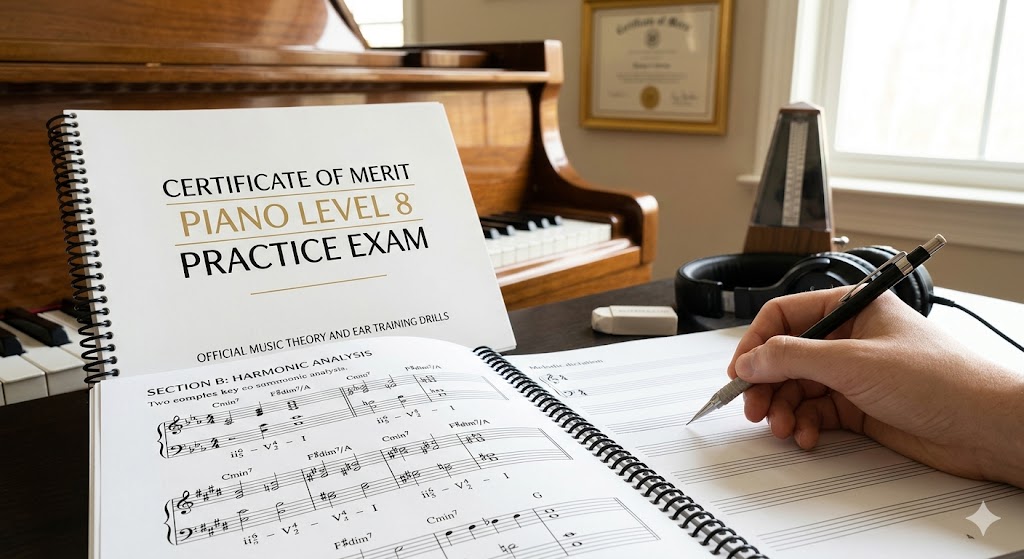
Additional Information
What the Course Entails and
Exam Details
To succeed at Level 8,
students must master a sophisticated range of musical concepts. The core
syllabus for Level 8 Piano includes:
Theory: Mastery of advanced
music theory, including all major and minor (natural, harmonic, melodic) key
signatures up to seven sharps and flats. Comprehensive understanding of
intervals (Major, minor, Perfect, Augmented, diminished) and complex compound
intervals. Detailed Roman numeral analysis of advanced harmonic progressions,
including all inversions of triads and common seventh chords (such as dominant
7th, diminished 7th, and major/minor 7th). Rhythmic concepts include tuplets
and mixed/complex meters. Advanced musical terms and a foundational
understanding of musical forms like Sonata-Allegro, Rondo, and Theme and
Variations.
Technique: Level 8 demands
flawless execution of advanced technical exercises, including multiple-octave
scales and arpeggios at specific tempos, utilizing all keys. This includes
contrary motion, four-note chords, and more intricate technical patterns.
Repertoire: Students must
prepare and perform several pieces from memory, selected from different musical
eras (Baroque, Classical, Romantic, and Impressionist/Contemporary). These
selections are drawn from a comprehensive, pre-approved list and demonstrate
refined interpretive skills, advanced dynamic control, and artistic maturity.
Sight Reading: The exam
requires fluid and expressive sight reading of music appropriate for the Level
8 standard, often involving multiple voices, complex rhythms, and modulation.
Ear Training: A separate
aural skills evaluation that includes identifying complex melodic dictation,
advanced chord progression recognition, interval identification (both melodic
and harmonic), and rhythmic patterns.
What to Expect in the Final
Exam
The full Certificate of Merit
evaluation is a multi-part exam typically administered in a single assessment
period. The real exam has three main components: Practical (Performance),
Technique, and Theory.
Theory Examination Format: The
Theory portion of the exam is a comprehensive written test and a separate
listening (ear training) test.
- Format: The written
theory exam features multiple-choice questions, analysis of printed music
scores, and "pen-and-paper" tasks (e.g., drawing correct
noteheads on a staff).
- Ear Training: This
section is completed concurrently, requiring students to listen to
recorded musical examples and identify specific elements like intervals,
chord qualities, and melodic sequences.
- Passing Score: Students
must achieve a score of 70% or higher to pass the Level 8 Theory and Ear
Training portions. Higher scores are recognized with distinctions such as
"Excellent" and "Outstanding."
- Rules: The real
evaluation is rigorous and is overseen by designated MTAC judges and
adjudicators. Communication during the theory exam is strictly prohibited,
and official study materials cannot be used.
Practice Exam Distinction: A
practice exam (like the official ones provided by MTAC and found in study
workbooks) is specifically a tool for preparation. It mirrors the exact format,
question types, difficulty level, and timing of the actual Level 8 Theory and
Ear Training tests. It is essential for self-assessment.
How to Study and Exam Centers
Preparation for Level 8
requires structured and dedicated study over many months, not weeks.
Effective Study Strategies:
Practice with Real Exams:
Utilize official MTAC Level 8 Practice Tests, which are often bundled in
official CM workbooks. These are the gold standard for preparation. Set a timer
and simulate real test conditions.
Utilize Theory Workbooks:
Purchase and methodically complete official Certificate of Merit Level 8 Theory
Workbooks, which are specifically written to the syllabus requirements. These
offer comprehensive drills on every topic.
Dedicated Aural Practice:
Level 8 Ear Training is advanced. Utilize specialized ear training software,
apps, or websites that drill advanced intervals (including tritones and
compound intervals), four-part chord identification, and complex melodic dictation.
Regularly test yourself.
Analytical Drills: Dedicate
separate study sessions solely to Roman numeral analysis of musical scores from
various stylistic eras. Analyze every single chord, inversion, and key change
to build analysis fluency.
Consult Your Teacher: Your
MTAC teacher is your primary resource. Schedule regular time to review your
practice exams and workbook answers with them to receive targeted feedback and
clarification on complex concepts.
Finding Exam Centers:
The real Certificate of Merit
evaluations are not taken at public testing centers like Pearson VUE. They are
administered locally by branches of the Music Teachers' Association of
California (MTAC).
Annual Scheduling: The
evaluations occur annually, typically in the spring.
Registration via Teacher:
Students cannot register themselves. You must study with an MTAC-member teacher
who will enroll you for the evaluation.
Physical Locations: The
theory and practical exams are usually held at local, branch-authorized
locations, such as music schools, colleges, churches, or large private studios
within your community. Your teacher will provide the specific details regarding
your assigned testing center and scheduled time.
Job Opportunities from the Course
While Level 8 itself is not a
professional license, achieving a passing grade demonstrates significant
advanced proficiency. This milestone is a critical validation required for
subsequent professional and academic steps.
Passing Level 8 opens the
following career and educational paths:
- Private Piano Tutor
(Independent): This qualification allows you to market yourself as an
advanced piano instructor, capable of teaching intermediate to advanced
students.
- Music School Faculty
Member (Preparatory Division): Many music academies and community music
schools hire teachers who have successfully navigated standard evaluation
programs like CM Level 8.
- Collegiate Music Studies
Candidate: Level 8 proficiency is a typical benchmark required for
successful audition and theory placement into university music performance
and education programs.
- Collaborative Pianist
(Intermediate-Advanced): Validates the fundamental skill set needed to
begin collaborating with choral ensembles, other instrumentalists, or
student soloists at an intermediate-to-advanced level.
- Church Pianist /
Musician: Level 8 demonstrates the advanced reading and harmonic analysis
skills required to serve as a pianist in religious organizations.
- Advanced Music Student /
Academic Milestone: Reaching Level 8 provides concrete proof of advanced
study on high school and college applications.
- Theory Teaching
Assistant / Tutor: Your advanced knowledge qualifies you to tutor
lower-level theory students (Levels 1–7) or serve as a teaching assistant.
- Pathway to 'Panel' Level
/ Diploma: Successful completion of Level 8 is the prerequisite gateway
for students aiming to achieve the Panel Level, which is the highest
academic honor the CM program offers and a near-professional
accreditation.
Frequently Asked Questions
Reviews
5.0
Based on 0 reviews
Leave a Review
No reviews yet. Be the first to review!