
Certification for Orthotic Fitters Practice Exam
$69.00
- Buy to unlock unlimited access to all Quiz questions and Answers in this Quiz.
- After purchase you can print a PDF of the whole quiz at any point. The PDF will contain the questions and the correct answers.
About this Exam
The Certification for
Orthotic Fitters is a professional credential designed for individuals who
specialize in the fitting, adjustment, and modification of prefabricated
orthotic devices. It is an ideal path for healthcare professionals, such as
medical assistants, athletic trainers, or durable medical equipment (DME)
specialists, who want to advance their skills and focus on patient care in the
orthotics and prosthetics (O&P) field. Earning this certification,
primarily offered by the American Board for Certification in Orthotics, Prosthetics
and Pedorthics (ABC) as the Certified Fitter-orthotics (CFo), validates your
competency to independently fit a specific scope of orthoses. This practice
exam serves as a direct mirror of the final certification test, allowing you to
gauge your knowledge, build confidence, and identify key areas for further
study.
Ready to test your knowledge?
Buy Now to Access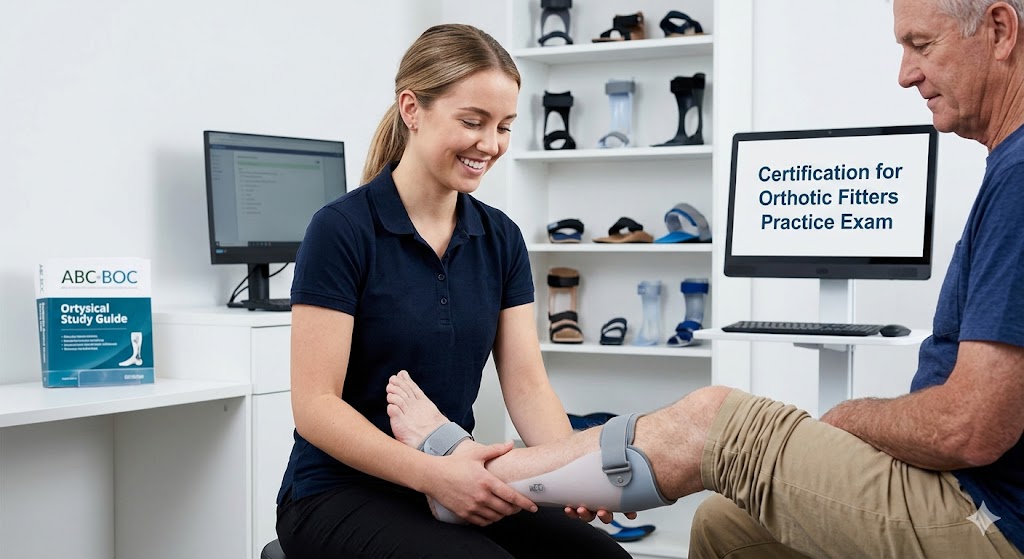
Additional Information
What the Course Entails and
Exam Details
Preparing for the Orthotic
Fitter Practice Exam involves mastering a robust body of knowledge. Most
candidates are required to complete an ABC-approved pre-certification course.
This course covers fundamental subjects such as human anatomy and physiology,
biomechanics of the lower limb, upper limb, and spine, and pathologies commonly
treated with orthoses. You will learn about various prefabricated orthotic
devices, including foot orthoses (FOs), ankle-foot orthoses (AFOs), knee
orthoses (KOs), spinal braces (e.g., LSOs, TLSOs), and upper extremity supports.
Crucially, the training emphasizes patient assessment, measurement techniques,
device selection criteria, fitting procedures, and patient education.
The practice exam itself, just
like the actual certification test, is structured around five primary practice
domains:
Patient Evaluation (30%)
Formulation of the Treatment
Plan (18%)
Implementation of the
Treatment Plan (30%)
Continuation of the Treatment
Plan (12%)
Practice Management (10%)
What to Expect in the Final
Exam
When you move from this practice
exam to the official Certification for Orthotic Fitters exam, you can
expect a comprehensive, computer-based test (CBT). For the ABC CFo credential,
the final exam consists of 125 multiple-choice questions. These questions are
designed to test not only your recall of information but also your ability to
apply clinical logic to real-world scenarios.
You will have a time limit of
two and a half hours to complete the test. The exam is administered throughout
the year, typically every other month, in a professional testing center
environment. It’s important to familiarize yourself with the rules: you will
need a valid government-issued photo ID, and no outside materials, including
calculators, are permitted during the session.
How to Study and Exam Centers
Effective preparation is the key
to success. Here are actionable study strategies to get you ready for the Orthotic
Fitter Practice Exam and the final certification test:
- Utilize the Official
Candidate Guide: The first step is to download and thoroughly review
the CFo Candidate Guide from the ABC website. It provides the official
content outline, which is your blueprint for success.
- Take Practice Exams
Multiple Times: Do not just take a practice exam once. Use it as a
diagnostic tool. Review every question you answered incorrectly,
understand the logic behind the correct answer, and revisit your study
materials in that specific area.
- Study in a Group:
Form a study group with colleagues or other candidates. Discussing complex
topics, quizzing each other, and sharing different perspectives on patient
cases can significantly enhance your understanding.
- Focus on Measurement and
Fitting Protocols: A large portion of the exam, specifically under the
Implementation domain (30%), is dedicated to proper technique. Practice
taking measurements on different body types and familiarize yourself with
the manufacturers' guidelines for fitting various prefabricated devices.
The practice exam is a flexible,
online resource that you can take anywhere with internet access. However, for
the Final Certification Exam, you must schedule it at a specialized
testing center, most commonly Pearson VUE, which has hundreds of locations
nationwide. You also have the option to take the final exam via live remote
proctoring, allowing you to test from home if you meet the technical and
environmental requirements.
Job Opportunities from the
Course
Earning your Certification
for Orthotic Fitters opens the door to numerous stable and engaging job
opportunities in various healthcare settings. This specialized credential is
widely recognized by employers in the O&P industry. Common job titles and
career paths include:
- Certified
Fitter-orthotics (CFo): The direct role for which you are certified,
working in O&P patient care facilities.
- Orthotic Fitter: A
general title in hospitals or clinics focusing on prefabricated device
provision.
- DME (Durable Medical
Equipment) Fitter: Specializing in fitting a wider range of medical
equipment, including orthoses.
- Orthotic Technician:
A role that may combine fitting with fabrication or modification work.
- Clinical Assistant:
Supporting certified orthotists and prosthetists in patient care.
- Health Technician
(Orthotic Fitter): Positions available within the U.S. Department of
Veterans Affairs (VA) hospital system.
Your journey to becoming a
certified professional starts with focused preparation. By using this study
guide and committing to practice, you are setting yourself up for a successful
career as an integral member of the healthcare team. Good luck!# Orthotic
Fitter Practice Exam
Welcome to your essential study
guide for the Orthotic Fitter Practice Exam. Successfully navigating
this practice test is a critical step towards earning your full Certification
for Orthotic Fitters, a credential that unlocks a rewarding career in
allied health. This article is designed to equip you with the knowledge and
strategies needed to excel.
Description
The Certification for
Orthotic Fitters is a professional credential designed for individuals who
specialize in the fitting, adjustment, and modification of prefabricated
orthotic devices. It is an ideal path for healthcare professionals, such as
medical assistants, athletic trainers, or durable medical equipment (DME)
specialists, who want to advance their skills and focus on patient care in the
orthotics and prosthetics (O&P) field. Earning this certification,
primarily offered by the American Board for Certification in Orthotics, Prosthetics
and Pedorthics (ABC) as the Certified Fitter-orthotics (CFo), validates your
competency to independently fit a specific scope of orthoses. This practice
exam serves as a direct mirror of the final certification test, allowing you to
gauge your knowledge, build confidence, and identify key areas for further
study.
What the Course Entils and
Exam Details
Preparing for the Orthotic
Fitter Practice Exam involves mastering a robust body of knowledge. Most
candidates are required to complete an ABC-approved pre-certification course.
This course covers fundamental subjects such as human anatomy and physiology,
biomechanics of the lower limb, upper limb, and spine, and pathologies commonly
treated with orthoses. You will learn about various prefabricated orthotic
devices, including foot orthoses (FOs), ankle-foot orthoses (AFOs), knee
orthoses (KOs), spinal braces (e.g., LSOs, TLSOs), and upper extremity supports.
Crucially, the training emphasizes patient assessment, measurement techniques,
device selection criteria, fitting procedures, and patient education.
The practice exam itself, just
like the actual certification test, is structured around five primary practice
domains:
Patient Evaluation (30%)
Formulation of the Treatment
Plan (18%)
Implementation of the
Treatment Plan (30%)
Continuation of the Treatment
Plan (12%)
Practice Management (10%)
What to Expect in the Final
Exam
When you move from this practice
exam to the official Certification for Orthotic Fitters exam, you can
expect a comprehensive, computer-based test (CBT). For the ABC CFo credential,
the final exam consists of 125 multiple-choice questions. These questions are
designed to test not only your recall of information but also your ability to
apply clinical logic to real-world scenarios.
You will have a time limit of
two and a half hours to complete the test. The exam is administered throughout
the year, typically every other month, in a professional testing center
environment. It’s important to familiarize yourself with the rules: you will
need a valid government-issued photo ID, and no outside materials, including
calculators, are permitted during the session.
How to Study and Exam Centers
Effective preparation is the key
to success. Here are actionable study strategies to get you ready for the Orthotic
Fitter Practice Exam and the final certification test:
- Utilize the Official
Candidate Guide: The first step is to download and thoroughly review
the CFo Candidate Guide from the ABC website. It provides the official
content outline, which is your blueprint for success.
- Take Practice Exams
Multiple Times: Do not just take a practice exam once. Use it as a
diagnostic tool. Review every question you answered incorrectly,
understand the logic behind the correct answer, and revisit your study
materials in that specific area.
- Study in a Group:
Form a study group with colleagues or other candidates. Discussing complex
topics, quizzing each other, and sharing different perspectives on patient
cases can significantly enhance your understanding.
- Focus on Measurement and
Fitting Protocols: A large portion of the exam, specifically under the
Implementation domain (30%), is dedicated to proper technique. Practice
taking measurements on different body types and familiarize yourself with
the manufacturers' guidelines for fitting various prefabricated devices.
The practice exam is a flexible,
online resource that you can take anywhere with internet access. However, for
the Final Certification Exam, you must schedule it at a specialized
testing center, most commonly Pearson VUE, which has hundreds of locations
nationwide. You also have the option to take the final exam via live remote
proctoring, allowing you to test from home if you meet the technical and
environmental requirements.
Job Opportunities from the
Course
Earning your Certification
for Orthotic Fitters opens the door to numerous stable and engaging job
opportunities in various healthcare settings. This specialized credential is
widely recognized by employers in the O&P industry. Common job titles and
career paths include:
- Certified
Fitter-orthotics (CFo): The direct role for which you are certified,
working in O&P patient care facilities.
- Orthotic Fitter: A
general title in hospitals or clinics focusing on prefabricated device
provision.
- DME (Durable Medical
Equipment) Fitter: Specializing in fitting a wider range of medical
equipment, including orthoses.
- Orthotic Technician:
A role that may combine fitting with fabrication or modification work.
- Clinical Assistant:
Supporting certified orthotists and prosthetists in patient care.
- Health Technician
(Orthotic Fitter): Positions available within the U.S. Department of
Veterans Affairs (VA) hospital system.
Frequently Asked Questions
Reviews
5.0
Based on 0 reviews
Leave a Review
No reviews yet. Be the first to review!