
Certified Animation Professional (CAP) Practice Test
$69.00
- Buy to unlock unlimited access to all Quiz questions and Answers in this Quiz.
- After purchase you can print a PDF of the whole quiz at any point. The PDF will contain the questions and the correct answers.
About this Exam
The Certified Animation
Professional (CAP) designation is a prestigious, industry-recognized credential
designed for aspiring and early-career animators looking to validate their
technical expertise and creative fluency. This certification signals to employers
that a candidate possesses a verified command of essential animation
principles, software workflows, and production pipelines. Whether your
specialization is 2D, 3D, or motion graphics, this practice test serves as the
critical final step in your preparation journey, helping you to identify
knowledge gaps and build the confidence necessary to pass the official exam.
Ready to test your knowledge?
Buy Now to Access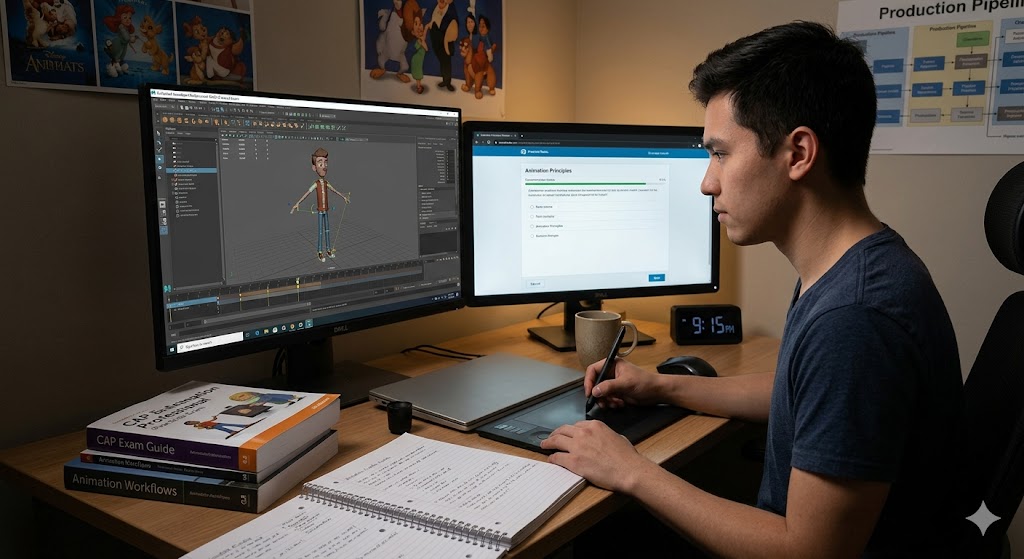
Additional Information
What the Course Entails and
Exam Details
The comprehensive CAP
curriculum covers the entire spectrum of modern animation production, ensuring
a well-rounded foundation for successful candidates. The test blueprint focuses
heavily on the application of the 12 classic principles of animation, such as
squash and stretch, anticipation, and timing. Beyond artistic theory, the exam
demands a strong understanding of technical workflows including character
design, storyboarding, 3D modeling fundamentals, rigging basics, texture
mapping, and lighting techniques. It also assesses proficiency in leading
industry software suites and the crucial management of rendering, compositing,
and final video output, ensuring you understand the complete production
lifecycle from concept to screen.
What to Expect in the Final Exam
The official CAP examination
is designed to be rigorous, requiring not just theoretical knowledge but
practical application. The exam typically presents a blend of multiple-choice
questions focusing on terminology, history, and pipeline logistics, alongside
practical, scenario-based simulation components. In these practical sections,
you may be required to demonstrate proficiency in keyframing, creating walk
cycles, or setting up a basic camera move within a simulated software
interface. Candidates are generally allotted 120 minutes to complete the exam.
While exact thresholds can vary slightly by certifying body, a passing score of
at least 75% is usually required to earn the designation, making thorough
practice with a structured guide absolutely essential.
How to Study and Exam Centers
Success on the CAP exam
requires a dual approach of focused study and hands-on practice. We highly
recommend first analyzing the official exam blueprint provided by the
certifying body to understand current weightings. Create a dedicated project to
apply every theory point—practice your rigging, your walk cycles, and your
particle effects until they become second nature. Utilize the CAP Practice Test
repeatedly to acclimatize to the question style, time constraints, and the
types of practical scenarios you will encounter. When you are ready, the
official CAP exam is typically offered through two primary channels. Many
candidates opt for the convenience of online-proctored testing, which requires
a stable internet connection and webcam. Alternatively, the exam may be
administered at authorized technical schools, creative arts colleges, or
dedicated professional testing centers specializing in technical
certifications.
Job Opportunities from the Course
Earning your Certified
Animation Professional (CAP) designation validates your skills and
significantly strengthens your resume, opening doors to a wide range of
exciting and creative career paths in the entertainment, advertising, and
digital media industries. The credentials earned through passing the CAP exam
unlock opportunities in roles such as Junior 2D Animator or 3D Character
Animator. It is an excellent stepping stone toward specialized positions like
Motion Graphics Artist and Stop Motion Animator. You can also leverage this
certification to secure roles as a Storyboard Artist, a Junior Rigger, or a
Technical Director, especially in larger production pipelines. Ultimately, this
certification proves your foundational readiness for a career as a general
Animator within visual effects (VFX) studios, game development companies, and
dedicated animation houses worldwide.Here is a comprehensive study guide and
SEO-optimized title for the Certified Animation Professional (CAP) Practice
Test, followed by a custom image based on this guide.
Certified Animation
Professional (CAP) Practice Exam
1. Description
The Certified Animation
Professional (CAP) designation is a prestigious, industry-recognized credential
designed for aspiring and early-career animators looking to validate their
technical expertise and creative fluency. This certification signals to employers
that a candidate possesses a verified command of essential animation
principles, software workflows, and production pipelines. Whether your
specialization is 2D, 3D, or motion graphics, this practice test serves as the
critical final step in your preparation journey, helping you to identify
knowledge gaps and build the confidence necessary to pass the official exam.
2. What the Course Entails
and Exam Details
The comprehensive CAP
curriculum covers the entire spectrum of modern animation production, ensuring
a well-rounded foundation for successful candidates. The test blueprint focuses
heavily on the application of the 12 classic principles of animation, such as
squash and stretch, anticipation, and timing. Beyond artistic theory, the exam
demands a strong understanding of technical workflows including character
design, storyboarding, 3D modeling fundamentals, rigging basics, texture
mapping, and lighting techniques. It also assesses proficiency in leading
industry software suites and the crucial management of rendering, compositing,
and final video output, ensuring you understand the complete production
lifecycle from concept to screen.
What to Expect in the Final Exam
The official CAP examination
is designed to be rigorous, requiring not just theoretical knowledge but
practical application. The exam typically presents a blend of multiple-choice
questions focusing on terminology, history, and pipeline logistics, alongside
practical, scenario-based simulation components. In these practical sections,
you may be required to demonstrate proficiency in keyframing, creating walk
cycles, or setting up a basic camera move within a simulated software
interface. Candidates are generally allotted 120 minutes to complete the exam.
While exact thresholds can vary slightly by certifying body, a passing score of
at least 75% is usually required to earn the designation, making thorough
practice with a structured guide absolutely essential.
How to Study and Exam Centers
Success on the CAP exam
requires a dual approach of focused study and hands-on practice. We highly
recommend first analyzing the official exam blueprint provided by the
certifying body to understand current weightings. Create a dedicated project to
apply every theory point—practice your rigging, your walk cycles, and your
particle effects until they become second nature. Utilize the CAP Practice Test
repeatedly to acclimatize to the question style, time constraints, and the
types of practical scenarios you will encounter. When you are ready, the
official CAP exam is typically offered through two primary channels. Many
candidates opt for the convenience of online-proctored testing, which requires
a stable internet connection and webcam. Alternatively, the exam may be
administered at authorized technical schools, creative arts colleges, or
dedicated professional testing centers specializing in technical
certifications.
Job Opportunities from the
Course
Earning your Certified
Animation Professional (CAP) designation validates your skills and
significantly strengthens your resume, opening doors to a wide range of
exciting and creative career paths in the entertainment, advertising, and
digital media industries. The credentials earned through passing the CAP exam
unlock opportunities in roles such as Junior 2D Animator or 3D Character
Animator. It is an excellent stepping stone toward specialized positions like
Motion Graphics Artist and Stop Motion Animator. You can also leverage this
certification to secure roles as a Storyboard Artist, a Junior Rigger, or a
Technical Director, especially in larger production pipelines. Ultimately, this
certification proves your foundational readiness for a career as a general
Animator within visual effects (VFX) studios, game development companies, and
dedicated animation houses worldwide.
Frequently Asked Questions
Reviews
5.0
Based on 0 reviews
Leave a Review
No reviews yet. Be the first to review!