
Certified Arborist Practice Exam
$69.00
- Buy to unlock unlimited access to all Quiz questions and Answers in this Quiz.
- After purchase you can print a PDF of the whole quiz at any point. The PDF will contain the questions and the correct answers.
About this Exam
Achieving the status of a
Certified Arborist marks a significant milestone for professionals dedicated to
tree care and maintenance.
This certification, awarded by
organizations like the International Society of Arboriculture (ISA), validates
your expertise in all facets of arboriculture, from species identification to
pruning techniques and diagnostic skills.
It is designed for individuals
currently working in the tree care industry who wish to formalize their
knowledge, enhance their career prospects, and establish themselves as
qualified experts.
A Certified Arborist designation
proves a commitment to high standards of tree health, safety, and sustainable
practices.
Ready to test your knowledge?
Buy Now to Access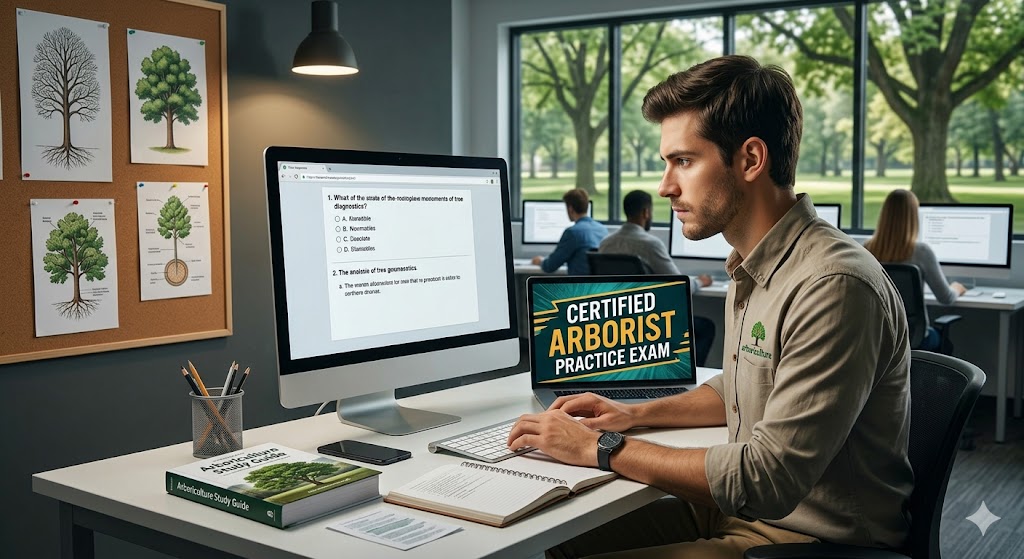
Additional Information
What the Course Entails and
Exam Details
While there may not be a single
"Certified Arborist course" that everyone takes (as it's often
knowledge accumulated through experience and self-study), the examination
covers a comprehensive body of knowledge critical to modern arboriculture.
Core syllabus topics generally
include tree biology, tree identification, and the principles of selection.
You will study essential
concepts like soil management, tree nutrition, and irrigation practices.
A significant portion is
dedicated to practical skills: proper pruning techniques, diagnosing tree
disorders, disease and insect management, and implementing structural support
systems.
Safety and work practices are
also paramount, ensuring compliance with industry standards and regulations.
What to Expect in the Final Exam
The actual Certified Arborist
Exam (not the practice version) typically consists of a combination of
multiple-choice questions and sometimes interactive scenarios.
Candidates can expect
approximately 150 to 200 multiple-choice questions covering the key domain
areas mentioned previously.
You are generally allocated
around three and a half hours to complete the examination.
A passing score is typically set
around 70-75% for each domain section, depending on the specific testing
organization, and candidates must pass the overall exam as well.
It is a computerized exam in
many settings, though paper-based options may still be available in some
locations.
No external aids are typically
allowed during the test, ensuring all knowledge comes from your preparation.
How to Study and Exam Centers
Effective preparation for the
Certified Arborist Exam involves a blend of study and practical experience.
Start by thoroughly reviewing
the certification handbook and recommended study guides, which outline the
exam's content outline.
Utilize practice exams
extensively to familiarize yourself with the question format, identify weak
areas, and manage your time effectively.
Hands-on experience in the field
is invaluable; try to connect the theoretical concepts with real-world
scenarios you encounter during tree care work.
Form study groups with other
aspiring arborists to discuss complex topics and share insights.
The exam is administered at
various authorized testing centers globally, including computer-based testing
facilities like Pearson VUE or specific organizations' physical centers.
You can often register and
choose your preferred location and time through the certification body's
website or official testing partners.
Job Opportunities from the
Course
Earning your Certified Arborist
designation opens doors to diverse and rewarding career paths within the tree
care industry and beyond. Potential job opportunities include:
- Arborist: General
professional specializing in tree health and management.
- Plant Health Care
Specialist: Focuses on diagnosing and treating plant pests, diseases,
and nutritional issues.
- Tree Climber/Arborist:
Skilled professional who performs pruning, rigging, and removal work while
climbing trees.
- Crew Leader/Foreman:
Supervises and guides tree care crews in daily operations.
- Consulting Arborist:
Provides expert advice, reports, and risk assessments for property owners,
developers, and municipalities.
- Urban Forester:
Manages trees within city environments, focusing on overall urban forest
health and planning.
- Tree Risk Assessor:
Evaluates potential tree hazards and recommends mitigation strategies.
- Landscape Supervisor:
Leads landscaping projects, integrating tree care best practices into
design and maintenance.
Utility Arborist: Manages vegetation around power lines and utility infrastructure.
Frequently Asked Questions
Reviews
5.0
Based on 0 reviews
Leave a Review
No reviews yet. Be the first to review!