
Certified Billing and Coding
$69.00
- Buy to unlock unlimited access to all Quiz questions and Answers in this Quiz.
- After purchase you can print a PDF of the whole quiz at any point. The PDF will contain the questions and the correct answers.
About this Exam
The Certified Biomedical
Equipment Technician (CBET) designation is the premier certification for
healthcare technology management (HTM) professionals. This certification is
awarded by the Association for the Advancement of Medical Instrumentation
(AAMI) Credentials Institute (ACI). It validates a technician's skill,
knowledge, and experience in ensuring the safety, efficacy, and productivity of
medical equipment. If you are a biomedical technician, electronics technologist
working in healthcare, or military BMET looking to formalize your expertise and
advance your career, the CBET credential is your essential next step. It tells
employers and colleagues that you have mastered the theoretical principles and
practical procedures required to manage complex medical device systems in a
modern healthcare environment.
Ready to test your knowledge?
Buy Now to Access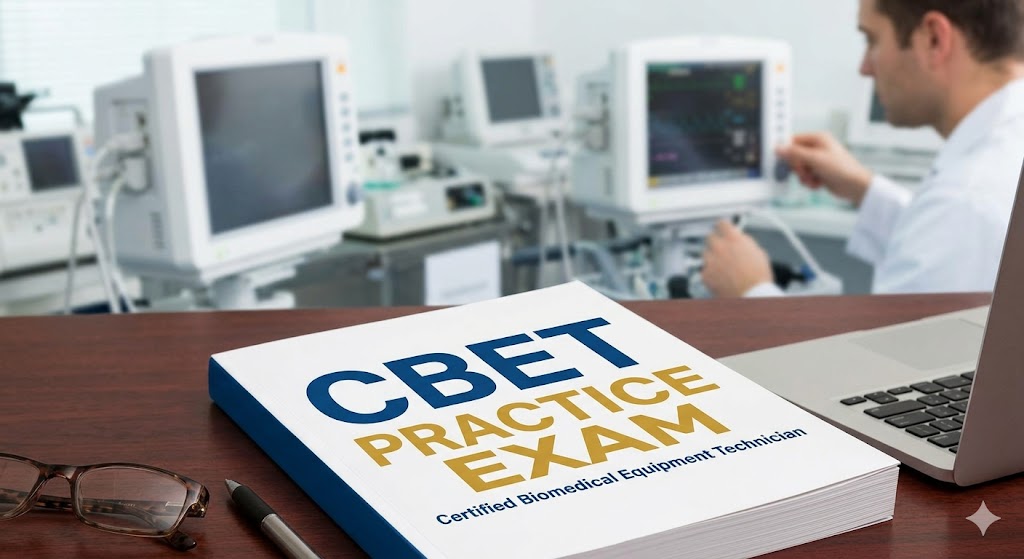
Additional Information
What the Course Entails and Exam Details
The CBET candidate is expected to have a foundational understanding of a broad spectrum of multidisciplinary topics. While there isn't a single mandatory "course," preparing for the exam entails a detailed review of the current ACI Content Outline. The core areas of knowledge and the skills covered in this comprehensive outline include:
• Anatomy and Physiology: Understanding the human body systems, basic medical terminology, and physiological concepts as they relate to medical device application.
• Public Safety in the Healthcare Facility: Mastery of safety standards such as NFPA 99, electrical safety requirements, infection control, and universal precautions.
• Fundamentals of Electricity and Electronics: Applying foundational electronic theories to voltage, resistance, current, power, and devices, including troubleshooting circuits and components.
• Healthcare Information Technology (HIT): Knowledge of networking, data security standards, troubleshooting software, hardware, and integrating medical devices with electronic medical records (EMR).
• Healthcare Technology and Function: Understanding the normal function, intended use, and technology of a vast array of medical devices, including monitoring, diagnostic, therapeutic, and life support systems.
• Healthcare Technology Problem-Solving: Applying critical thinking to identify, analyze, and resolve fault conditions in complex medical equipment efficiently and safely.
What to Expect in the Final Exam
The official CBET exam is a rigorous assessment of your HTM competence. You should expect a timed, computer-based testing experience. The final exam format exclusively uses multiple-choice questions to test your application of knowledge. Currently, the exam consists of 165 questions. You are allotted exactly three hours (180 minutes) to complete the test.
To earn your CBET certification, you must achieve a minimum passing score set by the ACI Board. This passing score is based on the number of questions answered correctly and is not a percentage. The standard passing threshold has historically been around 116 correct answers. You will receive a preliminary pass/fail report immediately after finishing, with official, detailed results mailed or emailed within a few weeks. No outside reference materials or electronic devices are permitted in the testing room, though a simple, five-function calculator might be provided or allowed depending on the center's rules.
How to Study and Exam Centers
Preparation is paramount for the CBET exam. A successful study strategy should be multifaceted and extended over several months. First, download and scrutinize the official AAMI/ACI Candidate Handbook and Content Outline. This is your master list of study topics. We highly recommend utilizing the AAMI CBET Smart Practice system, an interactive portal containing over 900 practice questions that provide instant feedback and detailed explanations.
Furthermore, consider organizing or joining a study group to discuss complex technical concepts. Dedicated CBET preparation courses are also offered by AAMI and other HTM professional organizations. You can purchase the official AAMI "BMET Study Guide" for a structured content review. For final practice, dedicate time to completing a full length "CBET Practice Exam" under simulated timed conditions to build your testing endurance and identify weak areas.
Regarding testing locations, AAMI utilizes a professional global testing network to administer the CBET exam. You do not take this exam at a university or authorized school. Instead, after your application is approved, you will register for a specific time slot at a computer-based testing (CBT) center managed by an approved partner, such as Kryterion Global Testing Solutions. These centers are located worldwide, ensuring accessibility for candidates. Some testing windows may also offer remote proctoring options, allowing you to take the exam from a secure home or office location.
Job Opportunities from the Course
Earning your Certified Biomedical Equipment Technician credential is a powerful catalyst for professional growth. This certification is frequently required for senior-level positions and is considered a differentiator when applying for competitive roles. Unlocking this credential can lead to the following specific job titles and career paths:
• Certified Biomedical Equipment Technician II / III (Senior BMET)
• Biomedical Engineering Specialist
• Clinical Engineer
• Clinical Equipment Manager
• Healthcare Technology Manager
• Field Service Engineer (for medical device manufacturers)
• Medical Equipment Sales Representative (with technical focus)
• Biomedical Informatics Specialist
• Healthcare Facilities Manager (with HTM oversight)
• Regulatory Affairs Specialist (for medical devices)
• Quality Assurance Technician (medical equipment)
• ISO/Accreditation Coordinator (HTM department)
• HTM Educator / Instructor
Frequently Asked Questions
Reviews
5.0
Based on 0 reviews
Leave a Review
No reviews yet. Be the first to review!