
Certified Cardiovascular Technician Practice Exam
$69.00
- Buy to unlock unlimited access to all Quiz questions and Answers in this Quiz.
- After purchase you can print a PDF of the whole quiz at any point. The PDF will contain the questions and the correct answers.
About this Exam
The Certified Cardiovascular
Technician (CCT) credential is a foundational certification designed for allied
health professionals who perform essential non-invasive cardiac tests. It is
administered by Cardiovascular Credentialing International (CCI) and serves as
a vital step for those looking to validate their skills in electrocardiography
(ECG), Holter monitoring, and stress testing. This certification is ideal for
EKG technicians, telemetry technicians, and monitor technicians seeking to
elevate their professional standing and demonstrate a commitment to high
standards of patient care. The CCT exam verifies your knowledge of
cardiovascular anatomy, physiology, and the ability to accurately interpret
cardiac rhythms.
Ready to test your knowledge?
Buy Now to Access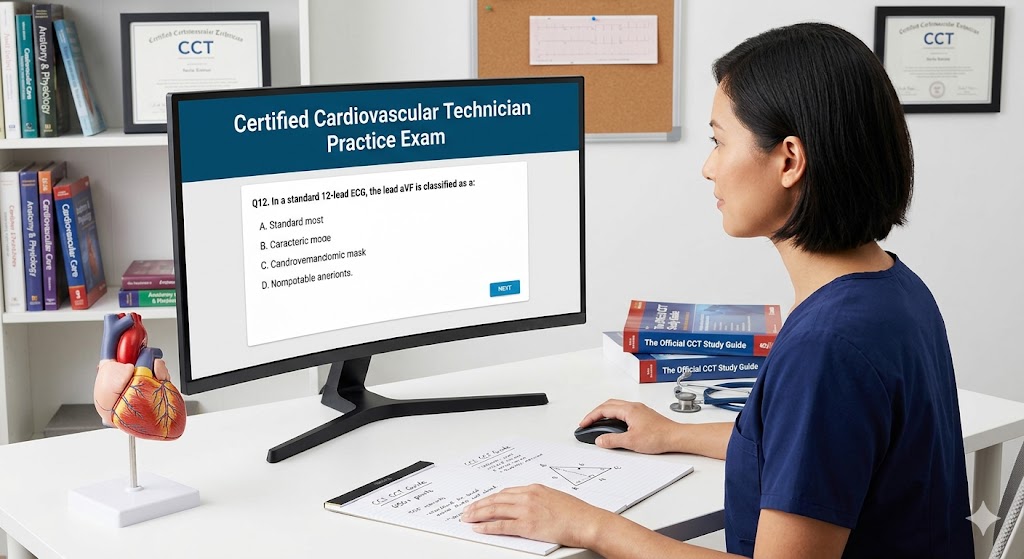
Additional Information
What the Course Entails and Exam Details
To prepare for the CCT exam, you must have a thorough understanding of non-invasive cardiac diagnostic procedures. While specific preparatory courses vary by educational institution, a robust study plan must cover the following core competencies, as outlined by CCI:
• Pre-procedural Activities (15%): Including patient standard precautions, obtaining a patient's history, and preparing the patient for testing.
• Performing Resting ECG (40%): Mastering 12-lead lead placement, modifying standard leads, and performing techniques for ambulatory monitoring.
• Analyzing Resting ECG (22%): A deep focus on rhythm identification, including sinus, atrial, junctional, and ventricular rhythms, along with various heart blocks and pacemaker function.
• Performing Stress Tests (10%): Understanding stress test protocols and safety, including the ability to recognize indications for terminating a test.
• Performing Ambulatory Monitoring (4%): Setting up and instructing patients on Holter and event monitors.
• Basic Cardiovascular Anatomy and Physiology: Knowledge of the heart's chambers, valves, blood flow, and electrical conduction system.
What to Expect in the Final Exam
The CCT exam is a comprehensive assessment that must be completed under strict proctored conditions. It is a computer-based test consisting of 130 multiple-choice questions.
Here are the specific details of the CCT final exam:
• Number of Questions: 130 (110 are scored, and 20 are unscored, pre-test questions used for future exam development).
• Time Limit: You will have 2 hours (120 minutes) to complete the test.
• Passing Score: The CCT exam uses a scaled scoring system ranging from 0 to 900. You must achieve a scaled score of 650 or higher to pass and receive your certification.
• Exam Delivery: All CCI exams are one-part exams, meaning you do not have to wait to take a separate component after finishing the first part. You will receive an unofficial score report immediately upon completion.
How to Study and Exam Centers
Effective preparation is key to passing the CCT exam on your first attempt. It is highly recommended to follow a structured study plan:
• Study Strategies: Use the official CCT examination handbook from CCI to understand the exact breakdown of knowledge areas. Create flashcards for cardiac rhythms, anatomical terms, and lead placement. Take multiple practice tests. Begin your practice without time limits and with open books to build a base. As you progress, introduce timed sessions to practice your pacing. Finally, simulate a full, timed, closed-book exam to build confidence for test day.
• Official Study Materials: Invest in the reference materials cited by CCI in their handbook. Many candidates find comprehensive textbooks on EKG and rhythm interpretation indispensable.
• Exam Centers and Modalities: The CCT exam is administered worldwide in a secure environment. Candidates can take the exam at a physical testing center through CCI's delivery partner, Pearson VUE, which has numerous physical locations globally. Alternatively, you can take the exam via online remote proctoring, allowing you to test from a private location like your home, provided you meet all hardware and environmental requirements.
Job Opportunities from the Course
Earning the CCT designation opens doors to several specialized roles in the cardiovascular field. Many healthcare facilities require or prefer this certification for employment, and it provides a strong foundation for career advancement.
The job titles and career paths this certification unlocks include:
• Certified Cardiographic Technician
• Cardiovascular Technician
• EKG/ECG Technician
• Telemetry Technician
• Cardiac Monitor Technician
• Holter Monitor Technician
• Stress Test Technician
• Cardiovascular Technologist (entry-level)
Frequently Asked Questions
Reviews
5.0
Based on 0 reviews
Leave a Review
No reviews yet. Be the first to review!