
Certified Compliance and Ethics Professional (CCEP) Certification Practice Exam
$69.00
- Buy to unlock unlimited access to all Quiz questions and Answers in this Quiz.
- After purchase you can print a PDF of the whole quiz at any point. The PDF will contain the questions and the correct answers.
About this Exam
The Certified Compliance and Ethics Professional (CCEP)
credential is a globally recognized certification that validates a
professional’s expertise in corporate compliance and ethics programs. This
certification is designed for individuals who manage, supervise, or consult in
compliance and ethics roles across any industry. By achieving the CCEP
designation, you signal to employers and stakeholders that you possess a robust
understanding of complex regulatory environments and the necessary skills to
implement, improve, and maintain an effective compliance program within an
organization. It is suitable for both those new to the field and experienced
professionals looking to validate their expertise.
Ready to test your knowledge?
Buy Now to Access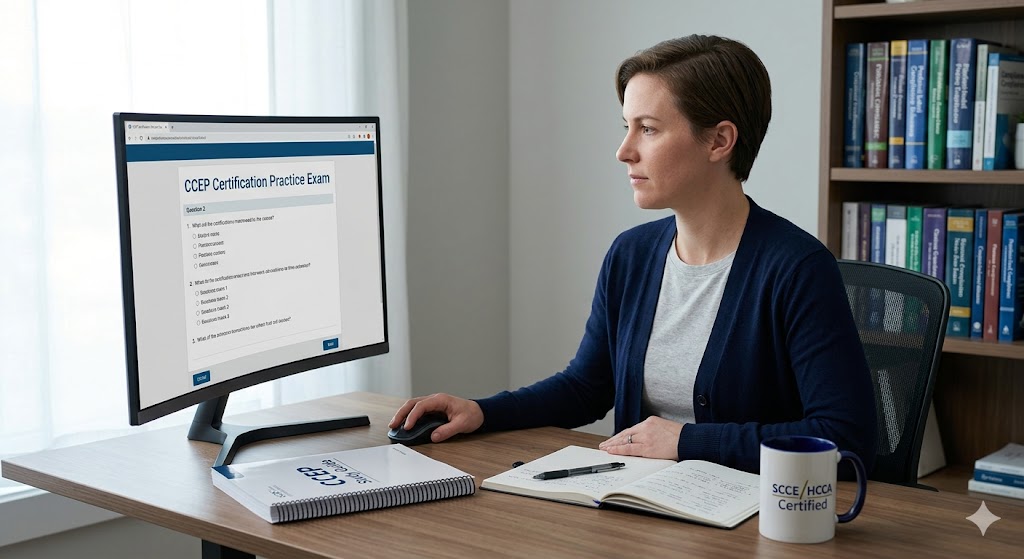
Additional Information
What the Course Entails and Exam Details
The CCEP examination does not have a single mandatory
training "course." Instead, candidates are expected to accumulate
knowledge through relevant work experience and continue their education with
specific, approved units. The exam itself tests a comprehensive body of
knowledge structured around five core domains, representing the essential
elements of an effective compliance and ethics program.
These domains include:
- Domain
1: Standards, Policies, and Procedures (approximately 20% of the exam)
covers foundational documents, conflict of interest policies, and document
retention.
- Domain
2: Compliance Program Structure and Governance (approximately 17%)
addresses reporting structures, leadership oversight, resource allocation,
and strategic planning.
- Domain
3: Training and Communication (approximately 19%) includes designing
effective training and promoting an ethical culture.
- Domain
4: Monitoring, Auditing, and Measuring Effectiveness (approximately 21%)
focuses on conducting risk assessments, monitoring systems, and reporting
metrics.
- Domain
5: Investigations, Discipline, and Remediation (approximately 23%) covers
managing hotlines, internal investigations, consistent discipline, and
whistleblower protection.
Candidates are assessed across three cognitive levels within
these domains: Recall (factual knowledge), Application (using knowledge in
specific situations), and Analysis (determining the proper action in complex
scenarios).
What to Expect in the Final Exam
The final CCEP exam is a rigorous test of your knowledge and
decision-making abilities. It consists of 115 multiple-choice questions, each
with four options. However, only 100 of these questions are scored; the
remaining 15 are unscored pretest items used for future statistical purposes.
You will have a total of 2 hours (120 minutes) to complete the entire exam.
The questions are structured to be practical. Many present
realistic workplace scenarios where candidates must identify the “BEST” course
of action, the “FIRST” step to take, or what is “MOST” important. In these
scenario-based questions, multiple answers may be technically correct, but you
must select the optimal response based on established compliance best
practices. The passing standard is determined using a standard-setting
methodology (often the Angoff method) ensuring consistency across different exam
versions. For most computer-based administrations, candidates receive their
results immediately after finishing.
How to Study and
Exam Centers
Effective preparation for the CCEP exam is key to success.
Start by thoroughly reviewing the Detailed Content Outline (DCO) provided by
the official certifying body (SCCE/HCCA). Align your study plan with the domain
weights and focus your efforts on areas where you feel least confident. Utilize
official study materials, which often include a combination of handbooks, study
guides, and online resources.
A fundamental part of your strategy must include taking a
reliable CCEP practice exam. Practice exams help you get used to the
multiple-choice format and the specific way questions are phrased, particularly
the scenario-based ones. They also serve as an excellent self-assessment tool
to pinpoint weak areas. Furthermore, join official study groups if available,
use flashcards for recall-heavy content, and practice applying ethical
frameworks to hypothetical scenarios.
The CCEP exam is administered exclusively through
standardized testing methods. You have the flexibility to take the
computer-based test (CBT) at a PSI testing center, which offers numerous
locations worldwide. Alternatively, you may choose the Remote Proctored Test
(RPT) option, allowing you to take the exam from the comfort of your home or
office while being monitored by a proctor via webcam. Paper-and-pencil exams
are also offered at select SCCE or HCCA events, though these require advance
scheduling.
Job Opportunities
from the Course
Earning your Certified Compliance and Ethics Professional
(CCEP) designation opens the door to a variety of specialized roles across
corporate, non-profit, and government sectors. The certification is frequently
requested or listed as highly desirable in job postings for professionals who
handle risk and regulatory oversight.
Potential career paths include:
Compliance Officer
Chief Compliance Officer
Director, Global Compliance
Program Manager
Compliance Manager
Senior Specialist – Ethics,
Compliance, and Privacy
Ethics Officer
Corporate Counsel / Assistant
General Counsel
Internal Auditor
Risk Manager / Chief Risk Officer
ESG Specialist (Environmental,
Social, and Governance)
Head of Trust and Safety
Pharmacy Benefits Compliance
Specialist
Delegation Oversight Associate
Compliance Specialist – Home Care / Healthcare
Frequently Asked Questions
Reviews
5.0
Based on 0 reviews
Leave a Review
No reviews yet. Be the first to review!