
Certified Diagnostic Ophthalmic Sonographer (CDOS) Practice exam
$69.00
- Buy to unlock unlimited access to all Quiz questions and Answers in this Quiz.
- After purchase you can print a PDF of the whole quiz at any point. The PDF will contain the questions and the correct answers.
About this Exam
The Certified Diagnostic Ophthalmic Sonographer (CDOS)
credential is a highly specialized certification designed for allied health
personnel who perform diagnostic ultrasound of the eye. This designation
validates a professional’s expertise in utilizing sound waves to generate
high-resolution images and precise measurements of ocular structures. The exam
and certification are particularly essential for diagnosing conditions in
patients with opaque media, such as dense cataracts or vitreous hemorrhage, where
traditional visual examination is limited. It is designed for experienced
ophthalmic medical technicians, sonographers, or other health professionals
looking to advance their careers and prove their competency in A-scan and
B-scan ultrasonography.
Ready to test your knowledge?
Buy Now to Access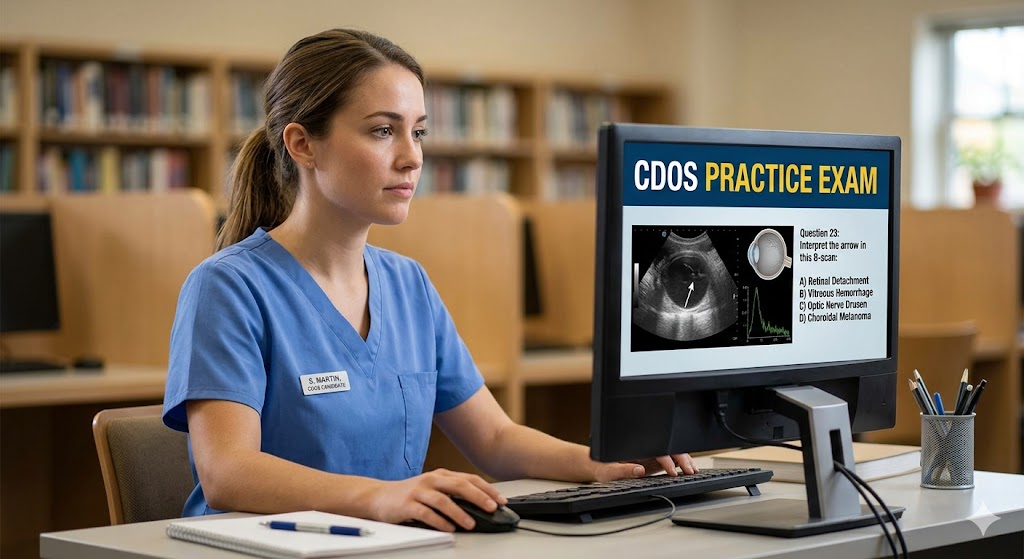
Additional Information
What the Course Entails and Exam Details
To prepare for the final CDOS exam, candidates must master a
detailed body of knowledge that covers both the technical principles and
clinical applications of ophthalmic ultrasound. The core course content and
exam syllabus encompass the following critical areas:
- Ultrasound
Physics and Instrumentation: Principles of wave propagation,
frequency, resolution, and artifact formation, as well as the operation of
A-scan, B-scan, and Ultrasound Biomicroscopy (UBM) systems.
- Ocular
Anatomy and Physiology: Detailed knowledge of all structures within
the eye, the orbit, and the extraocular muscles, along with related
physiological functions.
- Diagnostic
Techniques: Expertise in performing quantitative A-scan biometry for
axial length measurements, qualitative A-scan and B-scan for tissue
discrimination, and specialized UBM imaging of the anterior segment.
- Image
Interpretation and Pathology: Recognizing normal ultrasound anatomy
and the distinct acoustic signatures of ocular diseases, including retinal
detachment, choroidal melanoma, vitreous hemorrhage, intraocular tumors,
and optic nerve abnormalities.
- Patient
Care and Safety: Best practices for patient preparation, education,
communication, and the electrical and biological safety protocols specific
to ophthalmic ultrasound.
- Ethics
and Legal Considerations: Informed consent, patient privacy (HIPAA),
and professional standards in diagnostic reporting.
What to Expect in
the Final Exam
The final Certified Diagnostic Ophthalmic Sonographer (CDOS)
examination is a comprehensive, computer-based assessment administered by the
certifying board, typically JCAHPO (International Joint Commission on Allied
Health Personnel in Ophthalmology). While specific metrics can vary, candidates
can expect a multiple-choice format with questions that assess both theoretical
knowledge and the practical application of diagnostic skills. The exam is
rigorously timed to simulate clinical demand. Although a fixed passing score is
not always published and may adjust based on the current version of the test,
candidates must demonstrate a high level of proficiency in all content areas.
The examination focuses on critical thinking, image recognition, and the
ability to correlate ultrasonic findings with clinical outcomes. Candidates are
encouraged to review the current official JCAHPO candidate handbook for the
exact number of questions and the time limit allocated for their specific test
date.
How to Study and
Exam Centers
Effective preparation for the CDOS exam requires a
structured approach that combines classroom learning, self-study, and essential
hands-on experience. Here are actionable strategies for success:
- Utilize
Authorized Study Guides: Obtain the official exam content areas and
candidate guides provided by JCAHPO to focus your studies precisely.
- Enroll
in specialized training courses: Many professional organizations, such
as JCAHPO (through EyeCareCE) and the American Institute of Ultrasound in
Medicine (AIUM), offer workshops and online courses focused on ophthalmic
sonography.
- Master
Key Textbooks: Study foundational texts such as "Ophthalmic
Ultrasonography" and recent editions of standard ophthalmic imaging
manuals.
- Take
Practice Exams: Dedicate significant time to completing
multiple-choice practice exams to familiarize yourself with the question
style and manage your timing.
- Gain
Hands-On Experience: This is critical. The best study method is a
minimum number of documented scans in a clinical setting under the
guidance of an experienced mentor or ophthalmologist.
- Exam
Centers: The final CDOS examination is taken at independent testing
centers. The primary network used for this certification is Pearson VUE.
Candidates may schedule their exam at a Pearson VUE location after
receiving authorization from JCAHPO. Test sites are available globally,
allowing for convenient scheduling in professional, secure testing
environments.
Job Opportunities
from the Course
Obtaining the CDOS certification opens doors to specialized,
high-demand positions within the eye care industry. This credential
distinguishes you as a specialist and can significantly enhance your
employability and earning potential. Career paths and job titles for a CDOS
include:
- Certified
Diagnostic Ophthalmic Sonographer
- Ophthalmic
Ultrasound Specialist
- Lead
Ophthalmic Sonographer
- Clinical
Applications Specialist (for ultrasound equipment manufacturers)
- Clinical
Research Sonographer (focusing on ocular imaging trials)
- Ophthalmic
Diagnostic Imaging Supervisor
- Ophthalmic
Imaging Educator
Frequently Asked Questions
Reviews
5.0
Based on 0 reviews
Leave a Review
No reviews yet. Be the first to review!