
Certified Energy Manager Practice Exam
$69.00
- Buy to unlock unlimited access to all Quiz questions and Answers in this Quiz.
- After purchase you can print a PDF of the whole quiz at any point. The PDF will contain the questions and the correct answers.
About this Exam
The Certified Energy Manager (CEM) certification, awarded
by the Association of Energy Engineers (AEE), is a hallmark achievement for
professionals dedicated to optimizing the energy performance of facilities and
organizations. This comprehensive credential validates a professional's
holistic understanding of energy auditing, economic analysis, HVAC, lighting,
and sustainable systems management. It is designed for engineers, facility and
plant managers, architects, construction professionals, and environmental and
sustainability consultants seeking to lead energy efficiency initiatives and
demonstrate their specialized expertise in a rapidly evolving,
resource-conscious world.
Ready to test your knowledge?
Buy Now to Access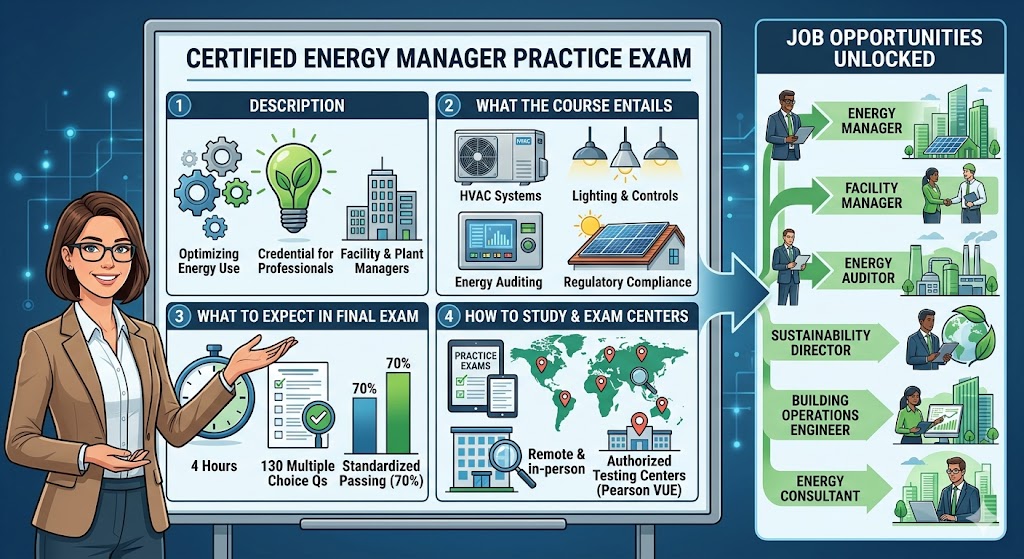
Additional Information
What the Course Entails and Exam Details
While not technically a standalone "course" in
the exam itself, the CEM credential requires candidates to possess a solid
foundation in the core Body of Knowledge (BoK). This includes understanding the
principles of energy auditing, conducting effective energy assessments, and
applying energy accounting techniques. The curriculum covers a wide spectrum of
functional areas: efficient lighting systems; heating, ventilation, and air
conditioning (HVAC); electrical systems, motors, and controls; compressed air and
refrigeration systems; renewable energy integration; thermal energy storage;
and building automation systems. Furthermore, candidates must understand energy
procurement, environmental regulations, codes and standards, and the critical
skills of energy project financing and performance contracting.
What to Expect in the Final Exam
The Certified Energy Manager exam is a robust, four-hour
assessment that tests both theoretical knowledge and practical application
across all core topics. The exam consists of 130 multiple-choice questions
administered in a proctored environment. Candidates are required to achieve a
standardized passing score, which is set at 70%. The exam typically covers
questions from over fifteen domains, requiring a balanced mastery of technical
systems, economic evaluations, and regulatory frameworks. The exam is often
computer-based and utilizes standardized testing software.
How to Study and Exam Centers
Preparing effectively for the CEM exam demands a
strategic blend of study materials and deliberate practice. The Association of
Energy Engineers offers official, multi-day preparation courses that provide a
direct review of the BoK. Beyond these, numerous reputable online portals and
authorized educational institutions offer comprehensive practice exams and
study guides designed to mimic the test format and complexity. Candidates
should prioritize reviewing the official AEE recommended readings, focusing heavily
on formulas, economic analysis calculations, and cross-disciplinary technical
concepts.
A key component of preparation is utilizing practical
study aids, such as official and unofficial Certified Energy Manager practice
exam sets, to build speed and accuracy. These resources are critical for
identifying knowledge gaps and mastering time management, given the lengthy
four-hour constraints.
The final CEM exam is typically taken in-person at
authorized Pearson VUE testing centers worldwide. Online proctored exam options
may also be available, depending on the current AEE policy, providing
flexibility for candidates to take the test remotely under secure conditions.
Specific authorized schools or physical testing centers may be listed on the
AEE website, and it is crucial to confirm availability and schedule the exam
with significant lead time.
Job Opportunities from the Course
Achieving the CEM designation unlocks a diverse array of
advanced career paths in energy, sustainability, and facility management. While
many professionals come from established engineering backgrounds, the
certification is highly valued across industries. Example job titles include:
Energy Manager; Facility Manager; Energy Auditor; Sustainability Director;
Energy Consultant; Building Operations Engineer; Utilities Manager; Senior
Commissioning Agent; Plant Manager; and Energy Efficiency Program Manager. This
credential often serves as a key prerequisite for leadership roles in
optimizing large-scale facility operations and implementing effective energy
savings programs.
Frequently Asked Questions
Reviews
5.0
Based on 0 reviews
Leave a Review
No reviews yet. Be the first to review!