
Certified Entry-Level Python Programmer (PCEP-30-02) Practice Exam
$69.00
- Buy to unlock unlimited access to all Quiz questions and Answers in this Quiz.
- After purchase you can print a PDF of the whole quiz at any point. The PDF will contain the questions and the correct answers.
About this Exam
The Certified Entry-Level Python Programmer (PCEP-30-02) is a fundamental, globally recognized certification that validates your comprehension of the core concepts of computer programming and the Python language. This qualification is strategically designed for students, absolute beginners to the world of coding, and professionals seeking a career change into IT who want to establish a strong, documented foundation. The PCEP-30-02 exam serves as the critical first step on the Python Institute's certification path, proving that you possess the essential skills necessary to write, interpret, and debug simple Python programs. By passing this exam, you demonstrate your readiness to delve deeper into more advanced programming and software development roles
Ready to test your knowledge?
Buy Now to Access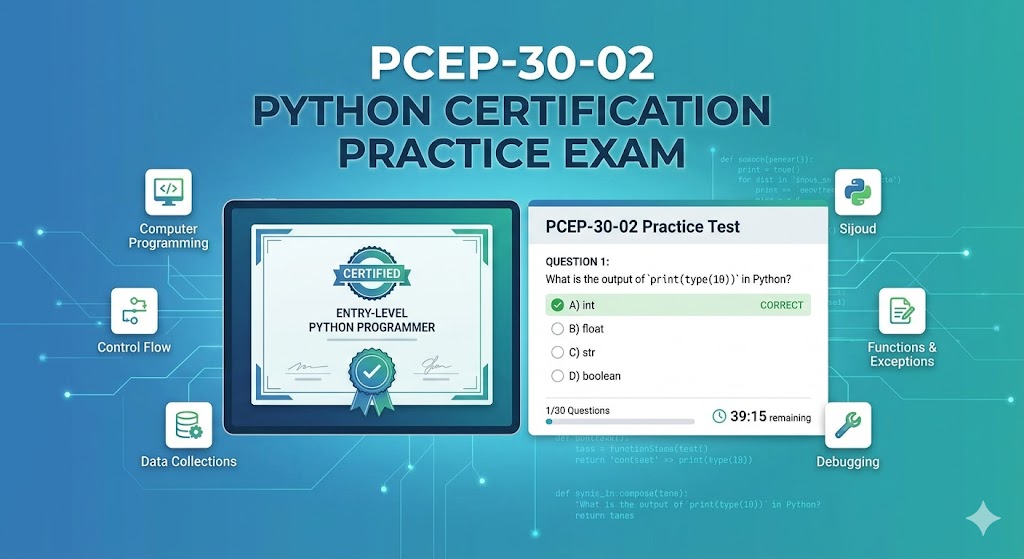
Additional Information
What the Course
Entails and Exam Details
To prepare for the PCEP-30-02 exam, candidates are
expected to master a well-defined syllabus that focuses on entry-level
programming skills. The official exam covers four primary domains, each with a
specific weightage in the final score:
- Computer
Programming and Python Fundamentals (18%): Understand the basics of
computer programming, including compilation vs. interpretation, Python's
logic and structure, fundamental data types (integers, floats, strings,
booleans), variables, literals, and the rules for constructing simple
expressions.
- Control
Flow – Conditional Blocks and Loops (29%): Master the mechanisms that
allow a program to make decisions and repeat actions. This section tests
your knowledge of conditional statements (if, if-else, if-elif-else),
loops (while, for), and control flow instructions (break, continue).
- Data
Collections – Tuples, Dictionaries, Lists, and Strings (25%): Gain
proficiency in handling Python's core data structures. This includes
creating, manipulating, indexing, and slicing lists, tuples, dictionaries,
and strings, as well as understanding their distinct properties and use
cases.
- Functions
and Exceptions (28%): Learn how to organize code into reusable components
and handle errors gracefully. This critical domain assesses your ability
to define and invoke functions, pass arguments, return values, understand
variable scope, and implement basic exception handling using try-except
blocks.
The PCEP-30-02 is a single-level, proctored (or
non-proctored, depending on delivery) exam. The detailed specifications are as
follows:
- Exam
Name: Certified Entry-Level Python Programmer
- Exam
Code: PCEP-30-02
- Question
Types: 30 single-choice and multiple-choice questions.
- Time
Limit: 40 minutes (an additional 10 minutes may be granted for non-native
English speakers if requested in advance).
- Passing
Score: 70% (700 out of 1000 points).
- Language:
English.
- Cost:
Approximately $59 USD (check the official Python Institute website for the
most current pricing and available discount vouchers).
What to Expect in
the Final Exam
When you take the final PCEP-30-02 exam, you will
encounter a challenging yet structured assessment of your foundational Python
skills. The exam will be conducted in a secure, proctored environment, ensuring
the integrity of the certification. You will have 40 minutes to answer 30
questions, which means you should aim to spend just over one minute per
question. The questions are a mix of theoretical concepts (e.g., "What is
the output of this code snippet?") and practical application (e.g., "Choose
the correct loop structure to achieve X"). The passing score of 70%
requires a strong, across-the-board understanding of all four exam domains. You
will receive your results immediately upon completion of the exam, and a
digital certificate will be issued to you shortly after passing. The exam is
designed to be fair and directly aligned with the published exam objectives, so
there are no "trick questions," only assessments of your actual
knowledge.
How to Study and
Exam Centers
Effective preparation for the PCEP-30-02 exam involves a
combination of theoretical study and extensive practical coding. Start by
thoroughly reviewing the official PCEP-30-02 exam objectives and syllabus.
Next, engage with structured learning resources. The Python Institute offers an
excellent, free, multi-part course, "Python Essentials," which is
tailored to the exam objectives and includes interactive labs. Complement this
with official study guides, beginner-friendly Python books, and reputable
online video courses on platforms like Coursera, edX, or Udemy.
However, the most critical part of your study plan should
be hands-on practice. Regularly write and run your own code snippets, solve
coding challenges on platforms like HackerRank, LeetCode (beginner problems),
or W3Schools' Python exercises. Utilize official and trusted third-party
practice exams (like those from Edusum, MyExamCloud, or the official sample
questions) to familiarize yourself with the question format, time constraints,
and identify your areas of weakness.
Exam Centers and Delivery: The PCEP-30-02 exam is
delivered through the OpenEDG (the Open Education and Development Group)
testing platform, in cooperation with its authorized testing partners.
Candidates have two main options for taking the exam:
Remote Proctoring: You can
take the exam from the comfort of your own home or office using a secure,
web-based testing system. This requires a reliable internet connection, a
webcam, and a quiet environment. OpenEDG uses a sophisticated remote proctoring
service to monitor the exam session.
In-Person Testing: Alternatively,
you can schedule and take the exam at an authorized OpenEDG testing center or
through a Pearson VUE testing center in your locality. These centers provide a
controlled environment and the necessary equipment to take the proctored test.
Some authorized schools and training providers also host exam sessions for
their students. You can register for the exam and choose your preferred
delivery method directly through the Python Institute or OpenEDG website.
Job Opportunities from the Course
Earning the PCEP-30-02 certification is a clear signal to
employers that you possess the necessary foundational skills to function
effectively in an entry-level Python-related role. While it is an
"entry-level" credential, it validates your competency and provides a
distinct advantage in a competitive job market. Here are specific job titles
and career paths this certification can unlock for you:
- Entry-Level
Python Developer: Start your career writing and maintaining simple Python
code under the guidance of senior developers.
- Junior
Python Programmer: Contribute to diverse projects, from web development to
data manipulation, using your foundational Python knowledge.
- Quality
Assurance (QA) Tester (Automated Testing): Utilize Python to create and
run automated scripts for testing software applications.
- Technical
Support Engineer (with Python Skills): Troubleshoot client issues more
effectively by understanding the codebase and scripting common tasks.
- Data
Analyst (Foundational Python): Apply Python for basic data cleaning,
analysis, and visualization tasks in a junior capacity.
- Junior
DevOps Engineer (for Automation): Use Python for automating routine system
administration tasks.
- IT
Associate: Transition into a role that requires Python knowledge for
system maintenance and process automation.
- Junior
Software Engineer (Python-focused): A stepping stone to more advanced
software engineering positions, starting with the core language.
- Technical
Writer: Combine your writing skills with technical knowledge to document
Python libraries and programs.
- Database
Administrator (with Python Scripting): Use Python to automate data backup,
migration, and management tasks.
- AI
Training Specialist (Python Coding): Join teams that use Python to create,
clean, and annotate data for training AI models.
Frequently Asked Questions
Reviews
5.0
Based on 0 reviews
Leave a Review
No reviews yet. Be the first to review!