
Certified First Responder (CFR) State Practice Test
$69.00
- Buy to unlock unlimited access to all Quiz questions and Answers in this Quiz.
- After purchase you can print a PDF of the whole quiz at any point. The PDF will contain the questions and the correct answers.
About this Exam
The Certified First Responder (CFR) designation is a
vital initial level of certification for individuals who are often the first to
arrive at the scene of a medical or traumatic emergency.
This exam is designed for aspiring personnel in fields
such as firefighting, law enforcement, workplace safety, and community
volunteering who need the official validation to provide critical, life-saving
care before a full Emergency Medical Services (EMS) team arrives.
By passing a comprehensive CFR State Practice Test, you
can confidently simulate the actual licensing exam, ensuring you possess the
knowledge and decision-making skills required for this high-responsibility
role.
This study guide acts as your blueprint to mastering the
essential components needed to succeed and begin your career in emergency
response.
Ready to test your knowledge?
Buy Now to Access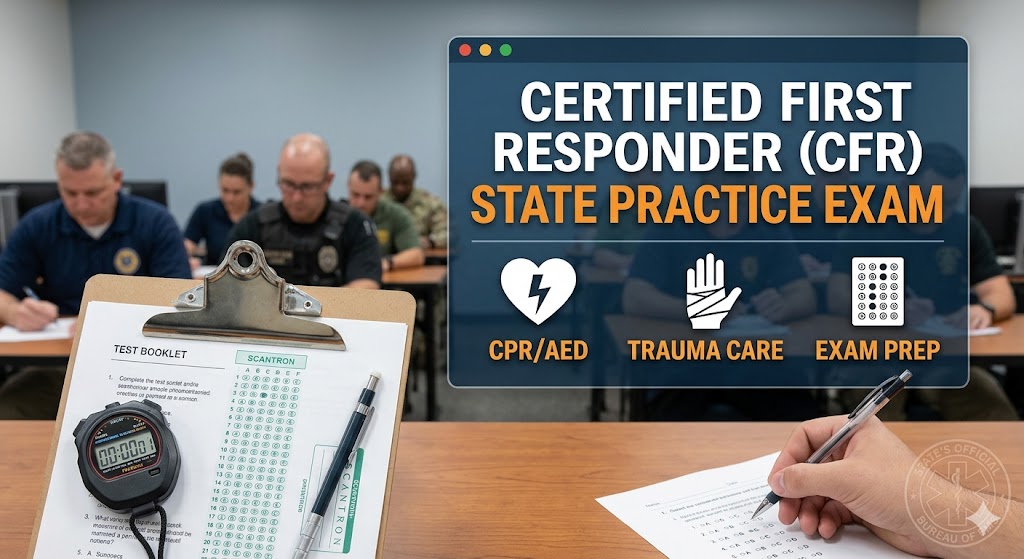
Additional Information
What the Course
Entails and Exam Details
A standard Certified First Responder course is an
intensive program that blends theoretical knowledge with hands-on skill
development.
The cognitive portion of the actual state exam—and this
practice test simulation—is focused on a standardized curriculum defined by
your specific state's Department of Health or Bureau of EMS.
The core domains you will need to master include:
- Preparatory:
EMS systems, legal and ethical issues, lifting and moving patients, and
personal safety.
- Airway:
Techniques for opening and maintaining a patient’s airway, and
administering supplemental oxygen.
- Patient
Assessment: Performing thorough initial, physical, and history-taking
assessments for medical and trauma patients.
- Circulation:
Review of CPR for all ages, including the use of an Automated External
Defibrillator (AED).
- Medical
Emergencies: Identifying and initiating care for conditions such as
respiratory distress, cardiac arrest, allergic reactions, diabetes, and
poisoning.
- Trauma:
Assessing and managing soft tissue injuries, bleeding control, shock
management, and spinal immobilization.
- Special
Populations: Overview of pediatric, geriatric, and obstetric emergencies.
- EMS
Operations: Standard protocols for responding to, interacting with, and
transferring care to other EMS providers.
The CFR state practice test is a powerful diagnostic tool
that assesses your readiness across these exact cognitive areas through
realistic multiple-choice questions.
What to Expect in
the Final Exam
While a practice test is a simulated environment,
it is designed to mirror the actual state licensing cognitive exam as
closely as possible.
Here are the typical parameters for the final state-level
written examination:
- Format:
The exam is almost universally a multiple-choice, computer-based
assessment. You will need to select the single best answer for each
question.
- Passing
Score: Though it varies by state jurisdiction, a typical passing score is
between 70% and 80%. It is critical to consult your specific state’s EMS
office for exact details.
- Time
Limit: You will be given a designated time frame to complete the exam,
commonly ranging from 1.5 to 3 hours, depending on the total number of
questions.
- Questions:
You can expect a standard exam to contain between 70 and 120 validated
questions that measure recall, application, and analysis of the CFR
curriculum.
- State
Specifics: Some state exams include additional modules on state-specific
protocols, legal variations, or the use of specific equipment.
Your best strategy is to take the practice test
seriously, strictly adhering to these time and behavioral constraints to
accurately gauge your actual preparedness.
How to Study and Exam Centers
Preparation for the CFR state licensing exam should be a
multi-faceted process. Simply taking a practice test once is not enough; you
must use it as a feedback loop.
Here is an effective study strategy:
Simulate Real Conditions:
Treat your practice test as the real exam. Set a timer, clear your workspace of
distractions, and do not use study materials. This helps build testing stamina
and reduces anxiety.
Diagnostic Review: After
completing the practice test, immediately analyze your results. Focus heavily
on your incorrect answers, not just your score. Identify the why behind
your mistakes—did you lack knowledge, or did you misread the scenario?
Targeted Study: Revisit your
textbook, course handouts, and online resources for the specific domains where
you performed poorly. Create flashcards for critical definitions and protocols.
Authorized Actual Exam
Centers: The actual state licensing exam is typically administered by a
state-authorized entity. This may include your original EMS training
institution, a community college, or a large professional testing service like
Pearson VUE or Prometric. For specific testing locations and to schedule your
exam, you must contact your state’s specific Emergency Medical Services (EMS)
office.
Practice tests for the CFR can be accessed through
approved online educational platforms and exam prep services.
Job Opportunities from the Course
Earning your state’s Certified First Responder
certification is an excellent entry point into multiple careers focused on
emergency response and public safety.
This credential is either a requirement or highly desired
for the following roles:
- Volunteer
Firefighter
- Police
Officer (required in many jurisdictions)
- Industrial
First Aid Attendant
- Campus
Security Officer
- Lifeguard
/ Aquatic Safety Staff
- National
Park Ranger / Law Enforcement Ranger
- Event
Medical Staff (for concerts, sports events)
- Ambulance
Driver (for basic services)
- Ski
Patrol Member
- Corrections
Officer
Additionally, the CFR certification serves as the
prerequisite or ideal foundation for those who wish to pursue higher levels of
training, such as Emergency Medical Technician (EMT) or Paramedic.
Frequently Asked Questions
Reviews
5.0
Based on 0 reviews
Leave a Review
No reviews yet. Be the first to review!