
Certified Flight Instructor – Instrument (CFII) Oral Practice Test
$69.00
- Buy to unlock unlimited access to all Quiz questions and Answers in this Quiz.
- After purchase you can print a PDF of the whole quiz at any point. The PDF will contain the questions and the correct answers.
About this Exam
The Certified Flight Instructor – Instrument (CFII)
certification is a crucial rating for flight instructors who wish to teach
students seeking their instrument rating. This exam focuses specifically on the
knowledge, instructional techniques, and practical application of instrument
flying procedures required to safely and effectively instruct in an IMC
(Instrument Meteorological Conditions) environment.
The CFII Oral Practice Test is designed to evaluate a
candidate’s understanding of complex instrument flight concepts, regulations,
and their ability to convey this information clearly and concisely to students.
Aspiring CFIIs, as well as current CFIs looking to expand
their teaching capabilities, will find this practice test indispensable for
assessing their readiness for the actual FAA oral exam.
Ready to test your knowledge?
Buy Now to Access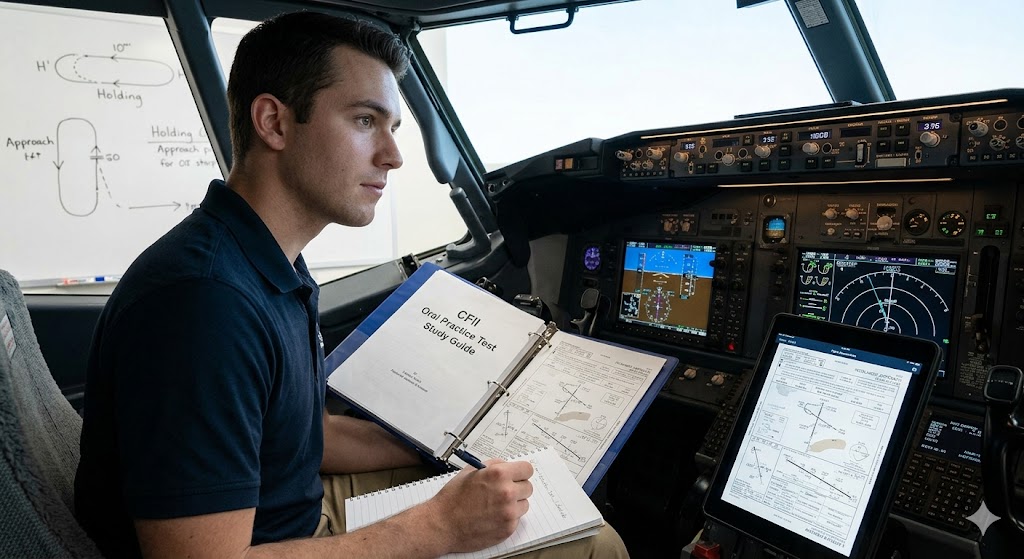
Additional Information
What the Course Entails and Exam Details
This comprehensive study guide and practice test covers the
core competencies required for the CFII rating.
The course structure typically involves in-depth study of
instrument flight fundamentals, advanced avionics, and instructional
methodologies.
Specific topics include knowledge of Federal Aviation
Regulations (FARs) pertaining to instrument flight operations, understanding
and interpreting IFR charts and publications, proficiency in navigating using
VOR, NDB, GPS, and ILS systems, mastering various instrument approach
procedures, and demonstrating the ability to effectively teach these concepts.
The exam itself evaluates the candidate's ability to analyze
and solve scenario-based problems, apply instructional techniques in an
instrument environment, and demonstrate a thorough understanding of the
physiological factors affecting instrument pilots.
What to Expect in the Final Exam
The actual CFII final exam consists of both an oral
component and a practical flight test (checkride).
The oral exam is a comprehensive discussion between the
applicant and an FAA Designated Pilot Examiner (DPE).
While there are no multiple-choice questions, the DPE will
ask scenario-based questions designed to test the applicant's depth of
knowledge and instructional abilities.
Topics covered during the oral exam include IFR regulations,
aircraft systems relevant to instrument flight, weather theory and
interpretation, IFR navigation and approaches, and holding procedures.
Applicants must demonstrate proficiency in teaching these
concepts clearly and accurately.
There is no specific time limit for the oral portion, but it
generally lasts several hours.
A passing score requires the applicant to demonstrate
satisfactory knowledge and instructional competence in all subject areas
covered by the CFII Airman Certification Standards (ACS).
How to Study and Exam Centers
Preparation for the CFII oral exam requires a combination of
self-study, flight training, and practice teaching.
Effective study strategies include thoroughly reviewing the
FAA Instrument Flying Handbook (FAA-H-8083-15B) and the Instrument Procedures
Handbook (FAA-H-8261-1A).
Utilizing online resources, practice exams, and study guides
tailored to the CFII oral exam can significantly enhance knowledge and
confidence.
Candidates should also practice explaining complex
instrument concepts to others, perhaps by role-playing with a flight instructor
or fellow student pilot.
The CFII oral exam is conducted at authorized flight schools
or FAA-designated testing centers.
Applicants must schedule the exam with an FAA DPE, who will
typically conduct the examination at a mutually agreed-upon location, often the
flight school where the applicant received training.
Job Opportunities from the Course
Upon successfully obtaining the CFII rating, individuals can
unlock a variety of rewarding job opportunities within the aviation industry.
These roles include:
- Flight
Instructor specializing in instrument rating instruction at flight schools
(Part 61 and Part 141).
- Check
Instructor providing instrument training for pilots seeking advanced
ratings.
- Airline
Pilot (CFII experience is often valued and can make candidates more
competitive).
- Corporate
Pilot (Instrument proficiency is essential for corporate flight
operations).
- FBO
(Fixed-Base Operator) Pilot providing charter or instruction services.
- Government
or Military Aviation Roles involving flight training or specialized
operations.
Frequently Asked Questions
Reviews
5.0
Based on 0 reviews
Leave a Review
No reviews yet. Be the first to review!