
Certified Floodplain Manager (CFM) Practice Exam
$69.00
- Buy to unlock unlimited access to all Quiz questions and Answers in this Quiz.
- After purchase you can print a PDF of the whole quiz at any point. The PDF will contain the questions and the correct answers.
About this Exam
The Certified Floodplain Manager (CFM) designation is the
premier professional certification for individuals dedicated to reducing flood
risk and protecting the natural functions of floodplains.
Administered by the Association of State Floodplain Managers
(ASFPM), this certification establishes a national standard of competence for
professionals working in flood risk management.
It is designed for a wide range of dedicated professionals,
including local floodplain administrators, city planners, civil engineers,
emergency managers, code enforcement officials, building inspectors, and
insurance professionals.
Possessing a CFM credential signifies to employers,
colleagues, and the public that you possess the necessary knowledge and ethical
commitment to effectively manage floodplains, administer the National Flood
Insurance Program (NFIP), and enhance community resilience against flood
hazards.
Ready to test your knowledge?
Buy Now to Access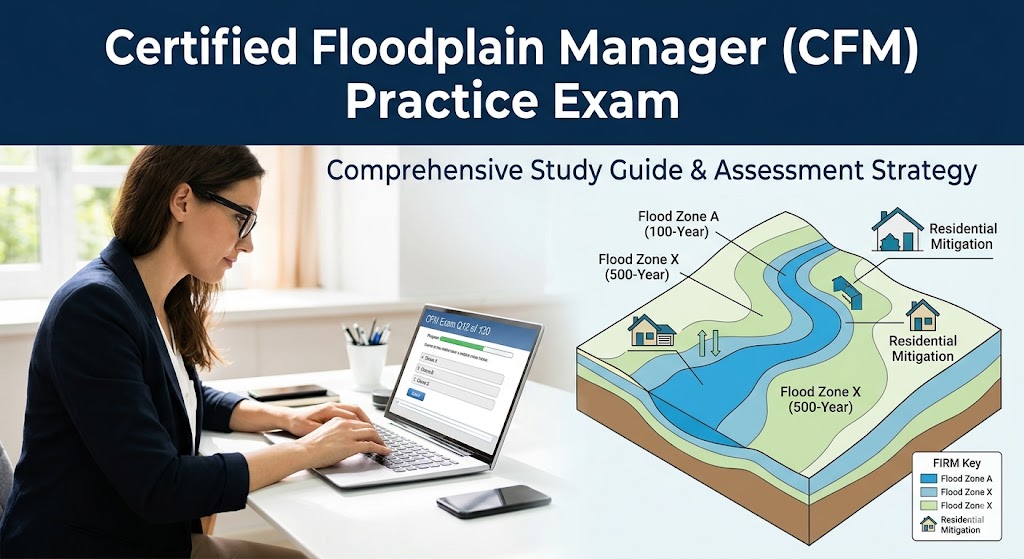
Additional Information
What the Course Entails and Exam Details
While there is no single mandatory "course" you
must take to sit for the CFM exam, your preparation is based on a mastery of
the Floodplain Management Body of Knowledge.
Most candidates spend significant time studying official
ASFPM technical references, with special emphasis on FEMA Publication 480,
"National Flood Insurance Program (NFIP) Floodplain Management
Requirements: A Study Guide and Desk Reference for Local Officials."
The CFM exam is a rigorous assessment that measures your
understanding of minimum national NFIP regulations and standard practices. It
does not focus on state-specific or higher local regulatory standards, which is
a critical point to remember during your study.
The core technical areas covered by the body of knowledge
and the exam include:
- Floodplain
Mapping: Understanding how to read, interpret, and use Flood Insurance
Rate Maps (FIRMs) and Flood Insurance Studies (FIS).
- NFIP
Regulatory Standards: Knowledge of the minimum federal requirements
for development within Special Flood Hazard Areas (SFHAs).
- Regulatory
Administrative Procedures: Mastering the permitting process, ordinance
administration, variance procedures, and enforcement.
- Flood
Insurance: Understanding the fundamentals of flood insurance coverage,
the Community Rating System (CRS), and mandatory purchase requirements.
- Flood
Hazard Mitigation: Identifying and implementing long-term solutions to
reduce or eliminate flood risk to buildings and infrastructure.
- Natural
and Beneficial Functions: Recognizing the ecological value of
floodplains and the importance of preserving their natural state.
What to Expect in
the Final Exam
The final Certified Floodplain Manager exam is a
closed-book, comprehensive assessment designed to simulate the decision-making
required in the field.
- Format:
The exam consists of 120 multiple-choice questions.
- Time
Limit: Candidates are given 3 hours to complete the exam. You
are advised to manage your time carefully, allowing approximately 1.5
minutes per question.
- Passing
Score: To become a CFM, you must achieve a passing score of at least 70%,
which generally equates to answering 84 out of 120 questions correctly
(scoring might vary slightly based on equating).
- Immediate
Results: In most testing scenarios, you will receive your pass/fail
results immediately after submitting your exam on the screen.
How to Study and
Exam Centers
Preparation is the absolute key to success on the CFM exam.
Study Strategies:
Immerse Yourself in FEMA 480:
This publication is considered the "bible" for the CFM exam. You
should study it thoroughly, particularly focusing on the quizzes or learning
checks at the end of each chapter.
Utilize Certified Floodplain
Manager (CFM) Practice Exams: Taking practice tests is highly recommended
to familiarize yourself with the phrasing, difficulty, and time constraints of
the actual assessment. Practice exams help you identify knowledge gaps early.
Review ASFPM Technical
References: ASFPM provides a curated list of study resources in their
digital library. These references clarify complex regulatory topics.
Attend Workshops: Many
ASFPM state chapters offer preparation workshops or "Managing Floodplain
Development through the NFIP" (FEMA 273/G273) courses. While not strictly
"exam prep" classes, they reinforce the core concepts.
Exam Centers and Registration:
Application Process: You
must first submit an application and the required fees to ASFPM or your
accredited state association to confirm your eligibility.
Authorized Testing: Upon
approval, you will receive information on how to schedule your exam. The
primary testing method is through specialized, secure testing centers managed
by ASFPM’s testing partner, currently Meazure Learning (formerly Scantron).
Physical and Digital Options:
Most candidates take the exam at a physical computer-based testing center to
ensure a secure environment. In some cases, secure remote proctoring options
may be available; check current ASFPM guidelines upon registration.
Job Opportunities
from the Course
Earning the CFM designation is a significant career
catalyst. It demonstrates verified expertise, making you a more competitive
candidate for specialized roles in both the public and private sectors.
The certification unlocks specific job titles and career
paths, including:
- Community
Floodplain Administrator
- Hazard
Mitigation Planner
- Water
Resources Engineer
- City
or County Planner
- Emergency
Management Director/Coordinator
- Building
Official or Code Enforcement Officer
- GIS
Analyst (Specializing in Flood Risk mapping)
- Environmental
Consultant
- Flood
Insurance Specialist/Risk Analyst
- Resilience
Officer
- Coastal
Zone Manager
Frequently Asked Questions
Reviews
5.0
Based on 0 reviews
Leave a Review
No reviews yet. Be the first to review!