
Certified Information Systems Security Professional (CISSP) Practice Exam
$69.00
- Buy to unlock unlimited access to all Quiz questions and Answers in this Quiz.
- After purchase you can print a PDF of the whole quiz at any point. The PDF will contain the questions and the correct answers.
About this Exam
The Certified Information Systems Security Professional
(CISSP) is widely considered the gold standard in cybersecurity certifications.
It is managed by the International Information System Security Certification
Consortium, known commonly as (ISC)²®.
This certification is designed for experienced security
practitioners, managers, and executives who want to prove their mastery of the
vast and shifting field of information security.
The CISSP validates that a professional has the deep
technical and managerial knowledge necessary to design, engineer, implement,
and manage an organization's overall security posture. If you are serious about
a top-tier career in cybersecurity, this is the credential you need.
Ready to test your knowledge?
Buy Now to Access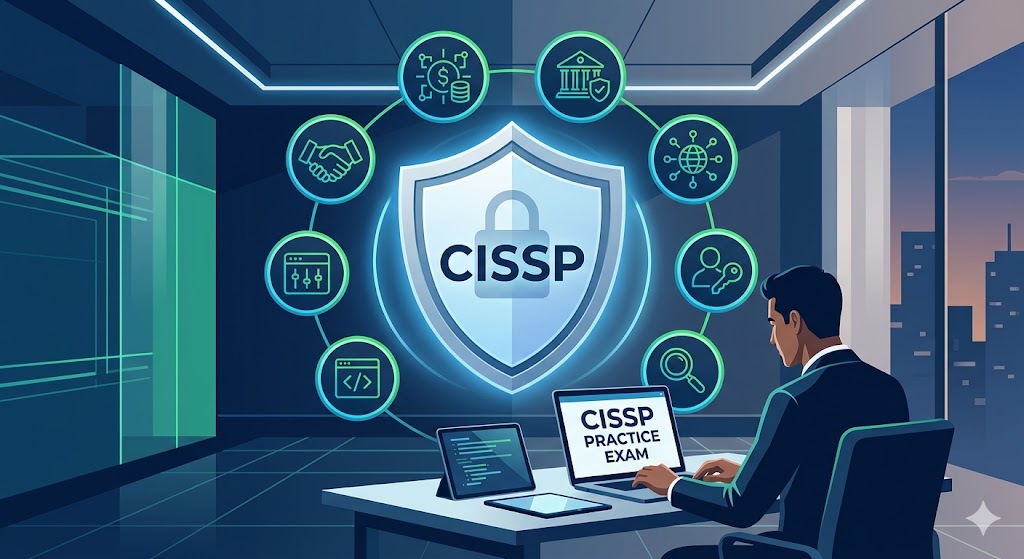
Additional Information
What the Course Entails and Exam Details
The CISSP body of knowledge is extensive, ensuring that
certified professionals understand the full breadth of the security landscape.
The exam curriculum is organized into eight distinct
domains, often referred to as the common body of knowledge (CBK). These domains
are updated regularly to reflect emerging threats and technologies. The current
domains are Security and Risk Management, Asset Security, Security Architecture
and Engineering, Communication and Network Security, Identity and Access
Management (IAM), Security Assessment and Testing, Security Operations, and
Software Development Security.
To succeed on the CISSP, you must master the fundamental
concepts within each of these areas and understand how they interconnect to
create a robust, defense-in-depth security strategy.
What to Expect in
the Final Exam
The CISSP exam is unique in its structure and delivery,
especially in English, where it utilizes Computerized Adaptive Testing (CAT).
This CAT format allows the exam to adapt the difficulty of
subsequent questions based on your performance on previous ones. English exams
range from 125 to 175 questions, which include a mix of standard
multiple-choice items and innovative questions, such as drag-and-drop or
hotspot interactions.
Candidates have exactly four hours to complete the exam. To
pass, you must achieve a scaled score of 700 points out of a possible 1,000. It
is a demanding, rigorous assessment that tests not just your technical recall,
but your ability to apply managerial and engineering concepts in real-world
scenarios.
How to Study and
Exam Centers
Preparing for the CISSP is a significant undertaking that
requires a structured and dedicated study plan.
Start with the official (ISC)²® study materials and complete
the common body of knowledge reference books. These provide the comprehensive
background you will need for every domain. We strongly recommend using
high-quality practice exams throughout your study process. A dedicated practice
exam helps you not only assess your knowledge but also get used to the often
difficult wording of CISSP questions.
Ensure you are studying not just to memorize but to
understand the "why" behind every security concept. Once you are
confident, you must schedule your exam through Pearson VUE, which is the
official testing partner for (ISC)²®. The CISSP exam is administered at highly
secure, professional Pearson VUE testing centers located across the globe.
Job Opportunities
from the Course
Achieving your CISSP certification instantly identifies you
as a top expert in the cybersecurity field and drastically improves your job
prospects.
Many high-level and executive security positions consider
CISSP a strong preference, if not an outright requirement. This credential
opens doors to some of the most influential and lucrative roles in information
security.
Potential job titles for CISSP holders include Chief
Information Security Officer (CISO), Security Director, Information Security
Manager, Security Architect, Cybersecurity Engineer, Security Analyst,
Cybersecurity Consultant, and Risk and Compliance Manager.
Frequently Asked Questions
Reviews
5.0
Based on 0 reviews
Leave a Review
No reviews yet. Be the first to review!