
Certified Judge Advisor Practice Test
$69.00
- Buy to unlock unlimited access to all Quiz questions and Answers in this Quiz.
- After purchase you can print a PDF of the whole quiz at any point. The PDF will contain the questions and the correct answers.
About this Exam
Welcome to the comprehensive study guide for the Certified
Judge Advisor Practice Exam. This practice test is designed to help
individuals who are seeking to become a Certified Judge Advisor (CJA), a
vital leadership role within various competitive and structured deliberation
systems. Judge Advisors are not the primary decision-makers; rather, they are
the specialized experts who train, lead, and support the judging panel. Their
primary objective is to ensure that the judging process is consistent, fair,
impartial, and aligned with the established standards and core values of the
organization or event.
This certification is ideal for experienced volunteers,
former judges, and professionals who possess strong organizational,
communication, and critical thinking skills. CJAs are mentors and role models
who create a positive and inspiring experience for all participants by
safeguarding the integrity of the evaluation process.
Ready to test your knowledge?
Buy Now to Access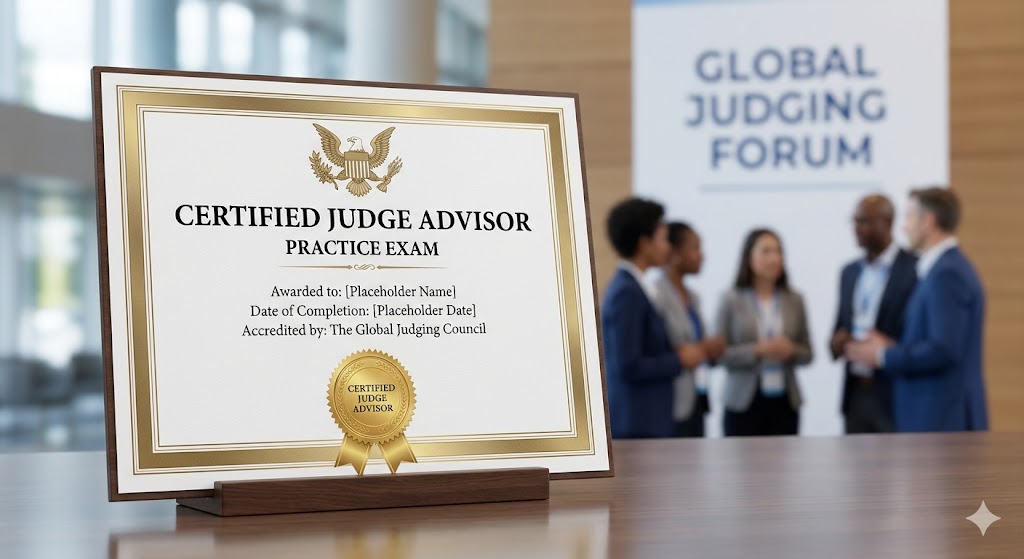
Additional Information
What the Course Entails and Exam Details
The study material and subsequent certification course for
Judge Advisors cover a wide array of competencies essential for successfully
leading a judging team. A CJA candidate must master both procedural knowledge
and interpersonal dynamics.
Core topics typically included are:
- Role
and Responsibilities of the Judge Advisor: Distinguishing the J.A.
from a regular judge; understanding the chain of command and
responsibilities to the event partner and the organization.
- Judge
Recruitment and Training: Effective strategies for selecting qualified
judges, managing potential conflicts of interest, and delivering
comprehensive training to ensure a shared understanding of rubrics and
standards.
- Judging
Processes and Tools: Masterful use of standardized evaluation tools,
including engineering notebook rubrics, team interview guides, and
observation sheets.
- Facilitating
Deliberations: Techniques for guiding a panel through complex,
respectful, and fact-based deliberation sessions to determine award
recipients, while maintaining strict confidentiality.
- Ethics
and Integrity: Deep understanding of fairness, youth protection
policies, and managing bias.
- Post-Event
Responsibilities: Ensuring proper documentation, providing feedback,
and coordinating the destruction of confidential materials.
What to Expect in the Final Exam
The actual Certified Judge Advisor Certification Exam
is designed to rigorously test a candidate’s ready knowledge of the policies,
tools, and situational judgment required for the role.
Standard exam formats and rules include:
- Format:
The final certification exam is typically a multiple-choice assessment
delivered via an online learning management system (LMS). Some advanced
certifications may include a scenario-based or practical component.
- Passing
Score: Organizations generally require a high passing score, often 80%
or 90% and above, demonstrating masterful understanding of the materials.
- Time
Limit: There is usually a strict time limit, ranging from 60 to 120
minutes. Candidates must manage their time effectively to address all
questions.
- Prerequisites:
You may need to complete specific training modules or have prior
experience as a certified judge.
- Attempts:
Policies on retaking the exam vary by organization. Some require a waiting
period between attempts or limit the number of attempts within a single
competition season.
The Certified Judge Advisor Practice Test mimics this
format, offering a low-stakes environment to assess your readiness and identify
areas for further study.
How to Study and
Exam Centers
Effective preparation for the CJA exam requires a blend of
studying official documentation and practical application.
Actionable study strategies include:
Deep Dive into Official
Manuals: Your single most important resource is the current season's Judge
Advisor Manual and the associated Judging Guide. These are the authoritative
sources for all exam questions.
Utilize Organization-Specific
Training: Participate in all required pre-event training courses. This
often includes video modules, interactive quizzes, and, in some cases, monthly
discussion calls.
Use the Rubrics: Practice
scoring sample items (e.g., hypothetical engineering notebooks or observed
interview scripts) using the exact rubrics you will be teaching.
Practice Conflict of Interest
Management: Create and resolve hypothetical conflict-of-interest scenarios.
Simulate Deliberations:
Role-play a difficult award deliberation with experienced volunteers.
Take the Practice Test:
The Certified Judge Advisor Practice Test is a critical tool for
familiarizing yourself with the types of questions and the time constraints you
will face.
Exam Centers and Access:
The certification exam itself is almost exclusively
administered online through the official, password-protected online portals of
the authorizing organization. These are accessible 24/7. While you do not go to
a physical "exam center" like Pearson VUE for the certification, you
must take the online test in a quiet, undisturbed setting, adhering to all
honor code policies.
After successful certification, you will be authorized to
serve as a Judge Advisor at physical event centers or sanctioned competitive
tournaments.
Job Opportunities from the Course
Earning the designation of a Certified Judge Advisor
unlocks a valuable niche of career and leadership opportunities in the
volunteer and event-management sectors. The CJA certification proves you can
lead teams, manage complex processes, and uphold organizational integrity.
Career Paths and Role Opportunities include:
- Certified
Judge Advisor: Serving at regional, national, and championship levels
in organizations like FIRST Robotics, RECF/VEX, and debate leagues.
- Event
Coordinator / Event Partner: Leveraging your leadership and judging
knowledge to oversee entire competitive events.
- Tournament
Manager / Tournament Director: Leading the operational side of
tournaments, where understanding the judging process is crucial for
scheduling and logistics.
- Volunteer
Coordinator: Managing the recruitment and placement of volunteers,
including judging panels.
- Program
Director: Overseeing competitive programs within educational or
non-profit organizations.
- Chief
Judge: A related role focusing purely on the quality and application
of judging standards across multiple events.
Frequently Asked Questions
Reviews
5.0
Based on 0 reviews
Leave a Review
No reviews yet. Be the first to review!