
Certified Medication Technician (CMT) State Practice Exam
$69.00
- Buy to unlock unlimited access to all Quiz questions and Answers in this Quiz.
- After purchase you can print a PDF of the whole quiz at any point. The PDF will contain the questions and the correct answers.
About this Exam
The Certified Medication Technician (CMT) designation is
a vital credential for healthcare professionals desiring to advance their
careers and accept greater responsibility in resident care. This certification
is specifically designed for individuals, often already working as Certified
Nursing Assistants (CNAs) or other direct care workers, who want to legally
administer non-parenteral medications under the supervision of a licensed
nurse. It is an essential component of quality assurance in nursing homes, assisted
living communities, correctional facilities, and long-term care settings. Our
CMT State Practice Exam serves as a critical simulation tool, meticulously
crafted to replicate the format, content, and rigor of the official state
licensing test.
By engaging with these practice materials, candidates
validate their mastery of pharmacology fundamentals, safety protocols, and
documentation requirements. Utilizing this preparatory resource is the most
effective way to build the confidence needed to succeed on test day and ensure
you are job-ready for this critical role in patient health.
Ready to test your knowledge?
Buy Now to Access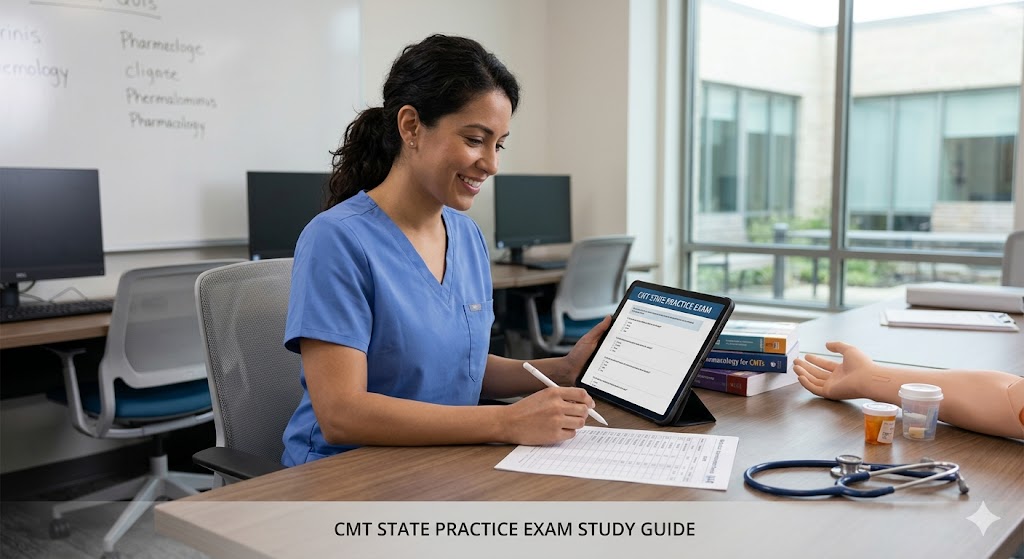
Additional Information
What the Course Entails and Exam Details
The CMT preparatory course and subsequent exam are
anchored in state-approved curricula focused entirely on the safe and effective
administration of medications. While the training program emphasizes practical
skills, the state exam evaluates your cognitive understanding of those
procedures and the theoretical knowledge underpinning them. You will be tested
on your ability to accurately interpret physician orders, understand the
purpose and effects of common drug classifications, and perfectly implement the
"Six Rights of Medication Administration" (right patient, right
medication, right dose, right route, right time, and right documentation).
Key knowledge areas include fundamental pharmacology,
safe dosage calculations, understanding medical abbreviations, identifying
signs of adverse reactions or drug interactions, and adhering to strict
infection control measures. Furthermore, a substantial portion of the exam
assesses your comprehension of documentation protocols, regulatory compliance,
and ethical responsibilities within your scope of practice. Mastery of these
details ensures the safety of the residents under your care and validates your
readiness for certification.
What to Expect in the Final Exam
The actual structure of the state CMT licensing exam
varies slightly from one jurisdiction to another, but most adopt a similar,
multi-faceted approach to verification. The process generally consists of two
distinct components: a written cognitive evaluation and a hands-on practical
skills demonstration. The written test is almost universally a computer-based,
multiple-choice examination. You should be prepared to answer a significant
number of questions—typically ranging from 50 to 100 items—within a set time
limit, often around 90 to 120 minutes. A passing score, often 75% or 80%, must
be achieved to pass this cognitive section.
The practical skills portion is equally crucial and
requires you to perform various medication administration procedures flawlessly
while being observed by a state-approved proctor or registered nurse evaluator.
You may need to demonstrate correct hand hygiene, measure liquids accurately,
prepare pills for administration, and correctly update a Medication
Administration Record (MAR). Often, missing a "critical step" (a
safety-related action) on the practical side results in an automatic failure of
that portion. Be prepared for strict scrutiny regarding aseptic technique and
resident safety during this evaluation.
How to Study and Exam Centers
Effective preparation requires a multi-layered approach
that combines rote memorization with contextual application of knowledge. Begin
by thoroughly reviewing the official CMT curriculum from your training course,
paying close attention to the textbook chapters on drug categories, side
effects, and adverse reactions. Creating detailed flashcards for medical
terminology, common drug names, and calculation formulas is highly effective.
You must integrate simulation into your study routine; repeat the CMT State
Practice Exam multiple times until you can confidently answer every question
correctly and can explain why the correct answer is right. Actively
practicing the physical skills portion with your instructor or a senior nurse
is also essential for success during the practical evaluation.
The final state exam is often taken at specialized
testing facilities or authorized educational centers. Depending on your state,
registration might occur through Pearson VUE, Prometric, or directly via your
state’s health department or Board of Nursing online portals. Many authorized
training schools, community colleges, and vocational centers serve as dedicated
testing sites for the practical skills component. We strongly recommend
visiting your specific state’s official credentialing website to confirm their
exact requirements, find registered testing locations near you, and understand
the required registration procedures.
Job Opportunities from the Course
Successfully navigating the CMT State Exam and achieving
certification unlocks several rewarding career opportunities within the booming
healthcare sector. Demand for medication-trained technicians is consistently
high, particularly as the population ages and relies more heavily on long-term
care services. Certified CMTs are uniquely positioned to earn higher wages and
accept greater levels of responsibility than entry-level direct care staff. The
designation often serves as a prerequisite for specialized roles and a
foundation for further nursing education. Key job titles and career paths
available with this certification include:
- Certified
Medication Technician (CMT)
- Medication
Aide (MA or CMA)
- Resident
Care Medication Manager
- Restorative
Medication Aide
- Assisted
Living Medication Lead
- Nursing
Home Med-Tech Coordinator
- Home
Health Medication Aide (in authorized states)
- Path
to Licensed Practical Nurse (LPN/LVN)
- Path
to Registered Nurse (RN)
Frequently Asked Questions
Reviews
5.0
Based on 0 reviews
Leave a Review
No reviews yet. Be the first to review!