
Certified Ophthalmic Assistant
$69.00
- Buy to unlock unlimited access to all Quiz questions and Answers in this Quiz.
- After purchase you can print a PDF of the whole quiz at any point. The PDF will contain the questions and the correct answers.
About this Exam
Embarking on a career in ophthalmology is a rewarding
journey, and achieving Certified Ophthalmic Assistant (COA) status is a crucial
first step.
This certification, administered by IJCAHPO (International
Joint Commission on Allied Health Personnel in Ophthalmology), is designed for
entry-level ophthalmic medical personnel.
It validates your foundational knowledge and skills in
essential areas of patient care, diagnostic procedures, and clinical practice,
demonstrating your competency to assist ophthalmologists.
Successfully preparing for the actual certification,
particularly through a comprehensive Certified Ophthalmic Assistant Practice
Exam, is paramount to launch your career with confidence.
Ready to test your knowledge?
Buy Now to Access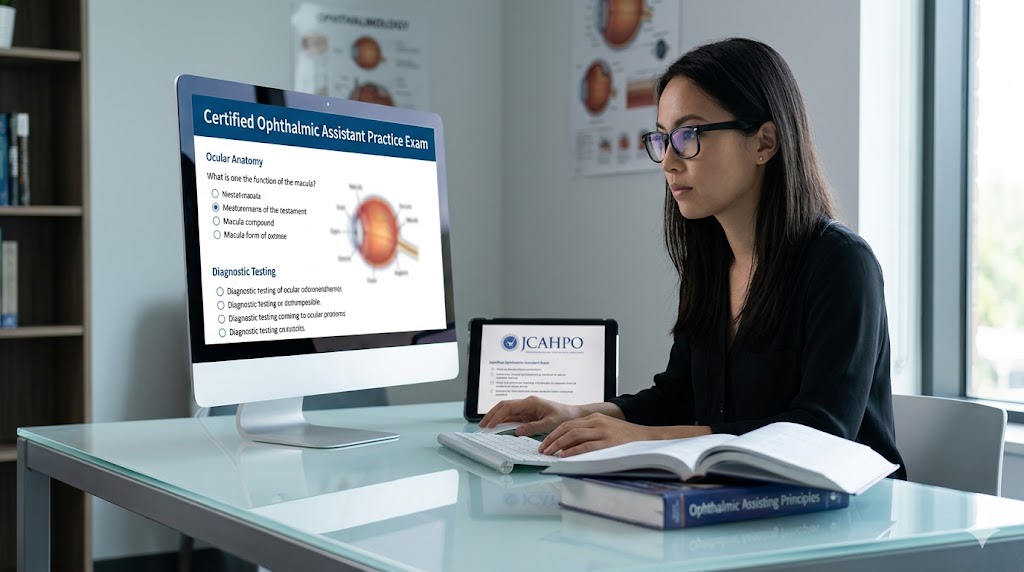
Additional Information
What the Course Entails and Exam Details
While not a single structured "course" in itself,
the journey to COA typically involves a combination of education (official
materials, independent study courses) and practical experience (usually 1,000
hours under MD/DO supervision).
A reputable Certified Ophthalmic Assistant Practice Exam
will cover the same core domains that appear on the real JCAHPO COA
certification test:
- Ophthalmic
Anatomy & Physiology: Comprehensive knowledge of eye structures,
visual pathways, and common conditions.
- Medical
Terminology & Pharmacology: Familiarity with key terms,
abbreviations, and common ocular medications.
- Patient
Care & History: Procedures for taking accurate medical history and
communicating effectively with patients.
- Ophthalmic
Procedures & Measurements: Conducting fundamental measurements,
including visual acuity, intraocular pressure (tonometry), and visual
field testing.
- Diagnostic
Testing & Instrumentation: Understanding and demonstrating the use
of common diagnostic tools and ensuring proper maintenance.
- Optical
Principles & Refraction: Grasping basic optical concepts and
assisting with refraction measurements.
What to Expect in
the Final Exam
The actual COA certification exam is a rigorous assessment
administered at official testing centers.
Here are the key details you can expect:
- Format:
The exam consists of approximately 200 multiple-choice questions
(some sources vary slightly, but around 200 is typical for JCAHPO COA).
- Time
Limit: You will typically have 3 hours (180 minutes) to
complete the test.
- Passing
Score: While specific numerical scores can be scaled, you must achieve
a performance level deemed equivalent to a passing standard set by JCAHPO
to obtain certification. (Search 2.1.2 indicates a minimum score of 72,
which is likely a scaled score or percentage benchmark.)
- Rules
& Procedures: Standard medical certification rules apply – the
exam is closed book, and you will need to provide valid, official
photo identification. Specific guidelines for permitted items like
calculators and personal belongings will be strictly enforced at the
testing center. Candidates should consult official IJCAHPO documentation
for the most precise and up-to-date information on exam specifications and
procedures.
How to Study and
Exam Centers
Preparation is everything when aiming for COA certification.
Your study plan should be comprehensive and strategic.
- Actionable
Study Strategies:
- Utilize
Official JCAHPO Resources: JCAHPO often provides recommended study
guides, reference lists, and potentially their own practice tests. These
are your most direct sources of information on exam expectations.
- Create
a Structured Schedule: Dedicate consistent study time to each of the
key domains covered on the exam. Use active learning techniques like
flashcards for terminology and anatomy, and summarize key procedures in
your own words.
- Engage
with a Certified Ophthalmic Assistant Practice Exam: This is one of
the most effective tools. Use practice exams to simulate the test
environment, get familiar with question styles, identify your strengths
and weaknesses in different content areas, and build your test-taking
stamina. Reputable practice exams will offer detailed explanations for
both correct and incorrect answers, solidifying your understanding.
- Review
Practical Experience: The COA requires significant on-the-job
training. Relate your study topics directly to the practical skills you
perform or observe in a clinical setting.
- Exam
Centers and Where to Take the Test:
- Final
Certification Exam: The official COA certification exam is generally
administered in a controlled environment. The most common location is a
professional Pearson VUE examination facility. Pearson VUE centers
are located globally, allowing candidates to schedule their exam at a
convenient location and time. JCAHPO's official website will guide you to
their designated testing provider and scheduling process for the formal
certification.
- Practice
Exams: While the final exam is at a center, Certified
Ophthalmic Assistant Practice Exams are typically accessible through
online portals, official study guides, or educational platforms from the
comfort of your home. They are designed for independent preparation
leading up to your formal test date.
Job Opportunities from the Course
Successfully preparing for and passing the COA exam, with
the support of a reliable Certified Ophthalmic Assistant Practice Exam,
opens doors to a variety of satisfying career paths in eye care. Here are
common job opportunities unlocked by this certification:
- Certified
Ophthalmic Assistant (COA): The official title, working under the
direct supervision of an ophthalmologist in clinics, private practices,
and hospital settings. You will directly engage in patient care,
diagnostic testing, and potentially assist with procedures.
- Help
Desk/Patient Services Coordinator: In larger clinics or eye care
networks, COAs often utilize their medical knowledge to guide patients,
manage appointments, and act as a crucial link between patients and
medical providers.
- Ophthalmic
Technician: While a distinct, higher-level certification exists, COAs
often assume technician-level responsibilities as they gain experience or
can pursue advanced certification to officially become a Certified
Ophthalmic Technician (COT).
- Ophthalmic
Imaging Specialist/Photographer: COAs with a keen interest in
technology and visual data can specialize in ocular imaging, taking
crucial diagnostic photos and scans.
- Clinical
Trials Research Assistant: Many academic and private practices conduct
research. COAs can assist in clinical trials by performing measurements,
ensuring compliance, and collecting crucial patient data under
investigator guidance.
- Practice
Manager or Supervisor (Potential Advancement): With years of
experience, significant domain expertise, and potentially further
training, a COA can advance to managerial or supervisory roles, overseeing
other ophthalmic personnel and clinic operations.
Frequently Asked Questions
Reviews
5.0
Based on 0 reviews
Leave a Review
No reviews yet. Be the first to review!