
Certified Orientation and Mobility Specialist Practice Exam
$69.00
- Buy to unlock unlimited access to all Quiz questions and Answers in this Quiz.
- After purchase you can print a PDF of the whole quiz at any point. The PDF will contain the questions and the correct answers.
About this Exam
The Certified Orientation and Mobility Specialist (COMS)
designation is the foundational professional certification for highly trained
experts who empower individuals with visual impairments. Designed for
rehabilitation and education professionals, this specialty certification
validates your entry-level knowledge and ability to apply essential orientation
and mobility (O&M) principles.
A COMS works with people who are blind, have low vision, or
possess other functional visual limitations across all age groups. They engage
a comprehensive approach that addresses the nonvisual, visual, physical,
cognitive, and psycho-social aspects related to a client’s mobility. This
allows their clients to achieve vital goals for education, employment, and
independent living. Candidates are required to have completed an extensive
educational program, typically a Bachelor’s or Master’s degree with an emphasis
in O&M, and a rigorous 350+ hour internship under an experienced COMS.
Ready to test your knowledge?
Buy Now to Access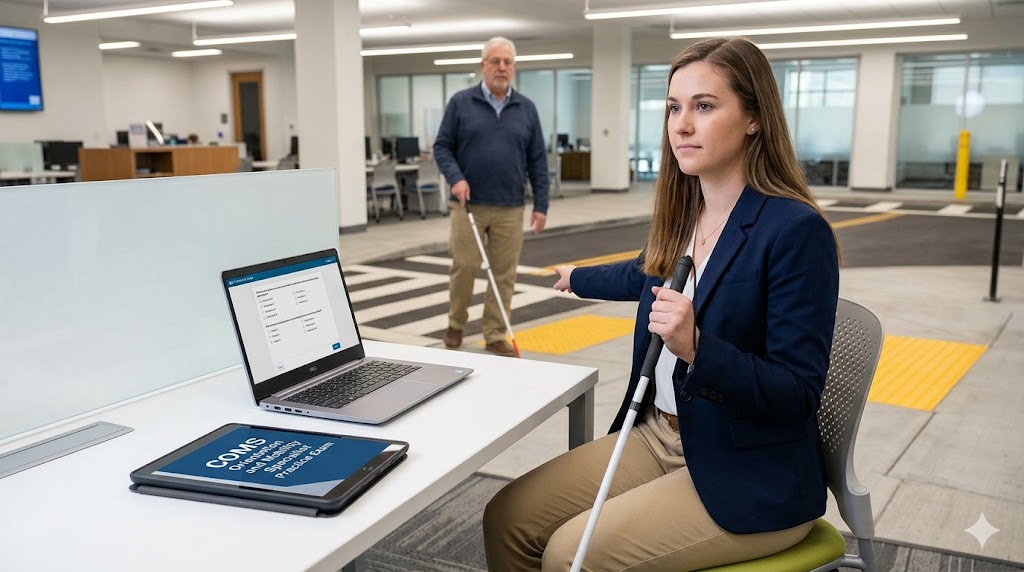
Additional Information
What the Course Entails and Exam Details
The COMS exam measures theory and resource knowledge,
assessing your ability to apply O&M principles to various practical
scenarios. Mastery of these core topics, as outlined in the official ACVREP
COMS Handbook, is critical for success. The final exam domains that form the
syllabus and core skill sets include:
- Client
Assessment and Information Management: Techniques for evaluating a
client’s current skills, needs, and goals, and managing relevant data.
- Instructional
Strategies and Methods: Applying effective teaching methods, including
inquiry-based and direct instruction, tailored to the learner.
- Environmental
Familiarity and Awareness: Teaching clients to understand and interact
safely with their physical surroundings, from indoor to complex outdoor
environments.
- Sensory
Skills and Perceptual Development: Enhancing a client's remaining
senses to improve environmental awareness and navigation.
- Code
of Ethics and Professional Issues: Understanding the professional
responsibilities and ethical standards of a COMS.
It is important to note that actual practice skills are
measured and verified during your internship. The written exam is a separate
step that validates your theoretical foundation.
What to Expect in the Final Exam
While exact details can be found in the most current COMS
Handbook, you can generally expect a robust exam. The official ACVREP Practice
Exam, for example, is composed of 142 multiple-choice and multiple-select
questions to be completed within four hours. The actual
certification exam follows a similar structure and covers knowledge-based
questions (facts from resources) and scenario-based questions (applying
knowledge to a described situation).
There is no additional penalty for answering incorrectly,
so you should answer every question on the exam, even if you must make an
educated guess. The score is reported on a scale, and the ACVREP determines the
passing standard. To have optimal success, focus your study efforts on the most
heavily weighted domains. When encountering scenario questions, carefully
analyze the key information provided—such as age group, environment, or visual
condition—and base your answer solely on that context. The exam does not
contain negative logic questions (e.g., "Which would not be
used...").
How to Study and Exam Centers
Effective preparation is the key to passing this challenging
exam on your first attempt. It is critical to use up-to-date resources. Any
study guide or practice exam developed prior to February 2023 is outdated
and should not be used. Here are actionable study strategies:
Thoroughly Review Official
ACVREP Resources: The ACVREP COMS Handbook is your primary resource.
Download and study the latest version, paying close attention to the detailed
objectives for each domain. Also, review the document "Strategies for
Taking the COMS Certification Exam" provided by ACVREP for invaluable
tips.
Take Official Practice Exams:
Purchase and complete the ACVREP COMS Practice Exam. This will simulate
the actual testing environment and provide instant feedback on incorrect
answers, helping you identify areas that need further review.
Utilize a Certified
Orientation and Mobility Specialist Practice Exam Question Bank: Gain an
edge by practicing with a large, diverse set of realistic questions from a
reputable source. Repetition builds confidence, speed, and accuracy, training
you for test day.
Implement Distributed Study
and Scenario Practice: Research shows that distributed study (over time)
is much more effective than cramming. Create a manageable study schedule and
practice applying O&M principles to new scenarios on your own.
Use Flashcards for Key Terms
and Concepts: Use flashcards to memorize essential definitions, landmarks,
techniques, and the COMS Code of Ethics. Use other tools like Quizlet with
extreme caution, as they may contain incorrect info.
You will not take the COMS exam at a physical testing
center like Pearson VUE. Instead, all ACVREP certification exams are
administered online via the ACVREP Webassessor test taker platform. Once
you have been declared eligible, you will log into your account to register,
pay the fee, and schedule your proctored, online exam. You can take it from the
comfort of your home, but it must be completed in one sitting, and you cannot
log out once you begin.
Job Opportunities from the Course
Earning your COMS certification is a major milestone that
unlocks diverse and rewarding career paths in a high-demand field. There is a
national shortage of O&M specialists, creating worldwide opportunities.
Potential job titles and career paths include:
- Orientation
and Mobility (O&M) Specialist: The most direct career path,
providing one-to-one instructional services to clients in various
settings.
- Independent
Living Skills Trainer (ILST): Teaching daily living skills, often
alongside O&M training, to enhance client independence.
- Itinerant
O&M Specialist (Schools): Traveling between different schools and
community sites to provide O&M services to students aged 3-21.
- Vision
Rehabilitation Specialist: Working with state agencies, non-profits,
or the VA to provide a full range of rehabilitation services.
- O&M
Instructor (Vocational Rehabilitation): Focusing on teaching
habilitative or rehabilitative O&M needs for clients seeking
employment.
- Teacher
of the Visually Impaired (TVI): A common dual-certification role where
a specialist with a TVI license also provides O&M services.
Frequently Asked Questions
Reviews
5.0
Based on 0 reviews
Leave a Review
No reviews yet. Be the first to review!