
Certified Peer Support Worker Certification Practice Exam
$69.00
- Buy to unlock unlimited access to all Quiz questions and Answers in this Quiz.
- After purchase you can print a PDF of the whole quiz at any point. The PDF will contain the questions and the correct answers.
About this Exam
The Certified Peer Support Worker (CPSW) certification is
a specialized credential designed for individuals who have personal, lived
experience with mental health or substance use challenges and are in recovery.
This certification validates their unique ability to
support others on similar journeys toward wellness and stability.
It is ideal for compassionate individuals who want to use
their recovery story to provide empathy, encouragement, and navigation support
to peers within clinical or community-based settings.
By becoming certified, peer workers demonstrate
professional competency in ethical boundaries, communication skills, and the
foundational principles of recovery-oriented care.
Ready to test your knowledge?
Buy Now to Access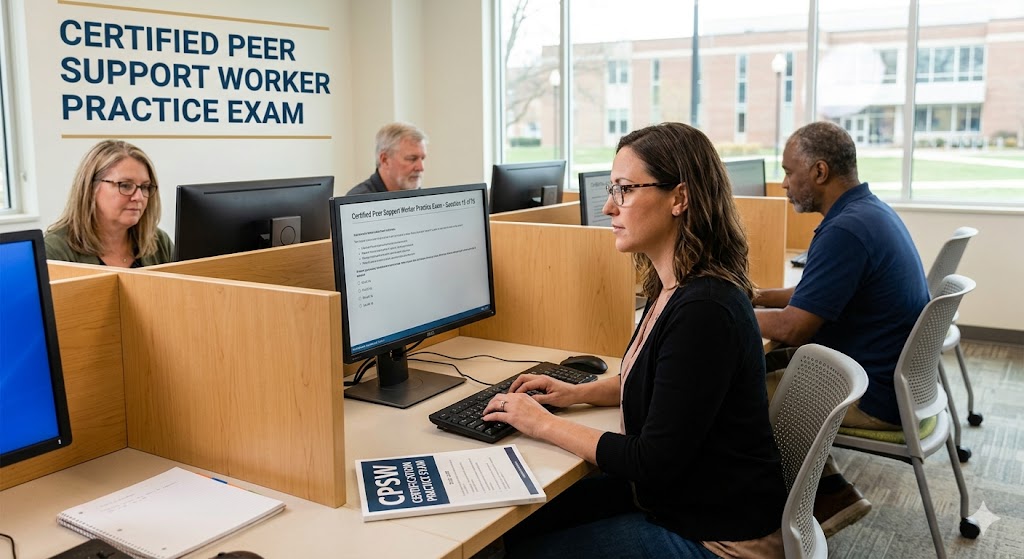
Additional Information
What the Course Entails and Exam Details
The preparation coursework for the CPSW exam covers
essential competencies that bridge lived experience with professional support
skills.
Core topics typically include the foundational principles
of recovery (hope, empowerment, self-direction), effective listening and
communication techniques, and strategies for initiating and maintaining
supportive relationships.
Candidates will delve into the Peer Support Role,
distinguishing it from traditional clinical roles, and master maintaining
ethical boundaries, self-care, and professional conduct.
The syllabus also emphasizes motivational interviewing
techniques, stages of change models, crisis response protocols, and assisting
peers in navigating complex healthcare and community resource systems.
Understanding confidentiality (HIPAA), cultural humility,
and advocacy are critical components of the curriculum.
What to Expect in the Final Exam
The CPSW final exam is generally a proctored,
standardized test designed to assess both theoretical knowledge and practical
application of peer support principles.
The format is typically multiple-choice questions, which
present real-world scenarios requiring the test-taker to identify the best
course of action based on recovery principles and ethical guidelines.
While the exact number of questions and time limit varies
slightly by state or certifying body, candidates should typically expect
between 60 and 100 questions to be completed within a 90 to 120-minute
timeframe.
A passing score usually ranges from 70% to 80%.
Some states may require a practical component or
interview in addition to the written exam, although the standardized
multiple-choice test is the most common format.
How to Study and
Exam Centers
Effective preparation for the CPSW exam involves a blend
of reviewing curriculum materials and applying practical concepts.
Actionable Study Strategies:
Review the Official Study Guide: Utilize the specific
curriculum provided by your state’s behavioral health authority or certifying
body (e.g., the state’s Office of Peer Recovery Services).
Use Practice Exams: Take authorized practice exams
multiple times to become familiar with the question formatting and time
constraints. Analyze incorrect answers to identify weak areas.
Form Study Groups: Collaborating with other candidates to
discuss ethical scenarios and communication techniques can provide valuable
perspectives.
Master Ethical Guidelines: Focus intensely on boundaries,
self-care, and confidentiality; these areas are heavily tested.
Reflect on Personal Experience: Practice articulating how
you would use elements of your personal recovery journey appropriately to
support a peer, keeping professional boundaries in mind.
Exam Centers and Testing Methods:
The CPSW exam is administered through authorized testing
avenues that vary by jurisdiction.
Most commonly, candidates register through their state’s
dedicated peer certification board or behavioral health department.
The actual test is frequently delivered via secure online
portals that allow candidates to take the exam from their own computers with a
remote proctor.
Alternatively, some states use established physical
testing centers (like Pearson VUE or local community colleges) for proctored,
in-person administration.
You will typically receive instructions on how to
schedule your exam once your training and application have been approved.
Job Opportunities
from the Course
Earning the Certified Peer Support Worker credential
opens numerous career paths within the behavioral health and recovery
landscape. Common job opportunities include:
Certified Peer Support Specialist: Providing direct
support, mentorship, and recovery planning to individuals in mental health
settings.
Recovery Coach: Helping individuals with substance use
disorders develop relapse prevention strategies and access community resources.
Peer Navigator: Assisting individuals in navigating the
healthcare system, finding housing, and connecting with social services.
Community Health Worker (with Peer Focus): Serving as a
bridge between communities and the healthcare system, with a focus on mental
wellness.
Peer Advocacy Coordinator: Working within organizations
to promote user-led services and advocate for peer rights.
Warmline Operator/Specialist: Providing empathetic,
non-crisis emotional support over the phone.
Wellness Coach: Guiding individuals toward holistic
wellness goals using recovery-oriented principles.
Forensic Peer Support Specialist: Supporting individuals
with lived experience who are involved with the criminal justice system.
Frequently Asked Questions
Reviews
5.0
Based on 0 reviews
Leave a Review
No reviews yet. Be the first to review!