
Certified Polysomnographic Technician
$69.00
- Buy to unlock unlimited access to all Quiz questions and Answers in this Quiz.
- After purchase you can print a PDF of the whole quiz at any point. The PDF will contain the questions and the correct answers.
About this Exam
The Certified
Polysomnographic Technician (CPSGT) is an entry-level certification awarded by
the Board of Registered Polysomnographic Technologists (BRPT).
It is specifically designed for individuals who are new
to the field of sleep medicine and technology.
This certification validates that a candidate possesses
the essential knowledge and basic skills required to conduct, monitor, and
record sleep studies (polysomnograms) safely and accurately.
Earning the CPSGT credential serves as a vital stepping
stone toward the broader Registered Polysomnographic Technologist (RPSGT)
designation.
It is ideal for high school graduates (or equivalent) who
have completed required clinical experience or accredited education programs
and are eager to launch a career in sleep health.
Ready to test your knowledge?
Buy Now to Access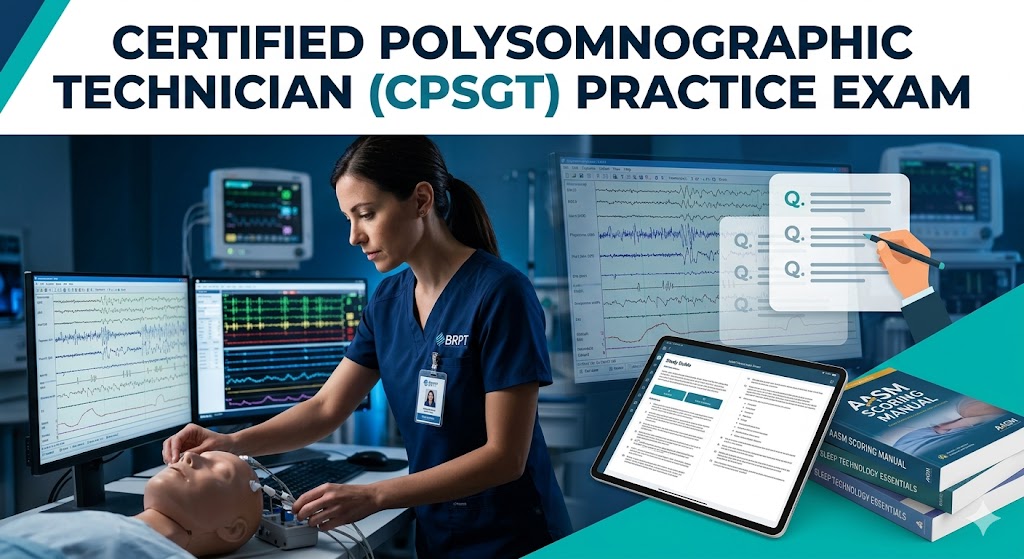
Additional Information
What the Course Entails and Exam Details
While there is no single "course" required for
the CPSGT, candidates must meet specific eligibility pathways involving a
combination of educational programs (like STAR-designated programs) and
clinical experience.
Preparation for the exam requires a deep understanding of
the domains outlined in the BRPT candidate handbook.
The core domains and skills covered include:
Study Performance and Recording: This includes preparing
the patient for the study, applying sensors and electrodes using the 10-20
system, calibrating equipment, and recognizing artifacts that can distort data.
Anatomy and Physiology: Understanding basic respiratory,
cardiac, and neurological physiology as it relates to sleep is crucial.
Device Operation and Maintenance: Technicians must be
proficient with polysomnography equipment, positive airway pressure (PAP)
devices, and oxygen delivery systems.
Emergency Procedures and Patient Safety: This covers
recognizing life-threatening situations, responding appropriately to clinical
events, and adhering to infection control guidelines.
Sleep Scoring Basics: While primarily an RPSGT skill,
CPSGT candidates must have a foundational knowledge of identifying sleep
stages, respiratory events, and movements based on the American Academy of
Sleep Medicine (AASM) Scoring Manual.
What to Expect in the Final Exam
The CPSGT exam is a computer-based testing (CBT)
examination.
The exam consists of 75 multiple-choice questions.
Of these 75 questions, only 60 are scored, while 15 are
pre-test items used for research and development; however, candidates do not
know which questions are which, so every question should be treated as
important.
Candidates are given exactly 1.5 hours (90 minutes) to
complete the entire examination.
The results are reported using scaled scores, ranging
from 200 to 500, with a scaled score of 350 required to pass.
Specific rules include bringing valid, government-issued
photo identification to the testing center and agreeing to security procedures,
including prohibition of electronic devices or reference materials inside the
testing room.
How to Study and
Exam Centers
Effective preparation for the CPSGT requires a structured
study plan combining theoretical knowledge and practical experience.
Start by obtaining and thoroughly reading the current
BRPT CPSGT Candidate Handbook.
Utilize the BRPT Exam Blueprint to understand the
weighting of each domain and focus your study time accordingly.
Review core textbooks, such as the Atlas of Clinical
Sleep Medicine and the current AASM Manual for the Scoring of Sleep and
Associated Events.
Perhaps the most effective method for assessment is to
take a formal CPSGT practice exam.
Reliable practice exams help familiarize you with the
wording of questions, the time constraints of the test, and identify specific
knowledge gaps that require further review.
The official CPSGT exam is administered via Pearson VUE,
which offers a vast network of professional testing centers globally.
Once a candidate's application is approved by the BRPT,
they will receive an authorization-to-test email allowing them to schedule
their exam at a convenient Pearson VUE physical location.
Job Opportunities
from the Course
Achieving the CPSGT designation immediately enhances
employability and opens doors to entry-level positions within sleep disorder
centers and hospitals.
It proves to employers that you possess verified
competency in sleep technology.
Specific job titles and career paths this certification
unlocks include:
- Polysomnographic
Technician
- Sleep
Technician I / Entry-Level Sleep Tech
- Sleep
Lab Assistant
- Clinical
Sleep Research Assistant
- Medical
Technician (Sleep Medicine Specialty)
- Pathway
to Registered Polysomnographic Technologist (RPSGT)
Frequently Asked Questions
Reviews
5.0
Based on 0 reviews
Leave a Review
No reviews yet. Be the first to review!