
Certified Procurement Transplant Coordinator (CPTC) Practice Exam
$69.00
- Buy to unlock unlimited access to all Quiz questions and Answers in this Quiz.
- After purchase you can print a PDF of the whole quiz at any point. The PDF will contain the questions and the correct answers.
About this Exam
The Certified Procurement Transplant Coordinator (CPTC)
credential is a prestigious, National Commission for Certifying Agencies
(NCCA)-accredited certification for medical professionals specializing in the
organ donation and procurement process. This exam is meticulously designed for
those who act as the vital link between a deceased donor and the surgical
recovery team. A CPTC coordinates every critical clinical detail, from the
identification and management of the organ donor to the facilitation of the surgical
recovery logistics. By conquering this exam, you demonstrate specialized
knowledge and a commitment to the highest standard of practice, ensuring that
the precious gift of life is facilitated with paramount care and ethical
precision.
Ready to test your knowledge?
Buy Now to Access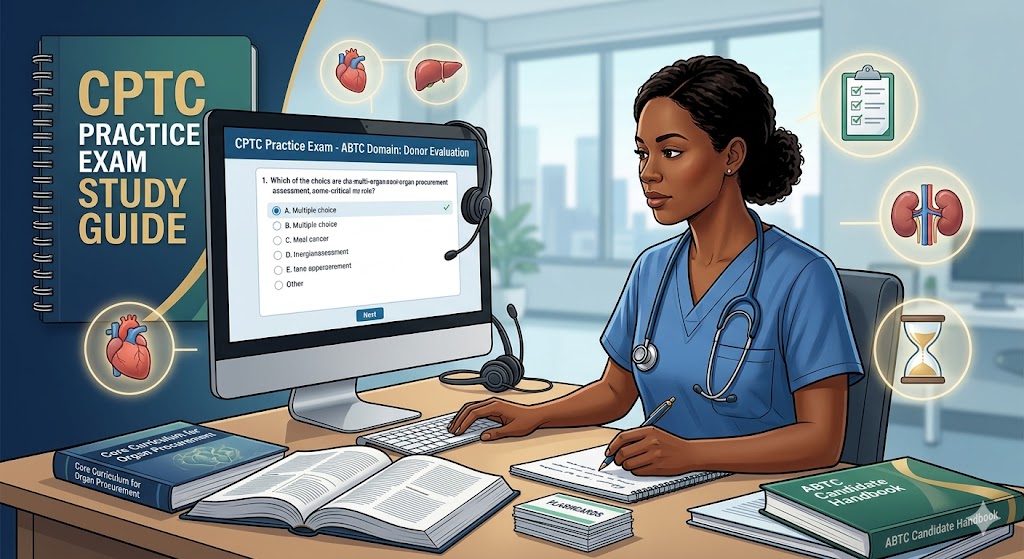
Additional Information
What the Course Entails and Exam Details
While the CPTC designation is obtained through an exam
rather than a single course, successful candidates must possess a robust
foundation in clinical practice. The exam’s blueprint focuses on key
operational and clinical domains essential for the procurement coordinator
role. These include donor evaluation and management—where you must assess the
viability of organs and manage physiological parameters in a deceased donor—as
well as authorization and ethical considerations. The syllabus also heavily emphasizes
logistics, operational flow, and standard protocols for organ recovery, from
coordinating surgical teams to ensuring aseptic organ preservation and
subsequent transportation. Understanding professional practice standards and
legal requirements in transplantation is also critical.
What to Expect in the Final Exam
The official CPTC certification exam, administered by the
American Board for Transplant Certification (ABTC), is a computer-based test
that challenges your ability to apply knowledge in a high-stakes scenario. You
should prepare for a multiple-choice format consisting of approximately 150
questions. Candidates are typically allotted a single, four-hour window to
complete the test. Since the exam relies on a scaled scoring system to ensure
fairness across different test versions, there is no fixed raw "passing
percentage." It is crucial to manage your time effectively, as there is no
penalty for guessing; ensure you answer every question. Be sure to consult the
most recent ABTC Candidate Handbook for official confirmation of question
counts and current time limits.
How to Study and
Exam Centers
Preparation for this comprehensive exam should start with a
dedicated review of the official ABTC CPTC Test Blueprint to ensure you
understand the weighting of each subject area. Actionable study methods include
studying standard perianesthesia or critical care nursing textbooks, utilizing
the core curriculum materials provided by the North American Transplant
Coordinators Organization (NATCO), and forming a focused study group. Many
candidates also find value in taking the official ABTC online practice exams,
which include 50 questions designed to mirror the actual exam format and level
of difficulty.
The official exam is administered at secure PSI testing
centers located across the country. To schedule your exam, you will need to
apply through the ABTC’s online portal. Once approved, you will be directed to
PSI’s scheduling system to choose a location, date, and time. Ensure you arrive
at least 30 minutes before your appointment with a valid government-issued
photo ID. Be prepared for standard security procedures, as the final exam
environment is highly structured.
Job Opportunities
from the Course
Earning the CPTC certification validates your unique skill
set to employers and organizations nationwide. This credential unlocks numerous
specialized career paths within organ procurement organizations (OPOs) and
transplant centers. The most common primary job title unlocked by this course
is a Certified Procurement Transplant Coordinator. However, other specific,
high-impact titles and advanced career paths include:
- Lead
Organ Procurement Coordinator
- OPO
Clinical Supervisor
- Director
of Procurement Operations
- Transplant
Clinical Educator
- OPO
Director of Quality Assurance
- Transplant
Surgical Recovery Specialist
Frequently Asked Questions
Reviews
5.0
Based on 0 reviews
Leave a Review
No reviews yet. Be the first to review!