
Certified Professional Dog Trainer (CPDT) Practice Test
$69.00
- Buy to unlock unlimited access to all Quiz questions and Answers in this Quiz.
- After purchase you can print a PDF of the whole quiz at any point. The PDF will contain the questions and the correct answers.
About this Exam
Elevate your passion for dog training to a professional
level by mastering the Certified Professional Dog Trainer - Knowledge Assessed
(CPDT-KA) exam. This comprehensive certification, offered by the Certification
Council for Professional Dog Trainers (CCPDT), validates your theoretical
knowledge of canine behavior, training science, and ethical practices.
Specifically designed for aspiring and practicing dog trainers, achieving this
distinction demonstrates your commitment to scientific, humane training methods
and signals credibility to clients and the pet industry alike. This practice
exam is your essential first step toward securing this prestigious credential.
Ready to test your knowledge?
Buy Now to Access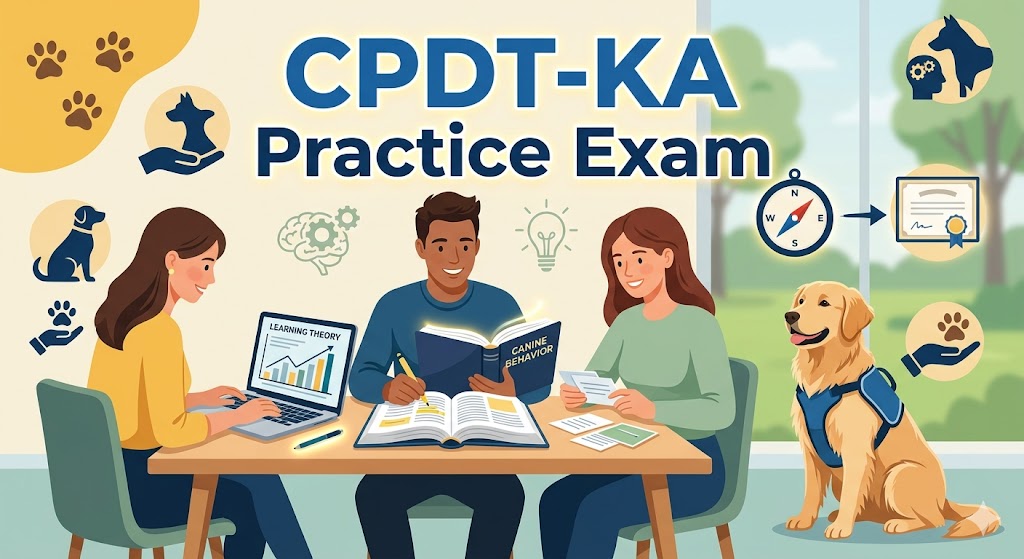
Additional Information
What the Course Entails and Exam Details
Preparing for the CPDT-KA certification requires a deep
understanding of several complex domains beyond simply knowing how to teach
commands. The study curriculum (which students follow prior to taking the exam)
focuses heavily on the scientific principles of animal learning and practical
application.
The core syllabus and examination areas include:
Instructional Skills (approx.
21%): Mastering techniques to effectively coach human clients, ensuring
they understand the training mechanics to work with their dogs successfully.
Animal Husbandry and Ethology
(approx. 17%): Understanding canine development, biology, sensory
capabilities, and natural behavior patterns necessary for safe and informed
training.
Learning Theory (approx. 33%):
A thorough command of classical and operant conditioning (the four quadrants),
reinforcement schedules, and other scientific behavioral concepts.
Applied Knowledge and Ethics:
Synthesizing these elements in real-world scenarios while adhering to the
strict CPDT-KA Code of Ethics.
What to Expect in the Final Exam
The actual CPDT-KA credentialing exam is a rigorous test of
theoretical knowledge, not a practical assessment with a live animal. When you
arrive at the testing center or log in for remote proctoring, you will face a
standardized, computer-based exam.
Here are the key details you must know:
- Format:
The exam consists of approximately 180 to 200 multiple-choice questions.
- Content
Focus: Every question is psychometrically linked to one of the
critical knowledge domains listed above.
- Time
Limit: You are typically allocated four (4) hours to complete the
examination.
- Passing
Score: The CCPDT utilizes scaled scoring to determine the passing
threshold, rather than a fixed raw number, to account for variations in
exam difficulty across versions.
- Environment:
The exam is administered in a secure, proctored environment. No outside
study aids are permitted.
How to Study and Exam Centers
Successfully challenging the CPDT-KA requires dedicated
study and robust practical experience (which is a prerequisite for
application). Leverage this practice exam often; use your results not just to
track your score, but to identify precise domains where you need to return to
your source materials.
Your effective study strategy should include:
Read the Source Material:
Use the official CCPDT reading list as your bible. Many candidates find
textbooks like "Don’t Shoot the Dog!" or detailed ethology
manuals to be invaluable.
Review Learning Theory DAILY:
This is the heaviest-weighted section. Ensure you can visualize and apply
"positive reinforcement," "negative punishment,"
"variable ratios," and "extinction bursts" instantly.
Cross-Reference Ethics:
Study the CPDT-KA Code of Ethics thoroughly. You must answer scenario questions
based on professional ethics, not just personal preference.
Practical Application
(Required): Remember, you must already have documentable practical hours
before you can even register. Apply your theoretical study to your real-world
clients.
Where to Take the Exam: The CCPDT contracts with an
established, global testing network (such as Prometric or similar) to ensure
test security. You will schedule your exam during specific testing windows held
several times a year. Candidates take the test at secure testing centers
located worldwide or via highly regulated remote proctoring, depending on
availability.
Job Opportunities from the Course
Earning your CPDT-KA credential opens doors across the
flourishing pet industry, immediately distinguishing you as a serious,
evidence-based professional. It is often a key requirement for employment in
reputable organizations or the foundation for a successful private business.
This certification unlocks and enhances numerous career
paths, including:
- Professional
Private Dog Trainer (Business Owner or Staff)
- Group
Obedience Class Instructor
- Shelter
Training Coordinator or Canine Behavior Specialist
- Veterinary
Behavior Technician
- Agility
or Dog Sports Coach
- K9
Handler (Police, Search & Rescue) or Trainer for Service Organizations
- Retail
Pet Training Manager
- Dog
Boarding and Daycare Behavior Consultant
Frequently Asked Questions
Reviews
5.0
Based on 0 reviews
Leave a Review
No reviews yet. Be the first to review!