
Certified Public Accountants (CPA) Ethics
$69.00
- Buy to unlock unlimited access to all Quiz questions and Answers in this Quiz.
- After purchase you can print a PDF of the whole quiz at any point. The PDF will contain the questions and the correct answers.
About this Exam
The Certified Public Accountants (CPA) Ethics Exam represents a critical milestone on the path to full licensure.
Unlike the rigorous numerical challenges of the Uniform CPA Exam, this specific test focuses entirely on the moral and legal obligations of the profession.
It is designed for candidates who have successfully completed the main CPA exam sections and are finalizing their state licensing requirements.
The CPA Ethics Practice Exam serves as the essential preparatory tool to ensure you understand and can apply the complex ethical standards required of today's financial leaders.
Ready to test your knowledge?
Buy Now to Access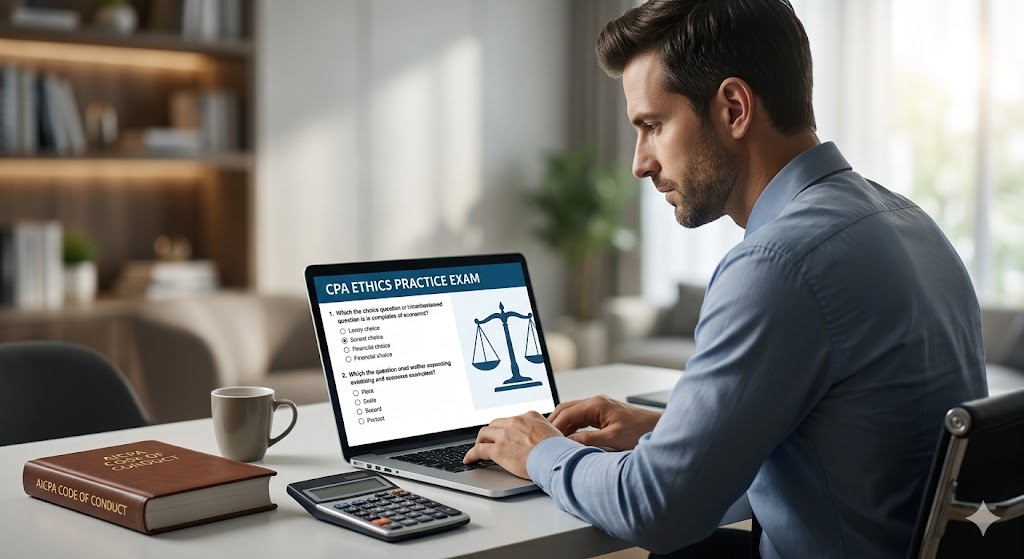
Additional Information
What the Course Entails and Exam Details
Preparing for this exam requires a deep dive into the
regulatory framework that governs accounting practitioners.
While exact content can vary slightly by state, most
candidates utilize the AICPA’s self-study course, “Professional Ethics: The
AICPA’s Comprehensive Course.”
This course covers foundational principles including the
AICPA Code of Professional Conduct and fundamental concepts of CPA
independence.
You will explore professional responsibilities toward
clients, employers, and the public, as well as specific rules regarding
conflicts of interest and confidentiality.
Furthermore, the materials detail the enforcement mechanisms
and potential penalties associated with ethical violations.
What to Expect in the Final Exam
The structure of the final CPA Ethics Exam is significantly
different from the four standard CPA sections.
Generally, this is an "open book" exam, allowing
you to reference course materials during the testing process.
The format consists entirely of multiple-choice questions
designed to test your application of ethical rules to real-world scenarios.
Candidates are typically allowed ample time, sometimes
several hours, and can often take the exam within their own home or office
environment.
The passing requirement is extraordinarily high, usually
requiring a minimum score of 90%.
You must carefully review the regulations for your specific
state board, as a small number of states require their own unique ethics
assessments rather than the AICPA course.
How to Study and Exam Centers
Success on this exam hinges on careful reading comprehension
rather than intense mathematical calculation.
The most effective study strategy is to thoroughly read the
provided AICPA course materials once before attempting any practice questions.
Focus your energy on understanding practical application
scenarios, particularly those involving CPA independence and client
relationships.
Using the CPA Ethics Practice Exam is paramount, as it
familiarizes you with the question style and highlights areas where your
ethical understanding needs refinement.
Regarding exam administration, most CPA Ethics Exams are
taken through a secure online portal provided by the AICPA or the candidate's
specific state board.
You are not typically required to visit a physical proctored
testing center like Pearson VUE for this specific requirement.
Job Opportunities from the Course
Passing the CPA Ethics Exam is the key that unlocks official
CPA licensure, significantly enhancing your professional value.
This credential opens doors to advanced leadership roles and
specialized career paths that demand the highest levels of trust and expertise.
Licensure enables you to advance into positions such as
Audit Senior or Audit Manager within public accounting firms.
You may choose a specialized path as a Tax Senior, managing
complex compliance issues for corporations or high-net-worth individuals.
The qualification is highly valued in the corporate sector
for roles such as Corporate Controller, overseeing entire accounting
departments.
Additionally, it serves as a crucial stepping stone toward
executive leadership as a Chief Financial Officer (CFO).
Furthermore, CPA licensure authorizes individuals to
practice as independent Certified Public Accountants, offering consultation or
running their own accounting firms.
Frequently Asked Questions
Reviews
5.0
Based on 0 reviews
Leave a Review
No reviews yet. Be the first to review!