
Certified Quality Process Analyst
$69.00
- Buy to unlock unlimited access to all Quiz questions and Answers in this Quiz.
- After purchase you can print a PDF of the whole quiz at any point. The PDF will contain the questions and the correct answers.
About this Exam
The Certified Quality Process Analyst (CQPA) certification
is a prestigious credential awarded by the American Society for Quality (ASQ).
It is specifically designed for professionals who, while
they may not have a traditional engineering background, are deeply involved in
the analysis and improvement of quality processes.
This certification validates your understanding of quality
tools and your ability to analyze and solve quality problems, making it ideal
for recent graduates, people new to the quality field, or experienced
professionals looking to formalize their process analysis skills.
Earning a CQPA 1 designation demonstrates a foundational
mastery of quality principles and a commitment to operational excellence within
any organization.
Ready to test your knowledge?
Buy Now to Access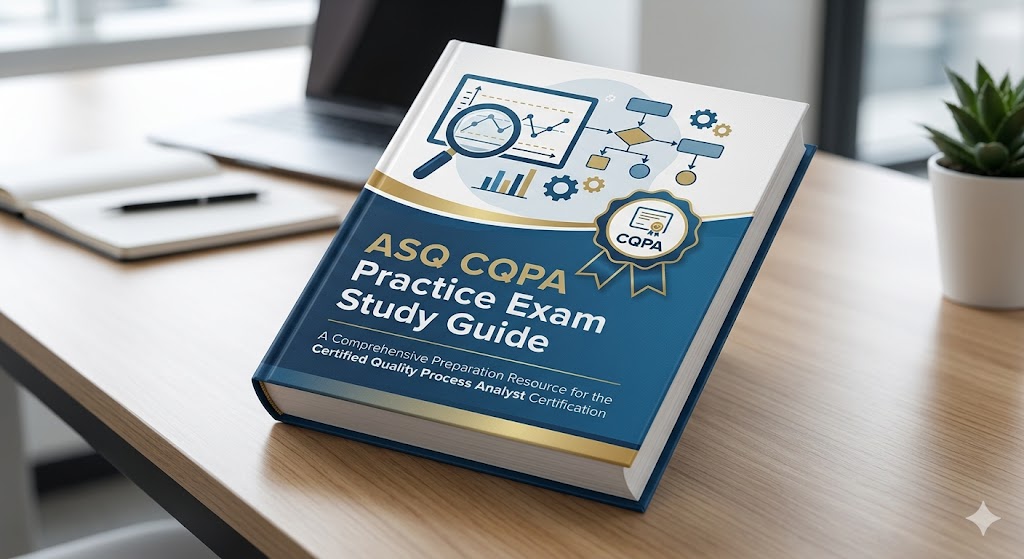
Additional Information
What the Course Entails and Exam Details
Preparing for the CQPA exam requires a robust understanding of the ASQ Body of Knowledge (BoK).
The course and exam cover fundamental domains essential for any quality professional focusing on process analysis.
Core topics include:
• Quality Concepts and Tools (22 Questions): Understanding the history of quality, common continuous improvement tools (like Pareto charts, fishbone diagrams, and flowcharts), and the Plan-Do-Study-Act (PDSA) cycle.
• Problem Solving and Improvement (18 Questions): Applying the DMAIC methodology (Define, Measure, Analyze, Improve, Control) and identifying various types of waste in a process.
• Data Analysis (30 Questions): Basic statistical concepts, data collection methods, and interpreting common statistical charts and graphs.
• Customer-Supplier Relationships (15 Questions): Understanding internal and external customers, defining requirements, and managing supplier quality.
• Corrective and Preventive Action (CAPA) (15 Questions): Identifying root causes and implementing effective CAPA plans.
The exam focuses on the practical application of these concepts in real-world scenarios.
What to Expect in the Final Exam
The ASQ CQPA exam is a comprehensive, rigorous assessment.
Here are the specific details of what you will encounter:
• Format: The exam is purely multiple-choice.
• Question Count: There are 110 total multiple-choice questions, but only 100 are scored. The remaining 10 are unscored 'pilot' questions used for future exam development.
• Time Limit: You are allotted 4 hours (240 minutes) to complete the computer-based test (CBT).
• Passing Score: The exam uses a scaled score. ASQ does not publish a raw percentage required to pass, but the scaled score required is typically 550 out of 750.
• Rules: This is a "modified open-book" exam. You may bring official, bound reference materials (like the ASQ Certified Quality Process Analyst Handbook) and a non-programmable calculator. Personal notes, loose papers, and electronic devices are prohibited.
How to Study and Exam Centers
Effective preparation is key to succeeding on the CQPA exam.
Study Strategies:
• Master the Body of Knowledge (BoK): Your primary resource is the ASQ CQPA BoK. Every question is mapped to a specific topic within this document.
• Use the Official Handbook: The ASQ Certified Quality Process Analyst Handbook is indispensable. Since the exam is open-book, you must be extremely familiar with this book, using tabs to find information quickly.
• Take Practice Exams: Utilize ASQ's official question bank and other reputable practice tests. This is critical for understanding the question format and managing your time.
• Join a Study Group: ASQ has local sections that often host study groups. Learning with peers can clarify complex topics.
Exam Centers:
ASQ administers the computer-based CQPA exam globally through its testing partner, Prometric.
You will need to apply and receive authorization from ASQ first. Once authorized, you can schedule your exam at a Prometric physical testing center closest to you. These are secure environment centers specifically designed for professional certification testing.
Job Opportunities from the Course
Achieving the CQPA certification signals to employers that you possess verified skills in quality analysis and process improvement.
This credential can unlock numerous career paths and increase your salary potential.
Specific job titles and career paths this certification supports include:
• Quality Process Analyst
• Quality Assurance Specialist
• Process Improvement Technician
• Quality Control Analyst
• Data Analyst (Quality Focus)
• Junior Quality Engineer
• Production Supervisor (Quality Track)
• Compliance Specialist
Frequently Asked Questions
Reviews
5.0
Based on 0 reviews
Leave a Review
No reviews yet. Be the first to review!