
Certified Recovery Support Specialist
$69.00
- Buy to unlock unlimited access to all Quiz questions and Answers in this Quiz.
- After purchase you can print a PDF of the whole quiz at any point. The PDF will contain the questions and the correct answers.
About this Exam
The Certified Recovery Support Specialist (CRSS) designation represents a crucial and rapidly growing professional role in the behavioral health workforce. This certification is specifically designed for individuals who possess lived experience in recovery from mental health or substance use challenges. This credential empowers peer professionals to utilize their personal history to support, mentor, and advocate for others currently navigating their own recovery journeys. The CRSS certification validates a specialist's skills in providing effective, recovery-oriented services, and the CRSS exam is the essential final step in earning this respected designation. It is aimed at compassionate individuals who are stable in their own recovery and seek to professionally guide others toward empowerment and wellness.
Ready to test your knowledge?
Buy Now to Access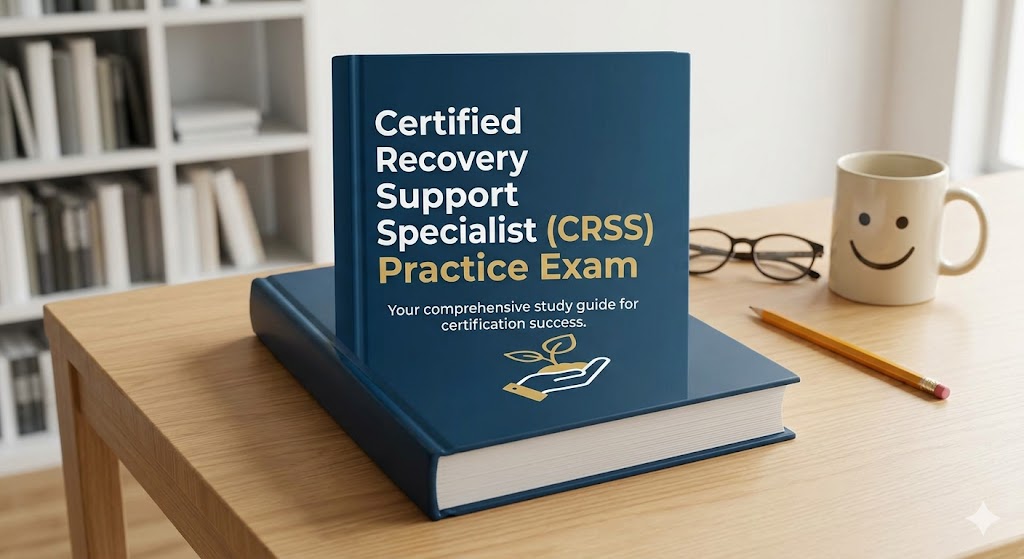
Additional Information
What the Course Entails and Exam Details
While exact curricula can vary slightly by state or
certifying body, training programs preparing candidates for the CRSS exam focus
on core competency domains. These foundational topics ensure that a specialist
can provide ethical and effective support. Candidates are expected to master
concepts related to advocacy, recovery principles, mentoring, and education. A
vital skill covered is professional responsibility, which dictates the scope of
the peer support role and emphasizes the crucial boundaries required.
Additionally, the coursework teaches strategies for communication, goal
setting, wellness planning, and navigating social service systems. The goal is
to translate lived experience into a professional toolset that fosters
connection without compromising clinical boundaries.
What to Expect in the Final Exam
Understanding the structure of the final CRSS exam is key to
managing test anxiety. The actual examination is typically administered as a
multiple-choice test, focusing on practical scenario-based questions that test
your ability to apply core recovery principles. These questions often ask how a
recovery support specialist should handle a specific client interaction or
ethical dilemma. In most jurisdictions, you are allotted a specific time limit
to complete the test, usually ranging from 1.5 to 3 hours. A passing score is
defined by the specific IC&RC member board or certifying body in your
state, so it is vital to check your local requirements. It is a closed-book
exam, and all personal materials are forbidden during the session.
How to Study and
Exam Centers
Effective preparation for the CRSS exam requires a blend of
conceptual review and practical application. First, obtain the official
candidate handbook and detailed Content Outline from your specific certifying
board; this document tells you exactly what topics will be on the test.
Dedicate focused study time to the specialized code of ethics, as this area is
often heavily weighted. Crucially, utilize a CRSS practice exam as a
cornerstone of your study method. Taking a practice test not only highlights knowledge
gaps but also helps you get comfortable with the wording and format of
scenario-based questions.
When you are ready to sit for the official exam, you will
need to schedule an appointment through your certifying board's approved
administrator. In many states, the exam is proctored via computer-based testing
networks such as Pearson VUE, which offer numerous physical testing locations
worldwide. Some state boards may also provide their own secure online portals,
allowing you to take the exam from your home with remote proctoring software.
Job Opportunities
from the Course
Earning the CRSS credential significantly expands your
career horizons within the social services and integrated healthcare fields.
This certification is highly valued by employers as it validates your
professional competence and readiness to work on collaborative recovery teams.
Achieving this certification unlocks numerous job titles and
career paths, including:
Recovery Support Specialist. Peer Support Specialist.
Recovery Coach. Residential Assistant in treatment facilities. Sober Living
Manager. Care Coordinator. Behavioral Health Outreach Worker. Case Management
Aide. Mental Health Associate.
Frequently Asked Questions
Reviews
5.0
Based on 0 reviews
Leave a Review
No reviews yet. Be the first to review!