
Certified Rhythm Analysis Technician
$69.00
- Buy to unlock unlimited access to all Quiz questions and Answers in this Quiz.
- After purchase you can print a PDF of the whole quiz at any point. The PDF will contain the questions and the correct answers.
About this Exam
The Certified Rhythm Analysis Technician (CRAT)
certification is a vital credential for healthcare professionals specializing
in electrocardiogram (ECG) interpretation and cardiac monitoring. This
certification validates an individual's expertise in analyzing complex heart
rhythms and patterns, positioning them as essential members of any cardiology
team. It is ideally designed for ECG technicians, telemetry technicians,
medical assistants, and cardiac monitoring personnel who wish to demonstrate
proficiency and advance their careers. The CRAT credential is a recognized mark
of excellence, signaling that a technician can accurately identify potential
cardiovascular issues, directly impacting patient outcomes and contributing
significantly to diagnostic precision.
Ready to test your knowledge?
Buy Now to Access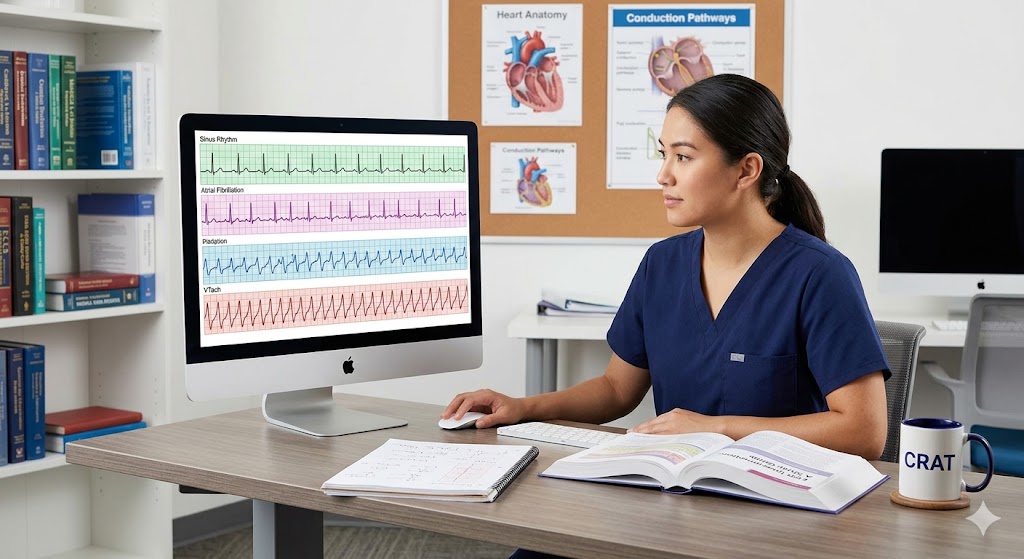
Additional Information
What the Course Entails and Exam Details
While the specific curriculum may vary slightly depending on
the course provider, a CRAT program typically covers comprehensive cardiac
physiology and extensive rhythm strip analysis. Core topics include the anatomy
and electrical system of the heart, the fundamentals of the electrocardiogram
waveform, and precise methodologies for measuring cardiac intervals. Students
explore sinus rhythms, atrial dysrhythmias, junctional rhythms, and
life-threatening ventricular abnormalities like ventricular fibrillation and
asystole. Beyond rhythm recognition, the training equips students to identify
artifacts that can distort ECG readings and addresses critical emergency
protocols for malignant arrhythmias. Mastering these complex concepts ensures
that technicians can confidently determine patient safety status in real-time
healthcare settings.
What to Expect in the Final Exam
The CRAT exam is generally conducted in a computer-based
testing format, comprising approximately 100 to 120 multiple-choice questions.
It is a timed examination, typically allowing candidates two hours for
completion. The questions assess a candidate's knowledge across various
domains, often including Basic Electrophysiology, Normal ECG, Arrhythmia
Identification, and Pacemaker Fundamentals. To achieve passing status,
candidates usually need a minimum score of around 70%. It is important to note
that the exam typically maintains a closed-book policy, prohibiting external
references. Preparation therefore relies on mastering the material and
fine-tuning speed and accuracy in interpreting cardiac strips under time
constraints.
How to Study and Exam Centers
Preparation for the CRAT exam requires a dedication to both
foundational knowledge and practical application. Begin by thoroughly reviewing
accredited study materials and textbooks that detail the anatomy of cardiac
rhythms. Utilize flashcards to quickly memorize the characteristics and
critical values associated with various dysrhythmias. Engaging with practice
questions is essential; practice exams help you understand the question format
and identify knowledge gaps. When taking a CRAT practice exam, focus on pacing
yourself and reviewing incorrect answers to ensure you comprehend the
"why" behind the correct interpretation. The physical examination is
often administered at secure, authorized testing centers, such as Pearson VUE,
which provides a controlled environment for candidates. Ensure you check with
your certifying body for specific registration details and location
availability.
Job Opportunities from the Course
A Certified Rhythm Analysis Technician (CRAT) designation
significantly enhances career opportunities within the healthcare field.
Certified technicians are in high demand and are eligible for various rewarding
positions that play a direct role in patient diagnostics and cardiac
monitoring. Key job opportunities unlocked by this certification include:
- Telemetry
Technician (Monitors and analyzes ECG data for patients across entire
hospital units)
- ECG/EKG
Technician (Performs standard diagnostic ECGs and assists with stress
testing)
- Holter
Monitor Technician (Processes and analyzes multi-day cardiac monitor
recordings)
- Cardiology
Clinic Assistant (Supports cardiologists in diagnosing and managing heart
conditions)
- Cardiac
Monitor Technician (Provides real-time arrhythmia detection in specialized
units)
- Emergency
Department Technician (Applies ECG knowledge during time-sensitive cardiac
emergencies)
Frequently Asked Questions
Reviews
5.0
Based on 0 reviews
Leave a Review
No reviews yet. Be the first to review!