
Certified Scrum Product Owner (CSPO) Practice Exam
$69.00
- Buy to unlock unlimited access to all Quiz questions and Answers in this Quiz.
- After purchase you can print a PDF of the whole quiz at any point. The PDF will contain the questions and the correct answers.
About this Exam
The Certified Scrum Product Owner (CSPO) is a fundamental,
globally recognized credential that verifies your mastery of the Product Owner
role within the Scrum framework.
Unlike many technical certifications, CSPO focuses heavily
on the business aspects of software development and product management.
The certification is designed for professionals who are
responsible for defining the product vision, managing the product backlog, and
maximizing the value delivered by the development team.
This study guide, including a robust CSPO practice exam, is
ideal for aspiring Product Owners, existing Product Managers, Project Managers
transitioning to Agile, or Business Analysts looking to deepen their strategic
impact.
By mastering the concepts covered, you prove your ability to
effectively bridge the gap between business stakeholders and technical
execution.
Ready to test your knowledge?
Buy Now to Access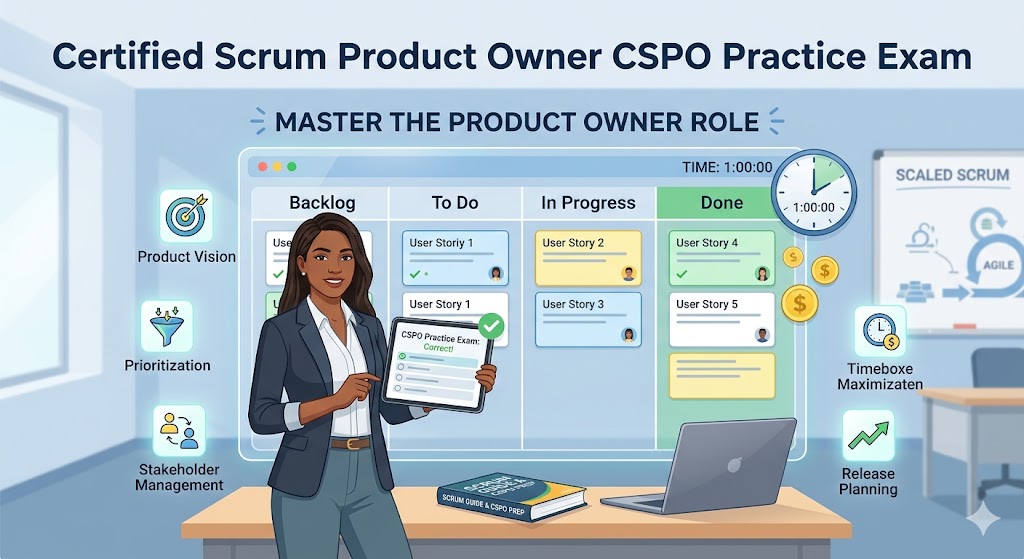
Additional Information
What the Course Entails and Exam Details
The path to earning your CSPO certification is unique
compared to other Scrum credentials.
It does not typically conclude with a standard, timed,
multiple-choice final exam taken at a testing center.
Instead, the main prerequisite is full attendance and active
participation in a two-day (14–16 hour) mandatory workshop taught by a
Certified Scrum Trainer (CST).
Diagnostic Practice Exams: Because there is no final
Scrum Alliance exam, a diagnostic CSPO Practice Exam serves as a
powerful assessment tool before or during your workshop to ensure
you fully grasp the core learning objectives.
Core Syllabus Covered: The learning goals provided by
the Scrum Alliance generally cover the following key domains, which a practice
exam will rigorously test:
Product Owner Core Competencies: Deeply understanding
the PO responsibilities vs. the Scrum Master and Development Team.
Product Vision & Strategy: How to define,
articulate, and maintain a compelling product vision that aligns with business
goals.
Understanding Customers and Users: Techniques for
segmenting users, gathering requirements, and empathy mapping.
Validating Product Assumptions: Moving from guesses
to data-driven decision-making using hypotheses and experiments.
Product Backlog Management: Mastering the essential
art of creating, refining, prioritizing, and ordering backlog items to maximize
return on investment (ROI).
What to Expect in
the Final Exam
As established, there is currently no final, high-stakes
exam administered by the Scrum Alliance for the initial CSPO certification.
Many people search for "CSPO exam details" because
other organizations (like Scrum.org for their PSPO credential) do have a test.
For the CSPO, the standard you must meet is set by your
Certified Scrum Trainer (CST).
While they will not give you a final exam score, they will
assess your understanding continuously throughout the two-day course.
You pass by engaging deeply in practical simulations,
answering questions correctly during workshop discussions, showing proficiency
in backlog refinement exercises, and demonstrating your competence to the
trainer during the class.
A diagnostic CSPO Practice Exam is your best method
for ensuring you feel confident in this real-time environment.
How to Study and
Exam Centers
Since your "exam center" is the two-day workshop
itself (which may be conducted live online or at an authorized physical
location by a CST-vetted school), your study strategy should be focused on
mastery, not memorization.
Step 1: Diagnostic Practice Exams. Use these tools first
to benchmark your current understanding. A well-designed practice exam allows
you to identify weak spots in prioritization theory, vision statement creation,
or user story definition before you attend the class. This diagnostic
approach allows you to formulate specific questions for your trainer.
Step 2: Study the Source Material. Read the
foundational document—The 2020 Scrum Guide. Every answer to a Scrum question is
rooted in this guide. Also, review the Agile Manifesto and its 12 Principles.
Step 3: Actively Participate. During your CST
workshop, ask challenging questions and engage in every simulation. Your
trainer is a resource, and your classmates offer real-world perspectives. The
more you put in, the more your competence (which the trainer is assessing) is
validated.
Step 4: Post-Class Refreshers. After your training,
use the CSPO Practice Exam again to confirm your retention and prepare
for real-world Product Ownership.
Job Opportunities
from the Course
Earning your Certified Scrum Product Owner credential
unlocks an immense range of career paths across nearly every industry, as
organizations increasingly adopt Agile to deliver value faster.
The certification proves you can prioritize, lead strategic
initiatives, and communicate effectively between tech and business.
Specific job titles unlocked by this credential include:
Primary Product Roles: Certified Scrum Product Owner
(CSPO), Associate Product Owner, Senior Product Owner, Agile Product Manager,
Product Line Manager.
Business Strategy & Analyst Roles: Senior
Business Analyst (with an Agile focus), Business Systems Analyst, Agile Product
Strategist.
Leadership & Transition Roles: Agile Coach,
Release Train Engineer (RTE), Agile Project Manager (transitioning from
traditional waterfall to a value-focused role).
Frequently Asked Questions
Reviews
5.0
Based on 0 reviews
Leave a Review
No reviews yet. Be the first to review!