
Certified Sommelier Practice
$69.00
- Buy to unlock unlimited access to all Quiz questions and Answers in this Quiz.
- After purchase you can print a PDF of the whole quiz at any point. The PDF will contain the questions and the correct answers.
About this Exam
Welcome to the ultimate preparation hub for the Certified
Sommelier Practice Exam. The Certified Sommelier credential, awarded by the
Court of Master Sommeliers (CMS Americas and Europe), is the respected second
level of certification for wine professionals globally. It is designed
specifically for individuals already working in the hospitality industry, such
as servers, bartenders, retail staff, and aspiring beverage directors. This
rigorous certification validates your comprehensive beverage knowledge, refined
tasting ability, and impeccable tableside service skills. If you are serious
about advancing your career in the world of wine and hospitality, conquering
this exam is your critical next step.
Ready to test your knowledge?
Buy Now to Access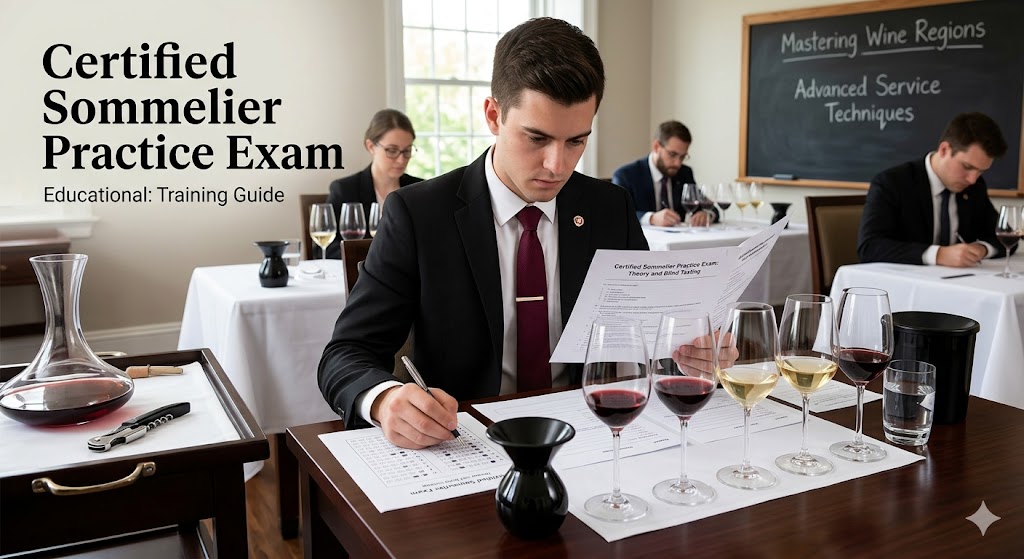
Additional Information
What the Course
Entails and Exam Details
This Certified Sommelier Practice Exam is a
simulation designed to prepare candidates for the actual examination day. The
core syllabus and required skills cover a vast array of topics across three
distinct pillars:
Theory Knowledge: Candidates must demonstrate
comprehensive knowledge of all major wine-producing regions of the world, their
significant grape varieties, classifications, history, and labeling laws. This
section also encompasses intermediate understanding of spirits, beer, sake,
cocktails, and proper beverage service practices.
Deductive Tasting: You are required to correctly
identify, analyze, and describe multiple wines using the Court of Master
Sommeliers’ specific Deductive Tasting Method.
Service Skills: The exam demands mastery in
professional wine service, including standard still wine service and sparkling
wine service. It covers the technical skills required in a restaurant setting,
such as proper opening, pouring, decanting, and customer interaction.
What to Expect in the Final Exam
While a practice exam aims to mimic the experience, the
actual Certified Sommelier Examination is a standardized, highly regulated
process. Candidates must prepare for the following format:
Exam Structure: The official exam consists of three
component parts, and all three must be taken and passed on the same day to earn
the certification.
Written Theory (Multiple Choice): A timed
examination, usually consisting of approximately 40 to 60 multiple-choice
questions covering all theoretical knowledge mentioned above. There is no
penalty for guessing. A passing grade is typically 60% or higher.
Tasting (The Deductive
Method): Candidates are presented with four distinct wines (usually two
white and two red) and given approximately 30 minutes to complete written
tasting descriptions. Candidates must accurately analyze and identify the grape
variety, region, and vintage, with a minimum passing score of 60%.
Service (Practical): This is a timed,
high-pressure practical examination where candidates perform specific service
duties, such as champagne service or decanting for a tableside guest (who is a
CMS examiner). You are graded on technical ability, professionalism, speed,
cleanliness, and product knowledge during the service interaction.
Time Limits: Strict time limits are enforced for all
three sections. The entire exam typically spans several hours on a single day.
Candidates are expected to be presentable in professional restaurant attire.
How to Study and Exam Centers
Studying for the Certified Sommelier exam requires a blend
of rigorous self-study, repeated physical practice, and refined sensory
training. This Certified Sommelier Practice Exam is your critical
rehearsal tool. Here is how to prepare effectively:
Actionable Study Strategies:
- Master
the CMS Deductive Tasting Method: Utilize official CMS tasting grid
templates and practice weekly, analyzing dozens of benchmark wines under
exam conditions.
- Deep-Dive
into Geography and Theory: Create flashcards for every major wine
region (e.g., all 61 Bordeaux classifications, Italian DOCGs, German
anbaugebiete). Study the official CMS Intro course workbook.
- Drill
Your Service Routines: Practice serving champagne and decanting still
wine repeatedly until the physical motions are fluid and precise. Film
yourself or have a mentor critique you. Focus on speed and minimizing
drips and sounds.
- Leverage
Practice Tests: Use comprehensive Certified Sommelier Practice
Exams to assess your knowledge under timed conditions. Focus on
understanding why you got questions wrong.
Where to Take the Exam:
Unlike lower-level introductory courses, the Certified
Sommelier (Level 2) Exam is held at specific physical locations globally,
primarily in major US and European cities. These are conducted in dedicated
facilities by authorized Court of Master Sommeliers examiners.
To register, you must apply directly through the Court of
Master Sommeliers (CMS Americas or Europe) official websites. After acceptance,
you will select an available exam date and location. Online options are
generally not available for the physical tasting and service portions of the
exam.
Job Opportunities
from the Course
Successfully earning your Certified Sommelier pin opens a
wide array of career paths in the lucrative global beverage industry. This
credential signals to employers that you possess both theoretical knowledge and
practical competence.
Career Paths and Job Titles Include:
- Certified
Sommelier (Level 2)
- Assistant
Sommelier
- Head
Sommelier
- Wine
Director / Beverage Manager
- Wine
Educator / Trainer
- Cellar
Master / Wine Collection Manager
- Wine
Sales Representative (Wholesale or Distributor)
- Wine
Importer / Portfolio Manager
- High-End
Hospitality Consultant
Frequently Asked Questions
Reviews
5.0
Based on 0 reviews
Leave a Review
No reviews yet. Be the first to review!