
Certified Sommelier Practice Exam
$69.00
- Buy to unlock unlimited access to all Quiz questions and Answers in this Quiz.
- After purchase you can print a PDF of the whole quiz at any point. The PDF will contain the questions and the correct answers.
About this Exam
The Certified Sommelier designation is the official second
step on the pathway toward becoming a Master Sommelier, administered primarily
by the Court of Master Sommeliers (CMS) Americas and Europe. This qualification
is designed for beverage professionals who already possess a baseline knowledge
of wine and a strong foundation in hospitality. It moves beyond the
introductory phase and validates a candidate's advanced understanding of
beverage theory, deductive tasting abilities, and refined technical service
skills.
Passing this exam proves that an individual has the
expertise required to manage a restaurant wine program effectively. The
credential is ideal for dedicated professionals currently working as servers,
bartenders, managers, or assistant sommeliers who are looking to formalize
their skills and advance their careers within the hospitality industry. It is a
demanding yet rewarding certification that signifies a major leap in
professional dedication.
Ready to test your knowledge?
Buy Now to Access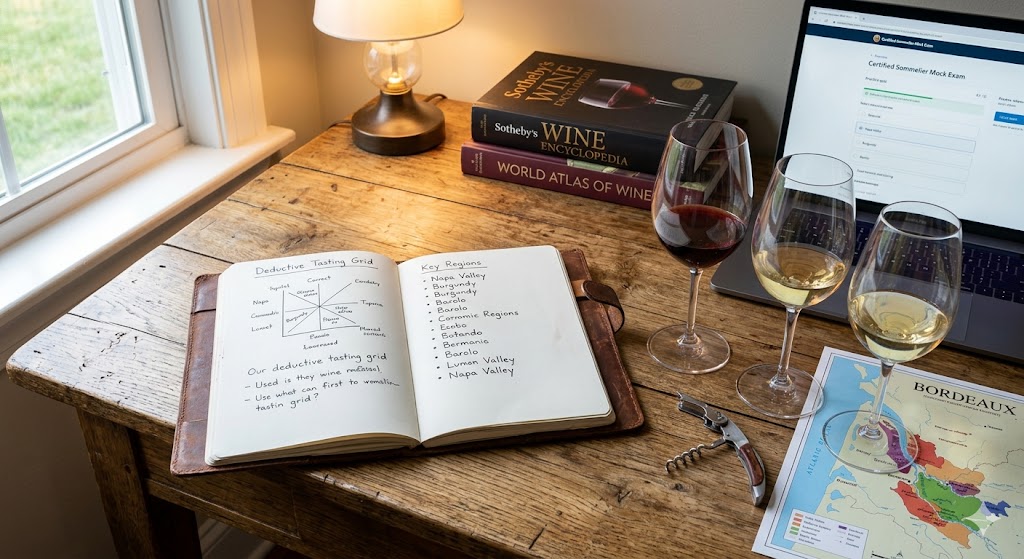
Additional Information
What the Course
Entails and Exam Details
This examination is not a course but a comprehensive
assessment of knowledge gained through industry experience, self-study, and
introductory coursework (such as the CMS Level 1 Introductory Course, which is
a required prerequisite). The curriculum covered by the examination is broad
and deep, ensuring the candidate is proficient in three major disciplines.
Candidates must prepare themselves independently across the entire spectrum of
the global beverage industry.
Theory Knowledge: The exam requires advanced
knowledge of all major and significant minor wine regions worldwide. This
includes detailed understanding of grape varieties, climate, soil types, wine
classifications (e.g., DOCG, AOP, QbA), and labeling laws. Candidates are also
tested on their knowledge of spirits, classic and modern cocktails, sake, beer
brewing processes, and proper food-and-wine pairing principles.
Tasting Skills: The tasting portion focuses on
deductive reasoning and sensory analysis. Students must develop the ability to
accurately describe a wine’s visual, aromatic, and structural components (such
as acidity, tannin, and body). Using the official Deductive Tasting Method
grid, candidates are expected to identify the grape variety, region of origin,
and vintage for specific wines in a blind tasting format.
Service Practice: The service section evaluates the
candidate's proficiency in table-side hospitality in a timed, professional
environment. Skills tested include the correct opening and pouring of still
wine (including decanting for sediment), sparkling wine service (e.g.,
Champagne), general wine service etiquette, safety protocols, glassware
selection, and the ability to interact professionally and efficiently with
guests.
What to Expect in
the Final Exam
The Certified Sommelier Examination is composed of three
distinct segments, all of which are typically administered on a single day.
Candidates must pass all three parts of the exam at the same sitting to earn
the credential. Failing one segment means the entire exam must be retaken. The
general structure of the final exam is as follows:
1. Theory (Written Exam): This is a 1-hour session
consisting of a combination of multiple-choice, matching, and short-answer
questions. The questions are detailed, covering a wide array of topics from
specific growing regions and aging requirements to technical knowledge of viticulture
and vinification methods globally.
2. Deductive Tasting: Candidates are given a timed
30-minute window (typically 15 minutes per wine) to blind-taste two wines: one
white and one red. The tasting must be recorded on the official Deductive
Tasting Method written grid, which is then scored based on the candidate's
accurate description of elements and their ultimate conclusion regarding the
wine’s identity.
3. Practical Service: This is the practical portion
of the exam, where a candidate acts as a sommelier while interacting with a
Master Sommelier judging the segment. This portion often lasts approximately 10
to 15 minutes. The candidate must typically serve a bottle of sparkling wine
(opening and pouring cleanly) and answer spontaneous questions related to wine,
spirits, or cocktails while demonstrating impeccable service etiquette.
Passing Score: The pass mark is generally 60% in each
of the three sections (Theory, Tasting, and Service) on the same day.
How to Study and
Exam Centers
Preparation for the Certified Sommelier exam requires
intense discipline and self-study, and taking a dedicated practice exam is an
essential step to measure readiness and identify knowledge gaps. Successful
candidates often spend months or years studying reference materials and
practicing practical skills before attempting the test.
Effective Study Strategies:
- Practice
with Mock Exams: Utilizing comprehensive practice exams is the most
effective way to prepare for the Theory section, as they simulate the
pressure and difficulty level of the actual test.
- Form
a Tasting Group: Blind tasting alone is difficult. Working with peers
allows you to compare notes and improve your deductive skills using the
standard grid.
- Study
Maps: Focus heavily on regional geography. You should be able to
visualize the appellations and sub-appellations of all major wine regions.
- Use
Flashcards: Create or buy flashcards for grape varieties, wine laws,
spirits, and classic cocktails.
- Practice
Service Daily: If you work in a restaurant, treat every customer
interaction as practice. If not, set up a dummy station at home and drill
the mechanics of opening and pouring wine perfectly.
- Utilize
Reference Books: Essential texts include "Sotheby’s Wine
Encyclopedia," "The World Atlas of Wine," and the
"Oxford Companion to Wine."
Exam Centers and How to Register: The Certified
Sommelier Examination is not taken through standard online portals (like
Pearson VUE). It is a physical, in-person exam administered exclusively by the
Court of Master Sommeliers Americas (or Europe/International branches,
depending on your location). The CMS organizes and schedules exam dates and
locations independently throughout the year in various major cities across
North America. To take the exam, candidates must monitor the official CMS
website for open registration dates. These sessions are highly competitive and
fill up quickly. Many exams are held in partnership with authorized local wine
schools, hospitality venues, or convention centers.
Job Opportunities
from the Course
Earning the Certified Sommelier title immediately enhances a
professional's credibility and opens doors to new opportunities within the
highly competitive beverage and hospitality fields. This qualification
indicates a level of expertise that allows employers to hire with confidence
for advanced roles.
Some of the job opportunities unlocked by this certification
include:
- Head
Sommelier (Restaurant/Hotel)
- Wine
Director / Beverage Manager (Restaurant Group)
- Assistant
Restaurant Manager
- Wine
and Spirits Sales Representative (Distributor/Importer)
- Brand
Ambassador for Wine or Spirits Producer
- Retail
Wine Specialist / Store Manager
- Professional
Wine Educator
- Catering
Beverage Coordinator
Frequently Asked Questions
Reviews
5.0
Based on 0 reviews
Leave a Review
No reviews yet. Be the first to review!