
Certified Wildlife Rehabilitator
$69.00
- Buy to unlock unlimited access to all Quiz questions and Answers in this Quiz.
- After purchase you can print a PDF of the whole quiz at any point. The PDF will contain the questions and the correct answers.
About this Exam
The Certified Wildlife Rehabilitator (CWR™) designation
represents a critical milestone for dedicated individuals working to rescue and
rehabilitate injured, orphaned, or distressed native wildlife. This
certification validates the specialized knowledge and skills required to
provide ethical and effective care, with the ultimate goal of returning animals
to their natural habitats. Whether you are an aspiring rehabilitator, a
seasoned volunteer looking to formalize your expertise, or a professional aiming
to satisfy state permitting requirements, earning your CWR demonstrates a
commitment to the highest standards in the field. It is designed for those who
have a deep passion for wildlife and a desire to contribute meaningfully to
conservation.
Ready to test your knowledge?
Buy Now to Access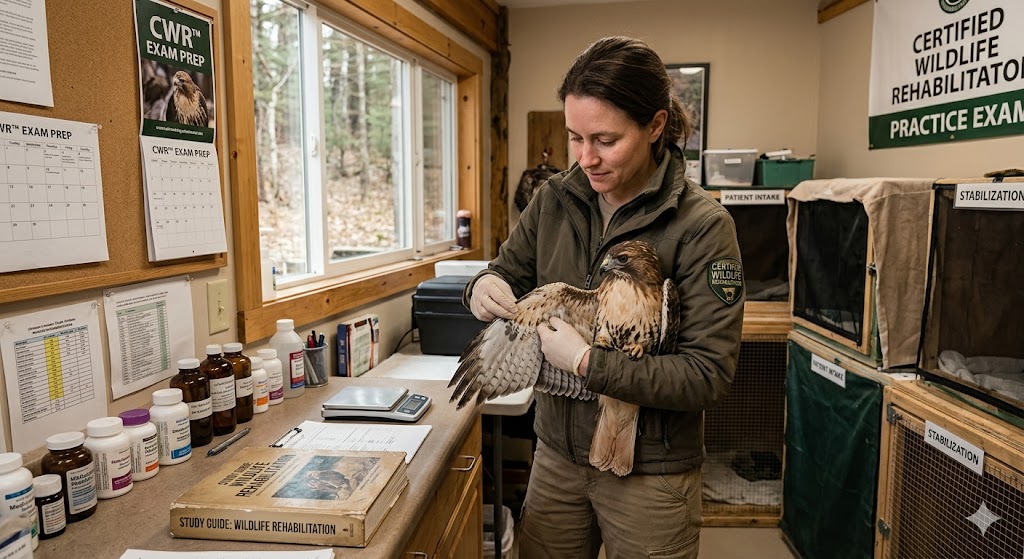
Additional Information
What the Course Entails and Exam Details
This comprehensive course, and the subsequent
examination, assesses a wide range of essential skills. The curriculum is
meticulously structured around 13 core disciplines. Key topics include wildlife
identification, natural history, and behavior, which are crucial for
understanding a patient's unique needs. You will cover principles of safe
handling, restraint, and human safety, alongside basic anatomy and physiology.
Critical care procedures are prominent, encompassing intake, triage, and
stabilization; hydration and fluid therapy; thermoregulation; wound management;
and the proper administration of medications and calculated dosages. The
certification also addresses important decisions like euthanasia, as well as
necessary care standards like nutrition, captive housing design, and
established criteria for release.
What to Expect in the Final Exam
While state requirements may vary slightly, the primary
CWR examination is typically an extensive online assessment administered via a
specific certification portal. Candidates must achieve a passing score of 80%
or higher. The exam format commonly includes multiple-choice and true/false
questions designed to evaluate both theoretical knowledge and practical
application. Notably, the CWR exam is an "open-book" format, allowing
you to reference your hard-copy study materials, though website searches are
strictly prohibited. It is a timed test, often requiring completion within 60
minutes. Be prepared to apply calculations and logical problem-solving to
real-world scenarios.
How to Study and Exam Centers
Effective preparation is key. We highly recommend
utilizing the International Wildlife Rehabilitation Council (IWRC) and the
National Wildlife Rehabilitators Association (NWRA) resources. Study methods
should focus on mastering the core 13 disciplines. This includes taking
official practice tests to familiarize yourself with the question types and
time management. Deeply reviewing the "Principles of Wildlife
Rehabilitation" manual is paramount. Create practical scenarios to
practice calculations for medication and fluid therapy.
The examination is usually taken online, allowing you to
schedule and complete it from a location with a stable internet connection.
Some states may require a proctored hard-copy exam at a specific physical
testing center, such as a state Department of Natural Resources office, or an
authorized school or rehabilitation facility. Check your specific local
permitting agency for the most accurate guidance on approved testing methods
and centers.
Job Opportunities from the Course
Earning your Certified Wildlife Rehabilitator designation
opens doors to numerous rewarding career paths dedicated to animal welfare and
conservation. Specific job opportunities and titles include:
- Wildlife
Rehabilitator
- Wildlife
Rehabilitation Specialist
- Animal
Care Manager (in a wildlife setting)
- Volunteer
Coordinator for a Wildlife Center
- Wildlife
Educator / Interpreter
- Veterinary
Technician (specializing in wildlife)
- State
or Federal Wildlife Agent (some permits require CWR)
- Conservation
Biologist / Field Technician
Frequently Asked Questions
Reviews
5.0
Based on 0 reviews
Leave a Review
No reviews yet. Be the first to review!