
Chapell and Meeks Licensure and Ordination
$69.00
- Buy to unlock unlimited access to all Quiz questions and Answers in this Quiz.
- After purchase you can print a PDF of the whole quiz at any point. The PDF will contain the questions and the correct answers.
About this Exam
The Chapell and Meeks Licensure and Ordination material is
the premier resource for candidates navigating the pastoral call within the
Presbyterian Church in America (PCA). It is designed to assist men seeking
licensure (permission to preach) or ordination (official setting apart for
pastoral ministry) as Teaching Elders. Based on the booklet "Preparing
for Licensure and Ordination Exams" by respected theologians Bryan
Chapell and Jim Meek, this guide provides the foundational framework and
essential content required to undergo the rigorous 'trials' of ordination. It
is a vital tool for seminarians, ministry leaders, and anyone preparing to be
examined by a PCA Presbytery to ensure they possess the necessary biblical,
theological, and historical knowledge, as well as pastoral discernment, to
shepherd God's flock.
Ready to test your knowledge?
Buy Now to Access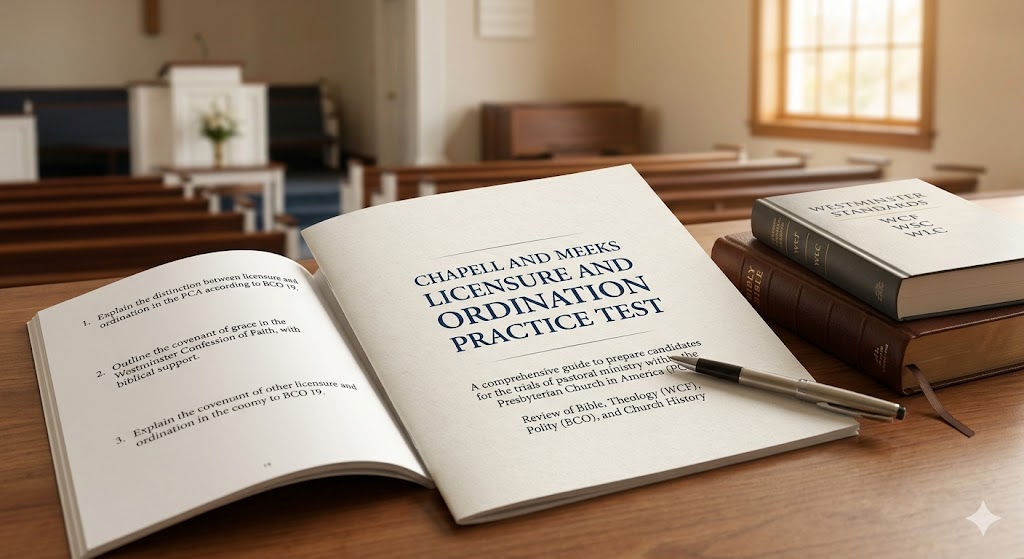
Additional Information
What the Course Entails and Exam Details
The "course" is a self-directed study regimen, and
this guide helps candidates prepare for the exams and trials administered by
their local Presbytery. The content covers the following core pillars required
for pastoral ministry in the PCA:
Westminster Confession of Faith and Catechisms:
Comprehensive knowledge of Reformed systematic theology, including the
doctrines of God, humanity, Christ, salvation, the church, and the sacraments.
Candidates must understand and be able to articulate their subscription to
these standards, identifying any exceptions.
Bible Content: A deep understanding of both the Old
and New Testaments, including key themes, covenants, narrative flow, major
characters, and critical passages. Candidates must demonstrate the ability to
handle the biblical text accurately.
Church History: Knowledge of the history of the
Christian church from the apostolic era to the present day, with a special
emphasis on the history of the Presbyterian tradition and the specific history
of the PCA.
Polity (Book of Church Order): Detailed understanding
of the form of government, rules of discipline, and directory for the worship
of God within the PCA. Candidates must know how to properly govern the church
according to Presbyterian principles.
Personal Religion: Candidates must give a clear
account of their Christian experience and call to the ministry.
Views on Current Issues: Evaluation of key
contemporary theological and ethical issues, demonstrating a biblical and
confessional perspective.
What to Expect in
the Final Exam
The actual licensure and ordination process in the PCA
involves multiple components called "trials for ordination," which
are administered by a committee of the local Presbytery. It is not a single
computerized test at a testing center. Candidates should expect:
Written Examinations: Presbyteries typically
administer written exams in major areas: Bible content, Systematic Theology
(specifically the Westminster Confession), Church History, Sacraments, and PCA
Polity (the BCO). The format may vary from essay questions to short answer.
Oral Examinations: This is often the most critical
stage. Candidates will be examined orally, first by a committee (like the
Candidates and Credentials Committee) and finally on the floor of the
Presbytery in front of all teaching and ruling elders. The oral exams test the
candidate's depth of understanding, clarity, conviction, and ability to think
pastorally and biblically under pressure.
Preaching: Candidates are required to preach a
sermon, which is evaluated for biblical fidelity, homiletical structure, and
pastoral application.
Sermon/Exegesis Paper: A candidate must present a
written sermon and, for ordination, a written exegesis of a particular passage,
demonstrating theological and linguistic competence.
Passing Score: Exams are not scored with percentages
but are graded as "Satisfactory" or "Unsatisfactory"
by the examining committee and the Presbytery, based on the candidate's
demonstrated competency and orthodoxy.
Time Limits: The written exams will have specific
time limits set by the Presbytery, often a few hours per subject. The overall
ordination process typically spans several months.
How to Study and
Exam Centers
To succeed, a long-term, systematic study plan is essential.
Here are actionable strategies and information on the exam process:
Study Strategies:
Read the Primary Sources: The absolute priority is
thorough reading of the entire Bible, the Westminster Confession of Faith and
Larger/Shorter Catechisms, and the PCA Book of Church Order.
Use the Chapell and Meeks Guide: Go through the
booklet systematically. It provides an excellent collection of study questions
that are representative of what Presbytery committees will ask. Answer every
question, providing biblical and confessional support for your answers.
Mock Exams: Work through previous years' exams from
your specific presbytery if available. Conduct mock oral examinations with
peers or mentors to practice articulating your answers clearly.
Mentorship: Seek out an experienced PCA pastor as a
mentor. They can guide your reading, provide mock exams, and help you navigate
the nuances of PCA life and polity.
Group Study: Collaborate with other candidates.
Teaching and debating concepts in a group is one of the best ways to solidify
your knowledge.
Exam Centers: There are no physical, public
"exam centers" like Pearson VUE for this process. The exams are
administered by the Candidate and Credentials Committee (or similar) of
your specific local Presbytery of the Presbyterian Church in America.
Written exams are usually given at a location arranged by the committee, such
as a local PCA church or on a online platform administered directly by the
presbytery. Oral examinations and preaching requirements are held during stated
or called meetings of the Presbytery at a local church hosting the meeting. You
must be under the care of a Presbytery to begin this process.
Job Opportunities
from the Course
Successful completion of the licensure and ordination trials
unlocks significant career paths in vocational ministry within the Presbyterian
Church in America and sister Reformed denominations. Candidates who are
licensed or ordained can fill the following roles:
- Senior
Pastor or Solo Pastor
- Associate
Pastor
- Assistant
Pastor
- Church
Planter (ordained with a specific call to start a new church)
- Stated
Supply (a temporary pastoral role)
- Chaplain
(Military, Hospital, Corporate)
- Missionary
(ordained for foreign or domestic missions)
- Seminary
Professor (often requires a PhD in addition to ordination)
- Presbytery
or Denominational Staff
Frequently Asked Questions
Reviews
5.0
Based on 0 reviews
Leave a Review
No reviews yet. Be the first to review!