
Child Development State Practice Test
$69.00
- Buy to unlock unlimited access to all Quiz questions and Answers in this Quiz.
- After purchase you can print a PDF of the whole quiz at any point. The PDF will contain the questions and the correct answers.
About this Exam
The Child Development State Practice Exam is an essential
tool designed for aspiring early childhood educators, childcare providers, and
anyone seeking state-level certification to work with young children. This
comprehensive practice test is meticulously crafted to simulate the rigor and
content of the official state licensing or certification examination. It serves
as a vital resource to assess your readiness, identify critical knowledge gaps,
and build the necessary confidence to succeed on test day. This exam is ideal
for students who have completed relevant coursework and are looking to validate
their understanding of fundamental child development principles and best
practices in early childhood education (ECE) settings. By successfully
completing this practice test, candidates can approach the official exam with a
clear understanding of the material they need to master to obtain their state
credential.
Ready to test your knowledge?
Buy Now to Access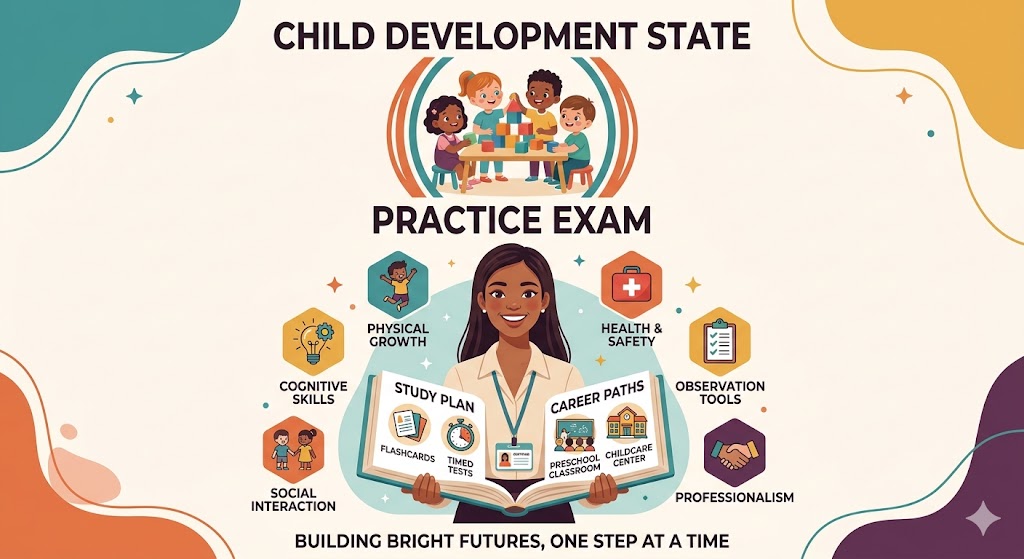
Additional Information
What the Course
Entails and Exam Details
This practice exam covers the core subject areas that are
universally recognized as critical for effective and safe childcare practice,
aligning with standard state regulations and the eight Child Development
Associate (CDA) subject areas. Candidates can expect to encounter questions
that require them to apply their knowledge rather than simply recall facts. The
practice exam typically entails a comprehensive review of the following
domains:
- 1.
Planning a Safe and Healthy Learning Environment: Creating injury-free
spaces, implementing infection control, and ensuring proper nutrition.
- 2.
Advancing Children’s Physical and Intellectual Development:
Facilitating motor skills, sensory experiences, language acquisition, and
problem-solving abilities.
- 3.
Supporting Children’s Social and Emotional Development: Fostering
self-esteem, teaching emotional regulation, and encouraging positive peer
interactions.
- 4.
Building Productive Relationships with Families: Developing effective
communication strategies and respectful partnerships with parents and
guardians.
- 5.
Managing an Effective Program Operation: Understanding administrative
responsibilities, regulatory compliance, and staff supervision basics.
- 6.
Maintaining a Commitment to Professionalism: Adhering to ethical codes
of conduct, understanding mandatory reporting laws, and pursuing
professional growth.
- 7.
Observing and Recording Children’s Behavior: Mastering diverse
observation techniques to assess development and inform curriculum
planning.
- 8.
Understanding Principles of Child Development and Learning: Applying
key developmental theories (e.g., Piaget, Vygotsky) across various age
groups.
What to Expect in
the Final Exam
While the format can vary slightly by state or specific
credentialing body, most final state-level child development licensing exams
are computer-based and primarily utilize a multiple-choice structure. You
should expect an exam that measures your functional knowledge through
scenario-based questions that describe common classroom situations. Typically,
the official exam will consist of 60 to 100 questions, which you must complete
within a specified time limit, often ranging from 90 minutes to two hours. The
practice test is designed to mimic this experience, allowing you to build
endurance and practice time management strategies. A passing score is generally
set between 70% and 80%, depending on the specific state’s standards. It is
important to note that most licensing bodies require candidates to possess a
valid high school diploma or equivalent and may have prerequisites regarding
completed training hours and hands-on professional experience with children
before scheduling the final exam.
How to Study and
Exam Centers
Effective preparation is the key to passing this exam, and
using a state practice test is arguably the most impactful strategy. A
structured study plan will help you cover all essential domains without feeling
overwhelmed. We recommend dedicating specific study sessions to one or two
domains each week.
- Actionable
Study Strategies:
- Take
Multiple Practice Tests: Do not just take the test once. Re-take the
practice exam periodically to chart your progress and confirm you have
mastered weak areas.
- Analyze
Your Mistakes: Review every incorrect answer on your practice tests.
Understand the rationale for the correct answer, which is often a
fundamental child development principle.
- Utilize
Flashcards: Create flashcards for critical terminology, developmental
milestones (physical, cognitive, social-emotional by age), and key
theorists.
- Focus
on Scenarios: Since final exams often use scenarios, practice
visualizing common classroom interactions and determining the most
developmentally appropriate professional response.
- Registering
for the Official Exam:
- The
official final state exam is typically administered at authorized,
proctored testing locations to ensure security. These are often
standardized proctoring networks like Pearson VUE or authorized test
centers located within state-approved community colleges and vocational
schools. For many states, you must first complete your eligibility
application, after which you will receive a “Ready to Schedule” notice to
book your appointment at a nearby center. The practice test, conversely,
is usually taken online, giving you flexible access to prepare anytime,
anywhere before heading to the official center.
Job Opportunities
from the Course
Earning your state child development certification opens the
door to numerous rewarding career paths dedicated to supporting the growth and
well-being of young children. This credential validates your expertise and
makes you a competitive candidate in the growing field of early childhood
education. The career opportunities unlocked by this certification include:
- Preschool
Teacher: Lead classrooms for children ages 3 to 5, designing and
implementing developmentally appropriate curriculum in private or public
centers.
- Childcare
Center Director: Manage the daily operations, staff, and regulatory
compliance of a child care facility.
- Lead
Daycare Provider: Provide primary care and educational activities in a
home-based or center-based daycare setting.
- Head
Start or Early Head Start Teacher: Work in federally funded programs
designed to support the development of children from low-income families.
- Nanny
or Private Educator: Offer personalized care and education to children
within a private household.
- Teacher's
Assistant/Aide: Support lead teachers in preschool or early elementary
classrooms.
- Before
and After School Program Coordinator: Develop and manage engaging
programs for school-age children.
- Child
Life Specialist Assistant: Work in healthcare settings to help
children and families cope with the stress of illness. (Note: Full Child
Life Specialist roles require further education).
Frequently Asked Questions
Reviews
5.0
Based on 0 reviews
Leave a Review
No reviews yet. Be the first to review!