
CIPS Defining Business Need (L4M2) Practice Test
$69.00
- Buy to unlock unlimited access to all Quiz questions and Answers in this Quiz.
- After purchase you can print a PDF of the whole quiz at any point. The PDF will contain the questions and the correct answers.
About this Exam
The Chartered Institute of Procurement & Supply (CIPS) Level 4 Diploma in Procurement and Supply is a widely recognized global standard, and the Defining Business Need (L4M2) module is a foundational pillar. This exam is meticulously crafted for professionals working within, or aspiring to enter, procurement, supply chain management, and commercial roles across all sectors.
It validates your ability to thoroughly understand, define, and communicate organizational requirements – the critical first step in any effective procurement cycle. Whether you are a buyer, specialist, or manager, mastering the art of defining business need ensures clarity, reduces risk, and drives value from the very beginning of the sourcing process
Ready to test your knowledge?
Buy Now to Access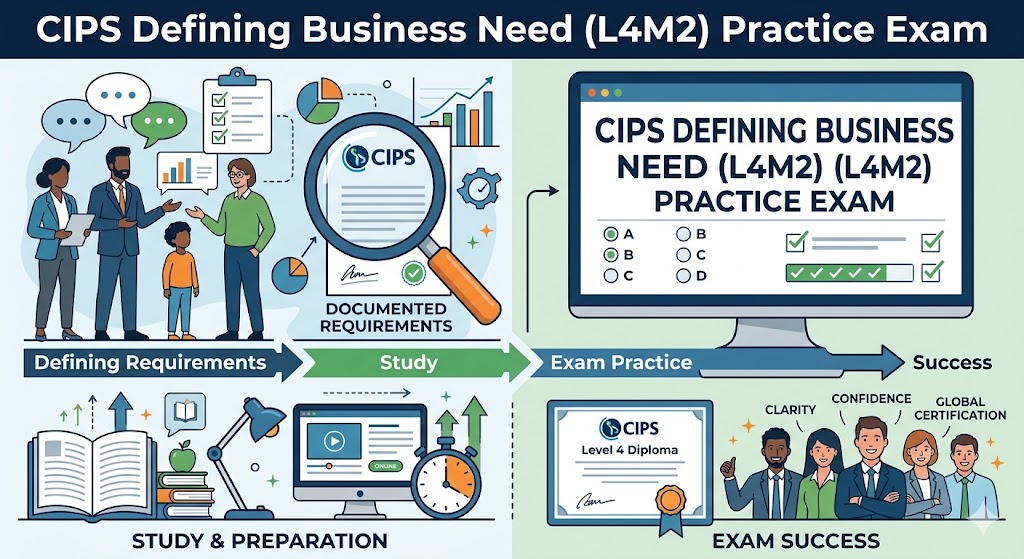
Additional Information
What the Course Entails and Exam Details
This crucial module dives deep into the strategic
importance of accurately defining business needs before engaging with potential
suppliers. The CIPS L4M2 syllabus covers a wide array of vital topics and
skills:
- Analyzing
Organizational Requirements: You will learn robust methodologies to
thoroughly investigate and understand why an item or service is
needed and what purpose it must serve.
- Developing
Specifications: Master the art of creating detailed and effective
specifications, exploring different types like conformance and
performance-based specifications to ensure clarity for suppliers.
- Making
Make-or-Buy Decisions: Understand the frameworks and factors (cost,
quality, capacity, capability, etc.) that guide whether an organization
should produce internally or outsource requirement.
- Stakeholder
Engagement: Learn strategies to effectively engage with diverse
stakeholders to capture requirements accurately and build consensus,
ensuring all perspectives are considered.
- Total
Cost of Ownership (TCO): Grasp the concept of TCO, looking beyond the
initial purchase price to consider all associated costs throughout the
lifecycle of the product or service.
- Sustainability
and Ethics: Explore how sustainable and ethical considerations should be
integrated into defining business needs and specifications.
- Value
Analysis and Engineering: Understand techniques for maximizing value by
analyzing product/service functions and finding ways to improve them or
reduce costs without sacrificing performance.
The knowledge gained empowers you to create clearer
specifications, minimize scope creep, enhance communication with both internal
departments and external suppliers, and ultimately deliver better outcomes for
your organization. The exam is designed to test your understanding and
practical application of these key concepts.
What to Expect in
the Final Exam
The final examination for CIPS Defining Business Need
(L4M2) is a computer-based assessment. This structure ensures efficiency and
often provides faster results compared to traditional paper-based exams. Here
is a breakdown of what you can expect:
- Exam
Format: The test primarily consists of objective-response questions,
predominantly multiple-choice and multi-response questions. Expect around
60 questions that challenge your comprehension and ability to apply
knowledge to realistic business scenarios.
- Passing
Score Requirements: To successfully achieve this module, you typically
need a passing score of 75% or higher. It is essential to aim high during
your preparation to confidently surpass this threshold.
- Time
Limits: Candidates are generally allocated 90 minutes (1.5 hours) to
complete the CIPS L4M2 exam. Effective time management is crucial to
ensure you can thoughtfully read and answer all questions within the
allowed timeframe.
- Specific
Rules and Conduct: Strict exam conditions apply. For in-person centers,
you will be monitored. For online proctored exams, your environment,
screen, and movements will be closely observed through your webcam and
microphone. Standard rules include no unauthorized study aids,
communication devices, or other interruptions.
Understanding the exam format and rules in advance
significantly reduces anxiety and allows you to focus solely on demonstrating
your knowledge. Utilizing CIPS L4M2 practice tests will help you practice under
timed conditions and get comfortable with the objective question style.
How to Study and Exam Centers
Effective preparation is paramount for success,
especially for such a globally recognized certification. Dedicate significant,
consistent time to studying the core module content. Here are some actionable
strategies to optimize your study routine:
- Utilize
Official CIPS Study Materials: Your primary resource should always be the
latest official CIPS study guide for Defining Business Need. Read and
thoroughly understand each chapter, focusing on key definitions,
frameworks, and practical examples.
- Incorporate
Practice Tests Regularly: This is perhaps the most critical preparation
method. Repeatedly engaging with high-quality CIPS Defining Business Need
(L4M2) practice tests is invaluable. Practice tests help you:
- Familiarize
yourself with the exam structure, question types, and wording.
- Identify
knowledge gaps and areas requiring further study.
- Improve
speed and accuracy under timed conditions.
- Build
confidence and reduce exam-day stress. Look for reputable practice test
providers offering scenario-based questions similar to the actual exam.
- Create
Structured Notes: Don't just read passively. Summarize each topic in your
own words. Use diagrams, flowcharts, and bullet points to visualize and
consolidate your learning. Pay close attention to distinguishing features
of different specification types or key steps in stakeholder engagement.
- Explore
Online Courses and Resources: Consider enrolling in accredited online
training programs, which often provide video lectures, quizzes, and tutor
support to reinforce your understanding and offer structured learning
pathways. Explore relevant procurement blogs, articles, and white papers
to broaden your context and see theoretical concepts applied in real-world
scenarios.
- Form
or Join a Study Group: Collaborating with fellow students can expose you
to different perspectives, foster insightful discussions, and keep you
motivated. Explain concepts to each other – a powerful technique for
reinforcing memory and understanding.
- Prioritize
Understanding Over Memorization: The CIPS L4M2 exam tests not just your
ability to recall facts but your capacity to apply knowledge practically.
Ensure you truly understand the principles behind each topic.
Where and How to Take the Exam:
CIPS exams, including Defining Business Need, are
computer-based and administered through specific, secure methods:
- Authorised
CIPS Study Centres and Exam Venues: Many organizations and educational
institutions globally are authorised to deliver CIPS qualifications and
host proctored, in-person exams in secure environments.
- Pearson
VUE Test Centres: CIPS has a global partnership with Pearson VUE, one of
the world's leading computer-based testing providers. Candidates can
schedule and take their L4M2 exam at any of the thousands of secure,
professional Pearson VUE test centers worldwide, offering maximum
flexibility and convenient locations.
- Online
Proctoring (Remote Exams): This increasingly popular option allows you to
take your exam from the comfort and safety of your own home or suitable
private space, provided you meet strict technical (internet stability,
compatible webcam/microphone, specific software) and environmental
criteria (quiet, private, free of distractions). A remote proctor monitors
you in real-time. This can be especially convenient for busy professionals
but requires careful preparation of your testing environment.
You must register for the exam via the official CIPS
website, specifying your preferred testing method and date within the scheduled
CIPS exam series. Plan well in advance to secure your desired slot and
carefully review all technical requirements for online proctoring if chosen.
Job Opportunities
from the Course
Achieving the CIPS Level 4 Diploma, supported by strong
knowledge from the Defining Business Need module, is highly regarded by
employers worldwide. Demonstrating competence in this crucial procurement stage
significantly enhances your employability and opens doors to diverse and
rewarding career paths:
- Procurement
Officer/Specialist: In these roles, you are directly involved in executing
procurement activities. Effectively defining business needs is critical
for sourcing the right goods/services at the optimal value. Your ability
to create clear specifications is a major asset.
- Junior
Buyer / Buyer / Senior Buyer: Buyers at all levels need a robust
understanding of defining requirements to select appropriate suppliers,
negotiate effectively, and manage supplier performance. Accurate need
definition prevents costly mistakes and disputes.
- Supply
Chain Analyst: Analysts require strong data analysis and process
understanding skills. Your capability in dissecting business needs and
translating them into clear requirements contributes significantly to
supply chain efficiency and optimization.
- Category
Management Roles (Associate/Manager): While often more strategic, category
managers need a thorough grasp of fundamental procurement processes,
including defining needs within specific spend categories, to develop
effective category strategies.
- Sourcing
Specialist: Focuses on finding, evaluating, and selecting suppliers.
Understanding the exact business need is essential for effective
sourcing and ensuring supplier proposals are truly comparable and meet
requirements.
- Commercial
Administrator/Manager: In organizations where procurement and commercial
management overlap, your ability to document requirements accurately and
integrate them into contracts is invaluable, minimizing commercial risks.
- Project
Procurement Coordinator: Ensuring that project-specific requirements are
accurately defined and procured efficiently within project timelines and
budgets is crucial for project success.
- Business
Analyst (Procurement Focused): Bridging the gap between business
stakeholders and procurement, these analysts focus heavily on capturing
and detailing procurement-related business requirements.
Regardless of the specific job title, the skills and
knowledge you gain through the CIPS L4M2 module are universally applicable and
highly valued in any procurement or supply chain function, demonstrating your
competence and commitment to professional excellence. Your enhanced ability to
define business needs will contribute directly to organizational efficiency,
cost savings, risk reduction, and overall success, making you a more effective
and marketable procurement professional.
Frequently Asked Questions
Reviews
5.0
Based on 0 reviews
Leave a Review
No reviews yet. Be the first to review!