
CIPT (Certified Information Privacy Technologist) Practice
$69.00
- Buy to unlock unlimited access to all Quiz questions and Answers in this Quiz.
- After purchase you can print a PDF of the whole quiz at any point. The PDF will contain the questions and the correct answers.
About this Exam
The Certified Information Privacy Technologist (CIPT)
designation is the preeminent credential for professionals who design,
implement, and manage privacy-preserving technologies and programs.
Developed by the International Association of Privacy
Professionals (IAPP), this certification validates a deep understanding of
incorporating privacy into the earliest stages of the product lifecycle and
building security and data governance controls.
It is specifically designed for technologists, data
scientists, engineers, product managers, software developers, and other IT
professionals seeking to merge technical acumen with robust privacy principles.
Ready to test your knowledge?
Buy Now to Access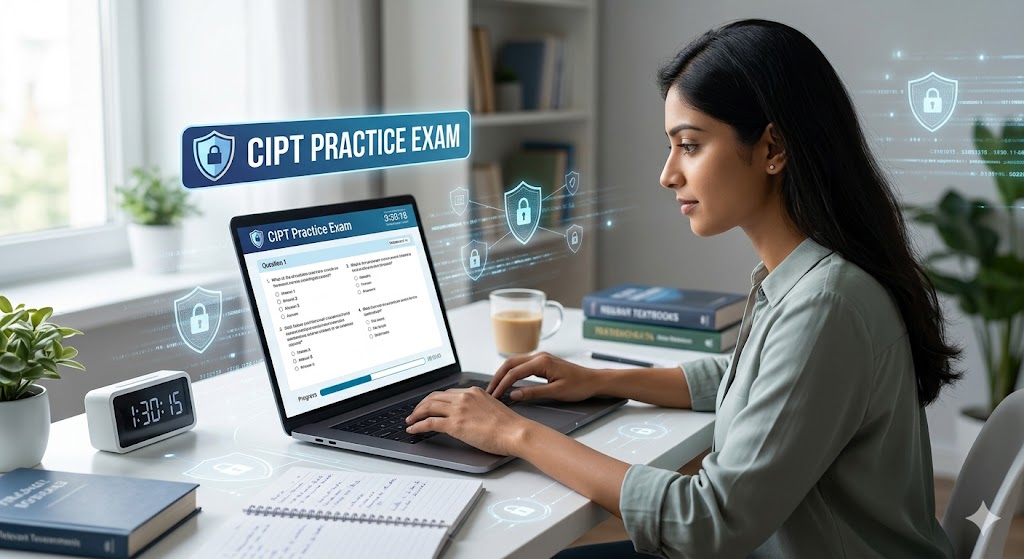
Additional Information
What the Course Entails and Exam Details
The CIPT body of knowledge covers diverse domains
essential for navigating today’s complex digital landscape.
Core topics include foundational privacy concepts, the
implications of emerging technologies (like IoT and AI) on data privacy, and
strategies for embedding privacy through the entire product and software
development lifecycles (PDLC/SDLC).
Candidates will delve into data management best
practices, identity management, encryption, access control mechanisms, and risk
assessment methodologies.
Furthermore, the course addresses the crucial
intersections of security and privacy, data anonymization techniques, and the
technological controls necessary for compliance with global privacy regulations
such as GDPR and CCPA.
Understanding these elements empowers professionals to
evaluate technologies and vendors for privacy compliance and to devise
innovative, privacy-by-design solutions.
What to Expect in the Final Exam
Preparation for the final CIPT exam requires both
conceptual understanding and practical application of privacy technologies.
The actual exam itself is administered by computer and
typically consists of approximately 90 multiple-choice questions.
Candidates are allotted 2.5 hours (150 minutes) to
complete the examination.
To achieve certification, a passing score of 300 on a
scale of 100-500 is required, which generally equates to answering roughly
60-70% of the questions correctly, though the exact passing point can vary
slightly per exam form.
The exam is rigorous, evaluating not only factual recall
but also the ability to apply privacy principles to realistic business and
technology scenarios through case-based questions.
How to Study and Exam Centers
Success on the CIPT exam hinges on a well-structured and
diligent study approach.
Begin your preparation with the official IAPP CIPT
textbook and body of knowledge as your primary resource.
Supplement this by attending official IAPP training
courses, reviewing webinars, and utilizing online forums to discuss concepts
with peers.
Critically, leverage high-quality practice exams, such as
the CIPT Practice Exam, to familiarize yourself with the question formats,
timing, and complexity, helping you identify areas that require further review.
These practice tests are invaluable for building
confidence and developing effective test-taking strategies.
Regarding exam delivery, the IAPP primarily partners with
Pearson VUE for test administration.
This allows candidates the flexibility to schedule and
take their exam either at an authorized Pearson VUE physical testing center
globally, or via the Pearson VUE OnVUE system for convenient online proctoring
from home or a private office, subject to specific technical and environment
requirements.
Job Opportunities from the Course
Earning the CIPT certification significantly enhances
professional credibility and opens doors to exciting career advancement
opportunities in the rapidly evolving privacy tech sector.
Organizations across every industry are actively seeking
skilled individuals who can bridge the gap between technical innovation and
regulatory compliance.
Specific job titles and roles frequently held by CIPT
professionals include Privacy Technologist, Data Privacy Engineer, Privacy
Solutions Architect, Privacy Product Manager, Data Governance Specialist, IT
Auditor, Information Security Analyst (with a privacy focus), Chief Privacy
Officer (for those combining technical and leadership skills), and Technology
Compliance Manager.
As organizations prioritize privacy as a differentiator
and regulatory enforcement intensifies, the demand for certified privacy
technologists is projected to remain exceptionally strong.
Frequently Asked Questions
Reviews
5.0
Based on 0 reviews
Leave a Review
No reviews yet. Be the first to review!