
CISSP Domain 6 Security Assessment and Testing Practice Test
$69.00
- Buy to unlock unlimited access to all Quiz questions and Answers in this Quiz.
- After purchase you can print a PDF of the whole quiz at any point. The PDF will contain the questions and the correct answers.
About this Exam
The Certified
Information Systems Security Professional (CISSP) is widely recognized experienced
security practitioners, managers, and executives.
Achieving this certification proves you possess the deep
technical and managerial knowledge required to effectively design, engineer,
and manage an organization's overall security as the gold standard in
cybersecurity certifications, designed for
posture.
Domain 6, Security Assessment and Testing, is a pivotal
component of the CISSP lifecycle, focusing on the vital processes and systems
necessary to provide continuous assurance to stakeholders.
This domain ensures you have the expertise to validate
that security controls are not only defined but are operating effectively in
real-world scenarios.
Ready to test your knowledge?
Buy Now to Access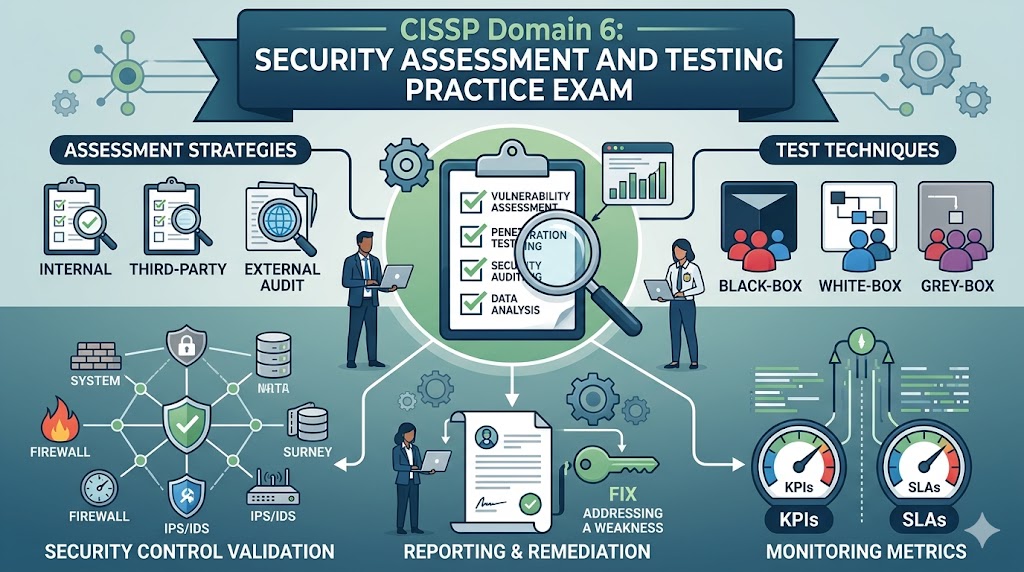
Additional Information
What the Course
Entails and Exam Details
The Security Assessment and Testing domain provides a
comprehensive toolkit for examining an organization’s security posture from
multiple perspectives.
The core syllabus equips candidates with the ability to
design and validate comprehensive assessment, test, and audit strategies,
encompassing internal, third-party, and external examinations.
Students are trained in diverse testing techniques,
distinguishing between vulnerability assessments and penetration tests, while
mastering methods such as white-box, black-box, and grey-box testing.
Furthermore, the course emphasizes the collection of
technical and administrative security process data, including account
management review, backup verification, and the generation of key performance
indicators (KPIs) and service level agreements (SLAs).
A final critical component is the ability to analyze test
output to generate professional, actionable reports that drive remediation and
ethical disclosure.
What to Expect in
the Final Exam
The CISSP examination utilizes Computerized Adaptive
Testing (CAT) for most English language versions, meaning the number of
questions and exam duration can vary based on your performance.
While the exact percentage varies slightly between the 8
domains, Security Assessment and Testing typically accounts for approximately
12% of the exam weight.
The exam consists primarily of multiple-choice and
innovative advanced innovative questions, rather than essay-based writing.
For the English CAT format, candidates have a total time
limit of 4 hours to complete between 125 and 175 questions.
To pass this challenging, closed-book exam, candidates
must achieve a minimum scaled score of 700 out of 1000 points.
How to Study and
Exam Centers
Preparation for the CISSP requires a dedicated and
structured approach. The foundation of your study should be the Official (ISC)²
CISSP Study Guide, as the examination is strictly based on the current Common
Body of Knowledge (CBK).
You should devote significant time to not just memorizing
definitions but applying concepts to complex scenario-based questions that test
managerial judgment.
The use of authoritative Domain 6 practice tests is
essential. These mock exams expose knowledge gaps and train you to think
critically about risk mitigation, control validation, and audit management
under time constraints.
Creating visual aids, such as mind maps, helps connect
complex topics like the differences between red, blue, and purple team
exercises, or the technical steps in a penetration test.
When you are ready to certify, you must schedule your
exam through the official Pearson VUE portal, which manages (ISC)²’s global
network of authorized testing centers.
This standard format ensures testing conditions remain
secure and professional, although remotely proctored options may be available
depending on your region and specific needs.
Job Opportunities from the Course
A CISSP qualification signals to employers globally that
you possess senior-level leadership and deep technical competence across the
breadth of information security.
Professionals equipped with strong knowledge of Security
Assessment and Testing from this domain are in extremely high demand for
mid-level and senior management roles that require operationalizing
organizational requirements into technical validation.
Job titles that directly unlock with this expertise
include Information Security Manager, IT Security Auditor, Penetration Tester,
Vulnerability Engineer, Security Architect, Chief Information Security Officer
(CISO), and Governance, Risk, and Compliance (GRC) Manager.
This certification proves you possess the operational
competence necessary to proactively identify vulnerabilities and manage
supplier risk effectively.
Frequently Asked Questions
Reviews
5.0
Based on 0 reviews
Leave a Review
No reviews yet. Be the first to review!